Sunday, 19 May 2019

Book Review: Liberty's Provenance, John Henshaw


Subtitled The Evolution of the Liberty Ship from its Sunderland Origins, John Henshaw's new book on these vitally historically important vessels aims, in his own words, to 'once and for all' settle the issue of their provenance. Whether or not he succeeds in this once and for all aim, this is without doubt a fascinating and beautifully presented account of the evolution of a particular maritime lineage, during a very generally exciting and interesting period of world history.

I'm no expert on things nautical, but I'm finding my interest in the logistical side of both real military history and my mini-military stuff is leading me, seemingly inexorably, towards a deeper interest in sea warfare generally, and The Battle of the Atlantic in particular. As Henshaw notes, Churchill said the war on the oceans was the 'dominating factor throughout the war. Never for one moment could we forget that everything happening elsewhere, on land, at sea, or in the air, depended ultimately on its outcome.'

And in keeping with this perspective, it's salutory to remember that whilst other theatres of conflict would have short periods of intense activity and longer periods of stasis or inactivity, the war at sea lasted the entire duration.

The fantastically named Hog Island shipyard. [1]

The level of detail here is quite daunting to a landlubber like me. Fortunately there's a glossary. The glossary is very helpful - they should be a mandatory standard feature in specialist books, in my view - but could've been better. E.g. the nautical meaning of terms such as beam and draught are given, but sheer isn't. And whilst many of the acronyms used are expanded and defined, not all are.

The book begins by looking at how in WWI a similar project was undertaken at more or less wars end, the ships made not seeing wartime service at all, and overproduction contributing to postwar shipbuilding slumps. Also late in coming was the adoption of convoys. In contrast, in WWII these projects were set in motion much earlier, and a mission to the US headed by the very young Cyril Thompson, of Sunderland shipbuilders Thompson's, was integral to the story told here, of the development of the Liberty ships.

Henshaw dedicates his book to Cyril Thompson, the 'unsung hero in the evolution of the Liberty ship', and extols their virtues by not only clearly tracing their lineage, but also highlighting how they not only met but exceeded their original brief, doing the job intended for them, and then going beyond that, forming the basis of numerous variants, and often surviving and serving long after WWII.

Liberty ship EC2-SC1.

There are plenty of photographs, liberally sprinkled throughout, many of which are great. There are also a good number of relatively poor quality. But as Henshaw explains, they're as good as he could find, and illustrate important points. Using such surprisingly scant reference material - scant when you consider over 2,700 of Liberty ships were built - Henshaw has produced what is probably the most attractive aspect of this book, the numerous line drawings.

Some of these are quite accurate, where plentiful reference such as other detailed drawings could be sourced, whilst others, as Henshaw is at pains to point out, are educated guesses based on the available evidence. I love them, and hope they might one day help me build models.

A fascinating book, well worth having/reading. 
----------
NOTES:

[1] Built expressly for the construction of these ships, and now the site of Philadelphia International airport.

This looks like a great kit. Definitely on my wish list!

As usual, when I read a book like this and find it exciting and inspiring, I want to get a model to build to further explore the interests that have been aroused. Trumpeter do a couple of 1/350 Liberty Ship models. I'd love to get and build one of those. Perhaps the SS John W Brown? This is also one of the only surviving seaworthy examples some of this once numerous class.

The real McCoy.

Wednesday, 15 May 2019

Book Review: Dark Valley, Piers Brendon


NB This is one of my archival posts, re a book I read aeons ago!

There are a number of detailed reviews of this book online already, so I won't go into any real detail regarding the contents, as it'd be fairly redundant. I simply want to add my voice to the chorus of approval. Like William Shirer's justly celebrated Rise And Fall Of The Third Reich this is sweeping, compelling history that really draws you in. The kind of thing that'll threaten to end your fiction reading. Why read fiction when real world events are so massively interesting?

These three would be scary enough individually. But together?*

The 1930s were, of course, the crucible of WWII, with extreme nationalist governments taking over ever larger swathes of the world: Italy, Spain and Japan were joined in this decade by Germany, and all these major powers can be added to the giants of Russia and, to a lesser extent, China. There was the fallout of worldwide recession, and all around the world, but most surprisingly perhaps, in the 'developed' West, liberalism and democracy were in crisis.

As others have noted elsewhere, Brendon has an excellent writing style, and is truly masterful at weaving together complex narrative and small anecdotal details. What a period the first half of the C20th was, with all this and more sandwiched between the cataclysms of two world wars! I borrowed this from a friend many years ago, and liked it so much I had to get my own copy after reading his (in a repeat of what had already happened with the aforementioned Shirer book).

The material relating to Japan is, I find, particularly fascinating, as so much historical literature on this period and the two world wars is so Euro-centric. Also the militarism of Japan differed markedly from that of Russia, Germany and Italy, in that it was much more broad based, rather than being focussed on a singular charismatic figurehead. Indeed, the Japanese Emperor seems to have been carried along on a martial current that flowed through a whole class (the officer class), ultimately more or less saturating the whole culture.

This '30s photo captures the whiff of 'horror film' around the development of Magnitogorsk. 

One specific episode amongst the many in this brilliant book that really struck me - haunted me even, for a little while after reading it - was the horror of Magnitogorsk (just the name sounds balefully ominous!), in Stalinist Russia, which was declared a closed city, i.e. off limits to foreigners, in 1937. I won't say why. Buy this superb book and read about it yourself.

* And of course there was Franco in Spain, the militants behind a Emperor Hirohito in Japan, and many lesser tin-pot tyrants in areas like the Balkans.

----------
I found an interesting article about Magnitogorsk here.

Tuesday, 14 May 2019

Book Review: Painting Wargame Figures, WWII In The Desert, Andy Singleton.


The way the title of this book is presented - Painting Wargame Figures, WWII In The Desert - is suggestive of a series. But I found no mention of this being the case. So I'm not sure if this is part of a series that will cover more of WWII, or is simply a stand-alone title.

The Desert War in North Africa isn't a part of WWII that I'm attracted to. But nevertheless, when offered the chance to review this, I jumped at it. And within a few paragraphs author Andy Singleton was already addressing issues that I was pleased to see mentioned, as they affect me very heavily, such as motivation when painting large quantities of figures.

In his introduction, and then in Part One: Basics, which comprises chapters called Tools of the Trade and Boot Camp, Singleton tackles getting set up and started, and also makes it clear that he's addressing his book, in the main, to entry-level folk. But of course he hopes us more grizzled types might also benefit.

A spread showing an American figure being painted.

Part Two: Painting Guides comprises six chapters, four on the various national forces (British & Commonwealth, Italian, US and German), one on camouflage (specifically the splinter camo' of the German fallschirmjäger), and one on basing. Each of the four national painting guides is further split into three levels: Conscript, Regular and Elite, which as you'd imagine moves from basic to advanced in aptly named stages.

Even though he's covering a theatre I'm less keen on, it's interesting to see how someone who works as a professional figure painter does things. I already use some of the techniques he uses, from priming figures with car spray paint to blocking in base coats, dry-brushing, washes, and so on. So for me there wasn't really anything significantly new here. 

That said, whilst many of his colour choices - and like the author I use Vallejo acrylics as my mainstay - are similar to or even the same as my own (inasmuch as the they overlap with my preferred European areas of interest in WWII) there were some that were of interest to me, such as the use of Vallejo 803 Brown Rose as a base colour for flesh.

A German figure, over black primer (no!).

The figures Andy paints in the book are all 28mm, with a lone 20mm exception. And in his list of manufacturers at the back of the book he only deals with 28mm, 20mm and 15mm scales. My own WWII forces are almost entirely 1/72, or 20mm, with a small smattering of 1/76. But years ago I had a German army of sorts in 1/300, a scale not mentioned at all in this book. And of course these days there's also 10mm, or larger scales like 40mm and 54mm, etc.

But, as Singleton says, the tools, methods and techniques used here could be applied to most if not all other scales, albeit in potentially differing degrees. A5 in format, approximately 150 pages long, the text is quite large, and the book is, as you'd hope and expect, heavily illustrated, largely with photos illustrating the step by step painting processes, this is a quick and easy read. I read the whole thing in a couple of hours.

There's a definite emphasis on simple practical advice, with a view to getting your miniatures painted and ready for action. That's all to the good. I don't know if somehow I missed it, but I was looking forward to the part where he was going to address motivation: 'I'll come back to talking about batch painting when we come to the 'keeping motivated' part of this book'. As that's a very live issue for me, my 6mm and 10mm Napoleonic armies languishing on the lead pile as they are. However, having made this mention of motivation, I don't recall seeing it addressed at any later point.

A Brit/Commonwealth soldier, showing basing methods.

Most of the figures are primed in white or grey, a method I now use myself. However, he does his German Africa Korps figure (not the later fallschirmjäger) over a black primer base. I used to prime in black at one time. I think it was a Games Workshop thing, or maybe Peter Gilder did it? I believe the idea was that it helped pre-shade, and potentially delineate stuff. But studying Anthony Barton's beautifully sculpted and painted figures cured me of that! A black base dulls the following paint layers, whereas white or pale grey allows the colours to sing more openly/brightly.

I'd like to see similar titles on European theatres of WWII, and it'd be great if they addressed other scales, and perhaps even included the assembly and painting of resin figures. If like me you're building forces around 1/72 and 1/76 model tanks and other vehicles, resin figures from Milicast, Dan Taylor and the many Eastern European brands in these scales are a great improvement on the more 'quaintly old-fashioned' soft plastic 20mm figures that used to be a mainstay in this scale.

As Andy Singleton himself and the book jacket blurb says, there's an emphasis on 'achievable results', which should make this a very useful book for its target audience. For that goal, I'd score this four out of five. But for me, as a fussy and longer of tooth modeller and painter, and what with a few editorial gaffes (the usual spelling/grammar stuff, plus a few places where steps appear to be missing in certain guides), I'm going within three and a half balkenkreuz.

Left, Commonwealth painted to Elite level; Italian Bersaglieri at right.


Friday, 10 May 2019

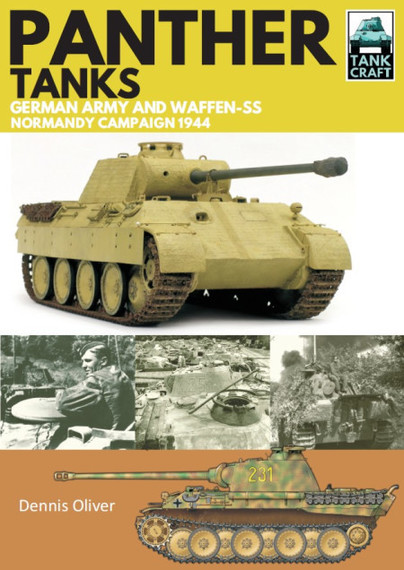
Book Reviews: Panther Tanks, Normandy '44, & Defence of the West '45, Dennis Oliver


Taken together these two titles, numbers 3 and 18 in the Tank Craft series, give a very decent account of the Panther tank, as deployed on the Western Front circa '44-45. One might immediately think 'what then of the Panther's history and development before this, and it's service on the Southern and Eastern Fronts?' I'll return to these thoughts in due course.

As ever with Dennis Oliver, he deploys his own particular approach, utilising maps, timelines, organisational schematics, unit histories, and so on. Where he follows the standard Tank Craft template is in the central three segments: Camouflage and Markings, Model Showcase, and Modelling Products.

A Panther pauses on a French road, Normandy, '44. [1]

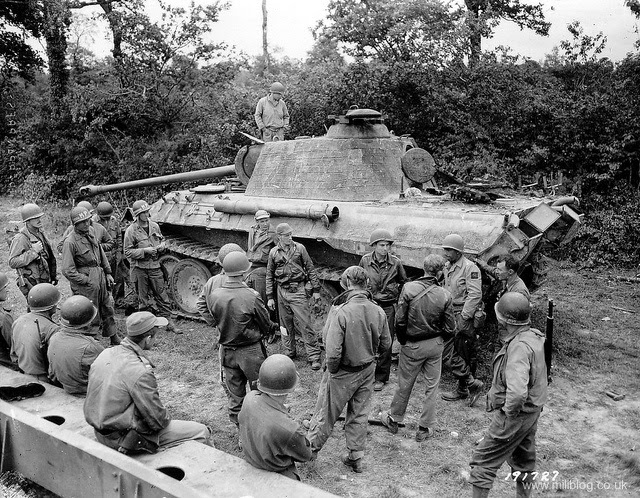
U.S. troops gathered around a disabled Panther.

The Normandy title features five models, all in1/35, and all very impressive. The Defence of the West  book, on the other hand, has just two 1/35 models and a single 1/48 example, the latter getting more pages than are normally given over to any one model in the Showcase section. Between the two books that's eight models, all bar one in 1/35. I'd have liked to have seen at least one bigger kit, in 1/16, perhaps, and one or two smaller models, in 1/72 or 1/76.

The colour profiles in the Camouflage and Markings chapter are nicely done, and are both fascinating and exciting. The range of styles and approaches the Germans employed, despite a palette of just three basic colours (which admittedly varied in themselves) was very diverse and, I find, endlessly intriguing. My only gripe on this front is that either the work of the illustrator, or perhaps the printing process, has rendered the core trio of colours less than 100% satisfactorily.

Panther in 'ambush' camo' scheme with infra-red sight.

Fabulous Panther Ausf G, by Lim Kian Guan, aka ChefLim. [2]

This is particularly noticeable with the green. The Dunkelgelb and Rotbrün, whilst only approximate, are near enough. But the green is way too light and bright. This is exaggerated even more in the bottom of the two cover images, shown at the top of this post (the Defence of the West one, sourced from Pen & Sword's own website listing for the book), where the green is almost fluorescent marker-pen bright! The actual books are closer colour-wise to the very top Normandy Campaign cover image.

Panzer graveyard with Panthers in the foreground.

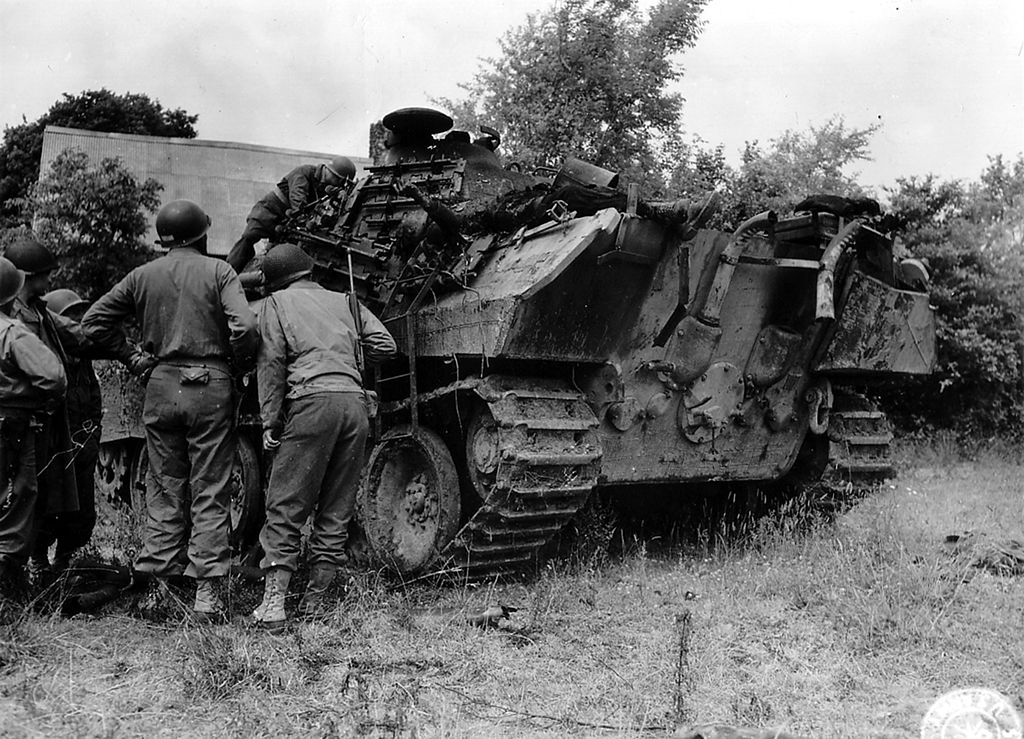
A grimmer graveyard scene. Is this 'Ursula' again? [3]

It's this colour issue that leads me to dock half a balkenkreuz. Whether Oliver's obsessively detailed coverage is a blessing or a curse - what of Panthers in Italy and Russia, and prior to '44? - depends on how much hardcore info you can take, and whether you can stretch to buying so many titles on the one vehicle.

At an RRP of £15 a time (£14.99 to be exact), they aren't exactly cheap! NB: at the time of posting this review both titles are available at reduced prices, at Pen & Sword's website. I'm lucky in that the publishers have been generous enough to send me copies gratis, for review. Otherwise I'd be lusting after these whilst lamenting the lack of brass in my pockets! Anyway, as regards useful info and inspiration, etc, these books are fab. And I'd highly recommend them.

----------
NOTES:

Note on photos/pictures: in this post I've tried to use images that do appear in the books under review.  The two exceptions are the final black and white image above, and the colour picture of ChefLim's model, which is from his website.

[1] This picture appears in a smaller/cropped format.

[2] This superb model appears in the Showcase section of the Defence of the West title.

[3] The more eagle-eyed might notice that a charred corpse lies atop the rear deck of this knocked out tank. In fact more than one German soldier died on the back of this particular Panther - which may be 'Ursula', a Panther featured in Oliver's book on several different occasions - as other pictures I found online show clearly. A grisly reminder of the true nature and costs of war.

Thursday, 9 May 2019

Terrain & Buildings: Russian Buildings, 6mm or 10mm?

Undercoated in Halfords grey primer, base coats going on.

I bought all these buildings quite a long time ago now. They were gathering dust, very literally, in a plastic tub. I decided, when I recently made a scratch-built Russian church-tower, to get these out, dust them off, and start painting them.

All the better buildings base-coated.

The buildings from the Big Battalions range by Total Battle Miniatures are fab, and very nicely varied, even including burnt-out/ruined hovels. I've base-coated them in a range of grey/browns, some veering towards beige, some brown, some green-ish. Only a result of these building have much stonework. As was the case in Russia at the time, most buildings were largely constructed from wood. And most old external wood turns a silvery grey, unless it's somehow preserved or painted.

Some other 6mm buildings I bought, at Salute, years ago.

Pictured above are some 6mm scale buildings, by Timecast. These are a lot lower quality, the resin being fairly brittle, and therefore more prone to chipping. They're also less well sculpted, being rather too regular and 'foursquare'. I will probably wind up using them. But perhaps hidden in amongst my Smolensk project scratch-builds. One good thing about them is that they're smaller than the Total Battle buildings, so actually work with my 6mm figures and my own scratch-built buildings.

The better buildings, from the Big Battalions range, are intended for use with 6mm scale figures. But they are too large in my view: if buildings are made in 'true' scale to an individual model figure - and remember each figure usually represents about 20-30 actual soldiers - they actually wind up seeming oversized. So I think I'll use the 6mm scale buildings from Total Battle with my 10mm figures, and build my own 6mm buildings.

Gradually getting into layering the paint on...

Painting is proceeding slowly... but it is proceeding. The Total Battle Miniatures buildings are superb. I'm painting them with a mixture of artists acrylics (Windsor & Newton, Rowney, etc.) and Vallejo. Using washes occasionally, to build up uneven patchy finishes, for a more natural look. When I've done the basic blocking in I'll give the lot a gloss varnish, and do some oil paint washes, to bring out the detail, and then seal it all off with some matt varnish.

Lighter colours and oxidising copper roofs blocked in.

Book Review: JagdPanther Tank Destroyer, Dennis Oliver


Another highly detailed and very specific Tank Craft title from the prolific Dennis Oliver, utilising his signature approach, with maps, timelines, unit histories, organisational schematics and so on. This particular publication covers one of my favourite German tanks, the Jagdpanther tank destroyer.

I remember buying some of these in 1/300, from Heroics & Ros, as a kid, and painting the tiny little blighters in the tri-colour ambush camouflage scheme. The 6mm scale is not one I've ever seen featured in these Tank Craft titles. There are three 1/35, one 1/48 and one 1/72 example in the Model Showcase section here. 

A fabulous 1/72 winter whitewashed Dragon Jagdpanther, by Jaroslaw Witkowksi, aka Gulumik.

This tank is featured in the Model Showcase chapter.

Another of Gulumik's 1/72 meisterwerks, above, appears in the Modelling Products chapter.

This is the old Esci kit, plus scratch-built detailing.

In keeping with both the stated aims of this series and the standards set so far, this book is a treasure trove of info and imagery. I have one relatively minor gripe on the latter front, however (and this is why I dock half a balkenkreuz); regarding the archival pictures, the vast majority show captured or destroyed Jagdpanthers. They're all very interesting photos. But it would have been great to see more either being built - there are a couple of great pictures of the MNH factory production line - or in active German service.

As usual with Oliver's contributions to this ever-expanding and very useful series, he's very time/theatre specific. On this occasion addressing the late-war Western Front, of 1944-45. Perhaps another volume will appear on the Eestern and Southern fronts? And perhaps that'll have more 'in action' photos and less wrecks?

Unfinished Jagdpanthers at the MNH factory, Hanover,  1945.*

I love this pic of Panthers in the rain. Note the brollys deployed by the crew!*

This abondoned Jagdpanther, Reichswald, March '45, appears a couple of times

The colour profiles, or Camouflage And Markings illustrations are, as usual, excellent. My only gripe regarding this last feature being that the green used in the three-colour schemes appears rather too bright. Anyway, all told, another great instalment in this excellent series.

* Neither of these specific photos are in this book.

Book Review: Tiger I, Southern Front, 1942-45, Dennis Oliver (Tank Craft)


It's interesting that whereas there's currently just the one book in the current Tank Craft series on the T-34 or Sherman, covering these vehicles over the entire war, some German armour is getting much more detailed treatment, as exemplified by the title under review in this post.

Dennis Oliver seems to have his own slightly different m.o. when it comes to his contributions to this very useful series from Pen & Sword. Most of the Tank Craft titles I've read by other authors follow a fairly standard format, whereas Oliver instead uses a series of his own devices, such as timelines, unit histories, and organisational schematics, etc.

A Tiger I in Tunisia.

If you are, as I am, a Panzer nut, then this is both a blessing and a curse: it's a blessing because more detail is great. It's a curse because it entails greater expenditure. There's also the matter of what kind of info you're after, and which approaches most chime with ones own tastes. Oliver's idiosyncratic approach is fine with me. Indeed, by and large I really like it. This said, the degree or depth of detail is pretty hardcore. And, whilst they're useful references, the timelines he frequently employs are, for me, quite hard going.

Certain key parts - the colour profiles, under the heading Camouflage & Markings - and the Model Showcase and Modelling Products segments are pretty much as per all the Tank Craft titles. Most of the models showcased in these titles, are 1/35, with just the occasional 1/48, 1/16 or - my preferred scale - 1/72. On this occasion, whilst the Products section mentions numerous 1/72 and 1/76 kits from several manufacturers, none are featured in the Showcase chapter.

A Tiger crew engaged in repairs in the field, Italy.

Of the theatres covered here, which are North Africa, Sicily and Italy, it's the last two that interest me most, and Italy in particular. The terrain which was being fought over, and the camouflage and markings of the materiel are all, for my money, more interesting than the dusty/sandy monochromes of the North African desert war.

All in all another solid chunk of highly useful/enjoyable stuff for us Panzer freaks. Love it!

Wednesday, 8 May 2019

Book Review - Images of War: 37-41, François Cochet


As if to illustrate a point I alluded to in a previous post on the M7 Priest title, regarding variable editorial quality (both are from the same Images of War series), this book on the earlier history of Germany's Fallschirmjäger is very different in feel and quality. Where the Doyle title came over very professionally, this reads like the work of an amateur/enthusiast. That in itself isn't necessarily an issue. But it becomes one when the writing is also plagued by other problems.

I'm a big 'fan', you might say, of the German military in WWII, but not - given the toxic political context of Hitler's Germany, in which it was rooted - an uncritical one. It seems to me that Cochet has been seduced by the German perspective to such an extent that his writing all too frequently reads as it's been lifted directly from the wartime commentary and picture captioning you encounter in such German propaganda publications as Signal or Der Adler.

A fairly hilarious training photograph. 

Plus points in the books favour are things such as the written and visual history of the beginnings of the German airborne infantry arm, the training the troops went through, and the fairly full coverage of the operations they took part in during the period covered herein. The bulk of the text, however, and even a good number of the images are not of the highest quality. But they are of course very useful if you have a particular interest in the subject. 

By way of an example of the poorer quality occasionally evident, there's a fairly comical instance where a picture describes the 'recovery of a container filled with heavy weapons'. Even a cursory glance at the image - which, alas, I can't find online (giving more than usual credence to the tag line 'rare photographs from wartime archives') - reveals that the contents of the container are very obviously food: one fallschirmjäger is even handing another a sausage! Heavy weapons indeed!!

A fallschirmjäger stands sentry on the Dordrecht bridge, Holland, 1940.

Despite my penchant for all things German in WWII, and their often very funky gear, I'm not massively drawn to the Fallschirmjäger branch of service. I don't quite understand why that is. But this book hasn't had the same effect on me as Doyle's Priest book did, which excited an interest in something I hadn't given much thought to before.

Having said all this, and despite being quite critical of the book, I would nevertheless like to see the second instalment, covering '42-'45. After the very costly deployment of airborne forces on Crete, which is covered here, Germany never repeated such operations on the large scale (the loss of aircraft alone in the Cretan operation having serious knock-on effects on German air strength, and directly affecting Barbarossa), the Fallschirmjäger effectively becoming, for the most part, a quasi-elite part of ordinary ground forces, save for the occasional special op, such as Skorzeny's famous rescue of Mussolini.

Casualties of the invasion of Crete.

In conclusion, not the best title in this series, but useful for those with a special interest in the subject.

---------------
Notes:

Whilst researching photos etc for this post, I found this page, here you can peruse the whole of an issue of Der Adler (August, 1940), from which I reproduce the following:

The airborne attack on Holland is front page news.

And in amongst the adverts, a possible source for the sentry image?