Showing posts with label R. F. Delderfield. Show all posts

Sunday, 15 September 2019

Book Review: Too Few For Drums, R. F. Delderfield


My wife and I recently went on a terrific short break, staying at three different AirBnB properties, for two nights each, and visiting three different National Trust properties: Petworth House, the Sandham Memorial Chapel, and Waddesdon Manor.

My holiday reading for this break was a deliberate change from the masses of non-fiction military history and modelling stuff I'm mostly reading these days. For a complete change of pace I borrowed Just One More Thing, Peter Falk's autobiography. That was fun. And, closer to home interests wise to this blog, I also took along and read Too Few For Drums, by novelist and Napoleonic history buff, R. F. Delederfield.

As a kid I'd read his Seven Men of Gascony, and loved it. Thanks to a comment on my review of that book, I became aware of Too Few For Drums. The Seven Men story, as the title makes clear, is from the French perspective, whereas Too Few is from the British. Set in Portugal, in 1810, it tells the story of Ensign Graham, a green young officer, and his small 'file', who become cut off behind enemy lines when a bridge is blown before they've got across.

This different cover is rather more suggestive of campaign romance!

I won't go into great detail. The premise is plausible, and Delderfield's deep and wide knowledge of his subject allows him to craft a very beguiling tale. Some of the characterisations are rather thin/clichéd. Only Graham and a female camp follower who joins the file are drawn in any real depth or detail. But it's well enough done to keep the reader involved, and all adds up to a ripping good yarn.

Delderfield unsurprisingly has his chief protagonists come together in more ways than one. But this rather obvious device is greatly tempered by the rumbling ruminations on the class divide between, essentially, officers and rankers. This was something of a leitmotif for Delderfield in much of his non-Napoleonic fiction, I believe. On the one hand it makes for something rather charmingly dated. But on the other it's both unusual in how it's handled, and not quite as anachronistic as it might seem, at first glance.

It's a very easy read. It could probably be read in a day, if you weren't doing anything else. I absolutely loved it. It was perfect holiday reading. And it was nice to read something still connected to one of my major interests, but a lot lighter and easier going than most.  I knock off half a bicorne for the flimsier characterisations of some of the protagonists. But I'd definitely recommend this to lovers of Napoleonic era historical fiction.

Saturday, 10 August 2019

Book Review: Seven Men of Gascony, R. F. Delderfield


NB: Another one of my occasional archival updates. This was originally written around 2014, but then forgotten about. Posting it now after a thread on TMP about Napoleonic historical fiction made me think of it again.

Delderfield was primarily a novelist, famed for being the author of A Horseman Riding By and other such works, from around the middle of the 20th century. I was loaned Seven Men of Gascony by a friend of my dads, when I was around 11-12 years old, who knew I was passionate about Napoleonic history.

I really enjoyed it back then. So much so, in fact, that I also borrowed and read one of the author's contemporary romances, Diana. All these years later, and I find myself getting back into Napoleonic history. I've now read several other books by Delderfield, all factual and all on Napoleonic subjects, The March of the Twenty-Six, about Napoleon's Marshals, and Napoleon in Love (no explanation necessary!) being the most recent.


Another of Delderfield's non-fiction Napoleonic works.


Returning to things one loved as a child can be hit and miss. But on this occasion I'm relieved to find that I still enjoy reading this. Having recently read Tolstoy's much lauded epic War And Peace, as well as Thackeray's Vanity Fair, it's nice to read fictionalised history of the era told from a French perspective (the characters being French, that is, the author was very much an Englishman), plus this is very much easy-reading compared with Tolstoy (and perhaps even Thackeray?).


That Delderfield was steeped in the history of the period is very obvious. Anyone who's read any of the many Napoleonic memoirs, of which there are an abundance, will recognise numerous tableaux, woven into this well told tale. 

Delderfield is an intelligent, articulate, old fashioned writer, and, as just mentioned, very well informed on his subject, which makes this an enjoyable read. Sure, it's not part of the canon of great literature, like War and Peace, but it's a much easier read, taking itself seriously enough, but not too seriously (a harsher way to say the same thing is that Tolstoy is deeper, but Delderfield is less pompous), and at times even as reflective on deeper themes as Tolstoy liked to continually remind us he or his characters were.


Chortle!


One of my main areas of interest in the Napoleonic era at present is Russia, 1812, and Delderfield's characters pass through this appalling episode, giving the reader some very evocative and memorable scenes. Delderfield rather cleverly structures the book as a whole around the major rivers in each theatre: we start under the heading of The Danube, during which episodes the protagonists pass through the Austrian campaign of 1809 (Aspern-Essling, etc.); The Tagus covers events in Portugal and Spain; The Niemen is the central-European bridge into Russia; the Elster finds the voltigeurs we're following retreating through Prussia; and the final river is The Sambre, where the books reaches it's conclusions. There's even a section called The Otter, in which the 'file' of soldiers wind up as prisoners in the south of England!


The River Otter. 


One senses that Delderfield includes something of himself in the character of Gabriel, who's the most fully-realised actor in the story. The others, mostly the titular 'Seven Men of Gascony', but also Napoleon, various Marshals, commanders and others, including Nicholette, a cantiniere, are colourfully drawn, but in a fairly simplistic way. I haven't read any Bernard Cornwall yet, but as far as my limited knowledge of historical fiction goes (mainly limited to Cadfael and Flashman at present), this is a good solid read, and will be of most appeal to those like myself with a 'thing' for Napoleonic history.

In conclusion, the overall story itself is a brisk, breezy, easy read, albeit that the tale it tells is far more arduous than is the experience of reading about it. Not a golden work of literary genius, perhaps, but good solid fun, with the added benefit of being told from the French side for once.


The author.

Friday, 9 June 2017

Book Review: The Retreat From Moscow, Delderfield


I do enjoy Delderfield's Napoleonic history books. It's a shame there aren't more of them, really. 

I finished this one a few days ago. Having read a fair bit on this campaign, I'd say that this isn't the greatest work on the subject. Some of the original protagonists memoirs, whilst very incomplete in their coverage, are superb. And Paul Britten Austen's 'word film' trilogy on the campaign is a masterpiece. 


A page from Korolev's fascinating Great Retreat.

Indeed, a lot of fresh information has augmented our understanding of this campaign since Delderfield shuffled off this mortal coil. Huge amounts or archaeological evidence has literally been unearthed (see above pic), and the role of disease in the dissolution of the grand Armée, for example, is now much better understood. [1]

Nevertheless, this is, as usual with Delderfield, an immensely easy and satisfying read. He draws heavily on numerous sources, particularly the memoirs of Bourgogne and Marbot, with a smattering of others, some familiar, some less so. He's wonderfully old fashioned and individualist about his sources, which is a refreshing change from the ultra-competitive hyper-academic nature of so much written these days.


The Grand Armée crossing the Niemen, 1812. [2]

The title is bit misleading, inasmuch as this is the story of the whole campaign, not just the retreat. It is, as books on the subject go, a brief and light treatment, of what was a massive and complex campaign. So he concentrates on the central body of the invasion, with only peripheral space given to the flanking forces, and other details not concerning the main invasion force.

It's not a book packed with revelations, rather it's the telling of a story that fascinates, written by a man fascinated with the story. And a man with a gift for easy yet compelling prose. As such, it'd be a great introduction to the subject. 


Delderfield has his heroes, such as Ney, with the rearguard...

and his villains, such as Bernadotte, turncoat and rival...

He does challenge some popular views, particularly in justifying Napoloen's actions at certain points (e.g. deciding to go to Moscow, instead of overwintering in Smolensk, and leaving the Grand Armée to return to Paris), but he also extols some familiar stories, being particularly taken with the bravery of Ney, the loyalty of Eugéne, and disparaging of the treachery of Bernadotte and the failings of Murat.


and even clowns... Murat flirts with his Cossack admirers.

----------
NOTES:

Ronald Frederick Delderfield.

One of the homes where Delderfield resided for a period in his life, in Croydon, has been honoured with one of those blue plaques. It's a very ordinary suburban terrace! I don't know why, but I find that very pleasing.

[1] Stephen Talty's fascinating Illustrious Dead is well worth reading for more on this topic.

[2] This stunning still is from Bondarchuk's epic Russian production of War & Peace.

Wednesday, 24 May 2017

Show Report: Partizan, 2017


Not having posted in bloomin' ages... In fact, not having done anything mini-military in ages (other than watch films or read books), I figured I had to go to Partizan, 2017, and get a fix of wargaming and whatnot.

This is what I needed to see!

Yes... oh yes!

Luvverly!

I managed to persuade Teresa to accompany me, for aulde thymes sake. It seems her days of humouring me thus are on the way out. And, to be honest, I can't really complain: she's been to enough shows with me. She's done her penance! She pretty much always ends up sitting down amidst the slightly odd crowd that is the wargaming fraternity, reading or watching something on her tablet., whilst I go round acquiring more stuff I probably ought not to.

I always like baggage train stuff. Plus this has a sign pointing to Cambridge, my local/home town.

This and the above are from a very nice 28mm AWI game.

I don't know if it's just me. Perhaps any other attendees who feel similarly, or differently, for that matter, could chip in? Although I won't argue that The George Stephenson Pavilion has some  things going for it - it's far better lit, for example - nevertheless, I don't like it as a venue. 

It seems airless. Very airless. And when you have hordes of wargamers, not all of whom have discovered the concept of personal hygiene, you need lots of air! I always end up feeling very out of sorts whenever I'm in these hangar like spaces. Even to the extent of dizzy spells. Mind you, it could be I'm just rather unfit. That's certainly very obviously true of many of us wargaming types!
The jungle scenery of Like A Stonewall's New Guinea hilltop scenario was stunning.

I think I may have more, and poss a little better pics... will post if I can find 'em!

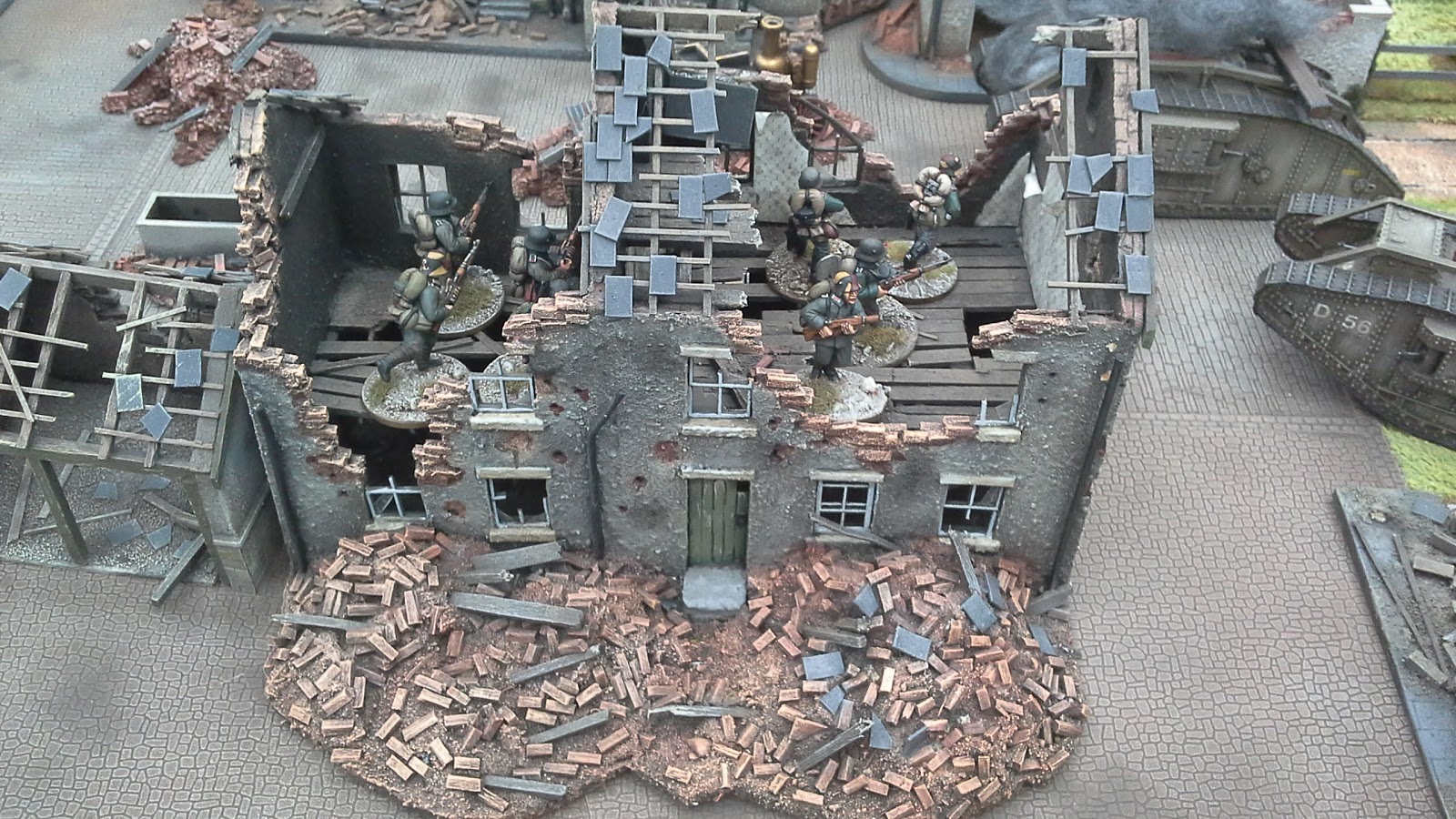
One of the reasons I like to go to Partizan, other than it being amongst the more 'local' shows for me (i.e only an hour or twos drive either way), is the eye-candy type games. And this year didn't disappoint in that respect, with many great looking games, and a few real corkers. My favourite was the 28mm WWI demo game put on by Great War Miniatures.

For me, this is how wargames should: a moveable diorama.

Getting down to eye-level revealed some stunning views.

My mate Paul is a WWI nut. He says he'll get me into it one day...

... stuff like this sells it to me big time. Fab!

I adore this gun and crew. A work of art!

From the visual beauty point of view, Great War Miniatures' Cambrai game (I think that's what it was? I didn't take any notes, or chat to many people this time!), was, quite frankly, simply stunning. I want to take a leaf from their book in both how they paint figures, and their attention to scenic detail (albeit I'm currently working in smaller scales). Their figure painting seems, to me, perfectly judged; neither too detailed nor too basic. And the colours - how close they are to 'authentic', I don't know - please the eye, and are easy to 'read', if you know what I mean.

Lots of great scenery...

Call the glazier...

Och, it's fine dae to get kilt...

Another funky German gun.

Two Mona Lisas!?

HQ-cum-dunny...

They also included some wonderful incidental detail, such as German soldiers looting artwork, champagne, and so on. And there was even a micturating Bosch, in a very nicely rendered bathroom. He'd obviously been imbibing, as he's missing the bath. Still, that room, along with most in this model model village, will need a complete refurb anyway!

My only book purchase.

What with all the expenses of our new home (nearly been here a year now!), I should’ve restrained myself after my first purchase, R. F. Delderfield’s The retreat From Moscow, which - despite its title - is the novelist and Napoleonic buff’s account of the whole 1812 campaign, which I got for £5. But, like the fool I am - and despite having forgotten to bring cash (as I did on the previous Partizan*) - I popped out to a garage for some lolly, and ended up overspending.

More WWII Jerry gear in 1/72.

Maybe it’s just me, but I was a bit shocked at the prices of all the figures and models. A pal commented on this as well, when I showed him my show swag. In the end, apart from the book, I just got some more 1/72 WWII German stuff: an Italieri Opel Blitz ambulance, and two sets from Plastic Soldier Co: RSOs with Pak 40s, and Medium Trucks. I’m in a kind of rear-echelon reverie, I guess.

It’s nice to finally see a mainstream brand suppling the RSO to those of us who, like me, love these strange little tracked tractors. But £17 for the two vehicles and two guns (plus crews, etc) did kind of hurt. On the plus side, PSC are generous in a supplying sufficient variety of parts to allow one to build 3 variants of the RSO (round cab, square cab, and mounted Pak 40), and either Opel Blitz or Mercedes trucks.

A smaller scale WWI game. Not sure who put this one on.

I always like being able to take serial shots such as this.
Another WWI game I didn't find out the name of.

More WWI: Lenton Gamers' 'Oppy Wood', in - I think? - 54mm.

I noted that there were quite a few WWI games. more than I'm used to seeing. I guess its the centenary of that conflict, which has no doubt focussed interest on it.

The brass.

Nice pink facings on these dragoons!

I like this panoramic eye-level shot.

The Perrys had a beautiful Egyptian Napoleonic game, which might've been the Battle of Alexandria (is this historical, or fictional?), pictured above and below.

Beautiful figures, beautiful scenery... fab!

Mmm... beige facings.

As a major fan of the work of Tony Barton, it was nice to see the 15mm Battle of Dresden, which featured hordes of beautiful figures from Barton's capable hands. I meant to ask if these were Battle Honours era figures, or the later/larger AB range. But I was in a taciturn mood this show, so just looked and snapped these pics. Was this the Too-Fat-Lardies game?

Beautiful lancers.


Nice scenery too.

Dem guns, dem guns... 

More fab cavalry.

I was sorely tempted to start buying figures for a new era; English Civil War, American Civil War, even WWI, perhaps. But I managed to restrain myself. This meant not even looking too hard at some stalls. Adler, who do the 6mm ranges that are the backbone of one of my Russia 1812 collections, aren't at that many shows. And normally Id make a bee line for them when they are. This time a furtive glance was all I dared! In case I suddenly bought a new army in a new era.

So, all in all, fun was certainly had. By me at any rate. I think Teresa's highlight was eating chips and beans in the caff! Actually, thats another thing I don't like about these sorts of modern venues: crap overpriced catering. Still, I enjoyed the show. And it gave y my fix of mini-military delights. So... mustn't grumble!

*Unbelievably, there are no cash machines on the site.