Showing posts with label war film. Show all posts

Sunday, 30 September 2018

Film Review: Sea of Sand, 1958


Although Richard Attenborough gets top billing, this is actually a very good ensemble piece. And the actors I didn't recognise were every bit as good as those I did.

The ensemble cast deliver good performances.

A scary apparition emerges from the desert... 

I only recognised Attenborough, who plays the cockney character Brody, and Percy Herbert, who plays a character called 'Blanco' White. It's actually White that's depicted on the (rather cool) cover illustration for this particular edition of the DVD, manning the machine-gun 'neath some netting, as 'Jerry' advances across the titular 'sea of sand'. I didn't recognise either Michael Craig, nor John Gregson, who play the two Captains, Cotton and Williams, respectively, leading the mission.


A nice 'strategic view' type image.

Trudging across the burning sea of sand.

The mission itself is to blow up a behind-the-lines fuel dump, and the unit is the LRDG, or Long Range Desert Group, to whom the movie is dedicated. War movie anoraks like me will bemoan the inaccurate arms and materiél. Those American half-tracks look nothing like the SdKfz 251s they're probably standing in for. 

Such inaccuracies also add to the fudging of a theme that occurs several times in the film, and no doubt happened for real as well, when our chaps pass themselves off as Germans by the rather overly simplistic means of Cotton donning an M43 Feldmutz!


The DAK did use captured materiél, but this smacks of expediency.

This Dodge looks rather more convincing.

Despite stepping on a few WWII cliché land-mines, this remains a very solid and enjoyable film. The mission is a tough one, and a lot goes wrong, causing one soldier to speculate on the presence of a 'Jonah' in their midst. But English pluck wins through, albeit not for all concerned. Not the greatest war film ever, and neither the most historically faithful nor the most hamfistedly patriotic, Sea of Sand is simply a very enjoyable boys-own adventure yarn.


The modern U.K. DVD cover.*

* What charm this has it owes to the vintage image that's been recycled for the artwork.

Thursday, 27 September 2018

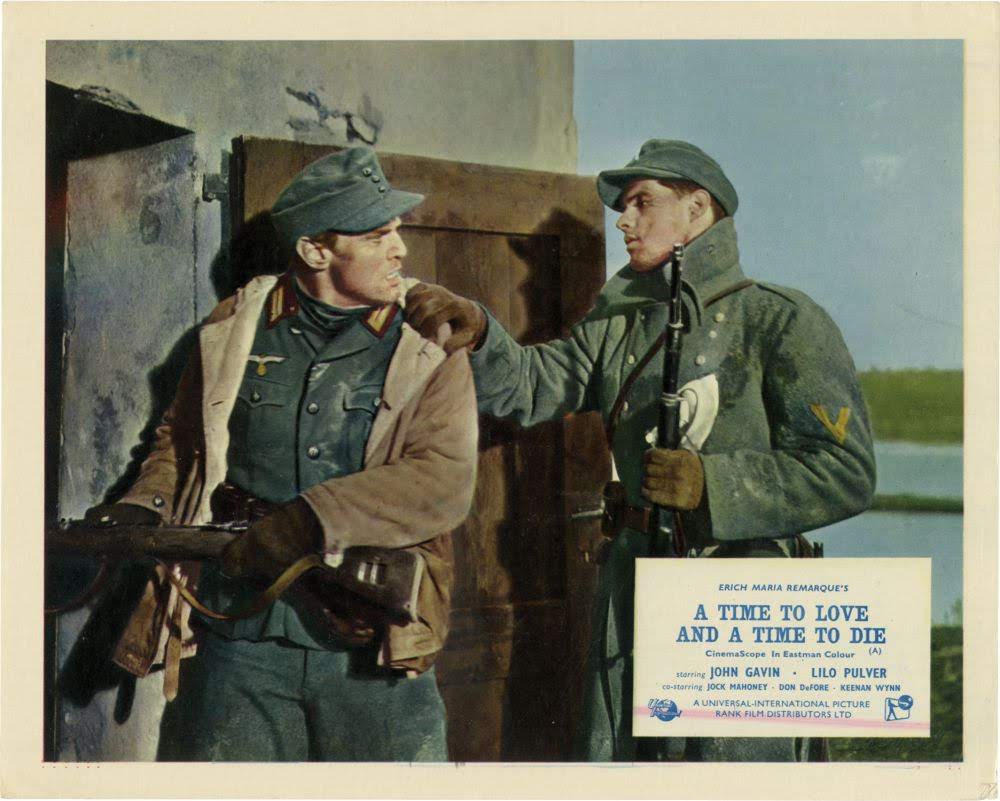
Film Review: A Time To Love & A Time To Die, 1958


A Time To Love And A Time To Die is one of a very small group of American films made during the 1950s, i.e. only very shortly after WWII itself, that explore the human side of the German experience of that epic conflict.

The only other similar film, in this particular respect, that I've seen thus far is Decision Before Dawn. The latter is a black and white movie, as much espionsge thriller as war film, set on the Western and Home Fronts, whereas A Time To Love is more melodrama and romance, is set on the Eastern and Home Fronts, and is in bright Technicolour.


Those groovy old lobby cards...

... have a certain period charm...

... don'tcha think?

Both depict decent young Germans as central characters, and both find these men back in Germany, struggling to reconcile their consciences with their roles in the war, and their relationships to the Fatherland and it's peoples. This film is based on a book of the same name by German author Erich Maria Remarcque (of All Quiet On The Western Front fame*), and director Douglas Sirk was himself also of German extraction, so it has a personal resonance for two of the key figures behind it.


A somber looking version of the book.

An earthier pulpier interpretation.

Despite their roles in the making of the film, which one hopes bring some authenticity to it, I found the choice of male lead, Frank Gavin, who plays German soldier Ernst Graeber, rather problematic. Decision Before Dawn's Oscar Werner was both actually German, and an excellent actor, making for a very convincing character. I found Gavin too hammy and all-American (he's actually of Hispanic/Latin-American extraction) to be very plausible. I was more than half expecting him to blurt out, 'Gee, ain't the Fatherland swell, baby!' at some point.

Having said this, both films explore in different ways the moral compromises and complexities facing basically decent young men fighting on behalf of a toxic ideology. In Sirk's movie this theme ought perhaps to feel even more central, inasmuch as the film starts and ends in that infernal crucible of the Nazi quest for 'lebensraum' (a horrifically ironic misnomer, as it transpired, in that it was always as much charnel-house as living space), the Eastern or Russian Front.


Gavin, good looking? Unquestionably. Charismatic? Possibly. Germanic? Nope.

Gavin and his love-bird, Lisalotte Pulver.

It's really only the poignancy of this thread that prevents this film from being somewhat cornball, thanks to the rather hammy home-front roles of several chief actors, including Gavin himself, and his female opposite lead and love-interest, Lisalotte Pulver, a Swiss actress who was at least a star of German cinema of that era.

Amidst the ruins of the German homeland we see how civilians cope or go under, and the paranoia of the regime is evoked (the nosey conformist 'house-frau' is suitably repellent). We even meet a Jew in hiding, who's temporarily sheltered by Professor Pohl, played by Erich Maria Remarque himself, whose conscientious behaviour has predictable results.


There's not much Ostfront war footage...

... but what little there is...

... is pretty good.

The ending is sad but predictable, and whilst it helps make one of the films central points, about the senseless waste of war (another thing it has in common with Decision Before Dawn), it still feels less convincing or weighty than perhaps it wants to.

When the credits rolled I must confess I felt somewhat disappointed by this film, especially as it's packaged and marketed by Eureka as part of their Masters of Cinema line, and would have given it just three balkenkreuz. However, in the course of writing this review I begin to think that, whilst Sirk's melodramatic style and the Yankee-doodle feel of some of the acting seem at odds with the subject, it is an interesting if uneven film, and worth watching.

Graeber is a principled grunt, going back to the front...

... whilst others play a morally looser game.

* As a result this film was sometimes referred to as All Quiet On The Eastern Front

PS - In addition to the author making a cameo, it's interesting that Klaus Kinski also has cameos in both Decision Before Dawn and this film.

Wednesday, 26 September 2018

Film Review: The Guns of Navarone, 1961


I decided to buy this after watching and loving Peck's performance in 12 O'Clock High, mainly because The Guns of Navarone was advertised with a trailer on the latter DVD. I must've seen this film several times as a kid. It always seemed to be on, back then, every xmas or new year. But sadly it didn't live up to the rosy glow of nostalgic remembrance. Nor, for that matter, to Peck's own hype, on the aforementioned trailer.

Despite a pretty strong cast, the film lacks chemistry.

The story certainly sounds promising: freedom loving desperadoes attempt the allegedly impossible task of destroying the impregnable super-guns of Navarone. Humbling the huge arrogant Nazi war machine, literally embodied here as massive 'wunderwaffen', to be destroyed by plucky little Everyman characters with little more than ropes, some dynamite, and - pardon the expression - a lot of spunk, is the stuff of WWII legends.


Big guns...

Peck is okay, Niven is, well, Niven, and Anthony Quinn wears a big hairy sheepskin and a pink sweater and pretends to be Greek (not altogether convincingly). Somehow, however, perhaps in trying too hard, this film fails, for me at any rate. It was Peck's baby, and, although he's a fine looking fellow who can certainly act, I don't think he got this right. It just doesn't feel credible. It's pretty damn long (which I'd see as a plus if it were better), and there's too much corn and ham in it. It ends up more like an overloaded but not quite satisfying submarine sandwich than an epic wartime thriller.


... misfire.

As to the film's relation to history: allegedly the movie is based on an Alistair MacLean book of the same name, which, in turn, was allegedly based on the Dodecanese campaign, centring on battle for the Greek island of Leros. But the Germans won that battle, which was fought by large forces on both sides. And I found no mention of superguns in the accounts I read. Instead it was a debacle that was compared to Gallipoli!


An older poster.*

This might pass muster for some diversionary matinee fun, particularly if you're full of port and turkey left-overs, but it's not the great film Peck hoped/thought it was.

* Even the vintage poster is, in this instance, a disappointment.

Tuesday, 31 October 2017

Film Review: Fury, 2014


I just finished watching this. For the - I think? - fourth time. Each time I watch it, I like it a bit more. The first time I watched it, I just thought the 'macho pose' factor, and the final scene - gunfight on the Sherman corral - were just too much. More on this particular episode later.


In the picture above the cast/crew of Fury are, l-r: Jon Bernthal, Michael Pena, Brad Pitt, Logan Lerman (behind Pitt), and Shia LaBeouf, as, respectively: Grady "Coon-Ass" Travis, Trini "Gordo" Garcia, Don "Wardaddy" Collier, Norman "Machine" Ellison and Boyd "Bible" Swan.

However, with each new viewing I think it's a better film. The ending is a bit, er... no, make that very OTT. But I've gone from finding it merely ridiculous, to enjoying it for what it is, cinematic overstatement. And the characterisation? Well, the macho factor is hard to acclimatise to, and the Hollywood tradition of using 'good ol' Southern boy' accents as a shorthand for gritty authenticity, still irks me. Just less so. [1]

What makes the film better with each viewing are, for one thing, the abundance of little details. It's taken a long time. But these days it's much more usual for WWII movies to depict not just weapons and equipment more accurately, but also combat environments generally, and all the stuff that goes with them; bombed-out towns, refugees caught in the crossfire, behind the lines scenes, etc.

Director Ayers and Pitt, in a muddy camp scene.

And despite the über machismo caveat, the cast in this film are actually pretty good, giving good performances. Watching the extras on the DVD one realises that meeting real WWII veterans, and going to movie 'bootcamp', with genuine military guys on hand to train them, all had salutary and useful effects on the actors. And I think these things help make Fury better than it might, at first glance, appear to be.

Initially I thought some of the actors rather wooden.

On first veiwing I thought it was a pretty dumb film, frankly. Populated by wooden caricatures. But there's a degree of sad truth in the way men gravitate towards defined roles under duress. So the characterisation might not be as two-dimensional as I originally thought. Certainly the mixture of brutality and camaraderie, or the good and bad sides of humanity, as brought out by warfare, aren't easy or comfortable viewing. But in that respect, this film depicts war honestly and authentically.

Two major themes that resonate most compellingly within the film are: the struggle between the degrading animalistic violence of war, and our more civilised compassionate side; and the family like bonds that develop under such extremes of duress. Don 'Wardaddy' Collier is, both literally and metaphorically, the father figure in the tank (and the tank is the family home!). He dishes out tough love, but he earns the respect and loyalty of his crew.

'Wardaddy' in one of his several father figure roles, helping 'Machine' pop his cherry.

'Wardaddy' as bad dad, making Norm' pop a cap in a defenceless Kraut's ass.

In his role as father figure, 'Wardaddy' helps Norman 'Machine' Ellison both gain experience and lose his innocence, in two notable and significant ways: scoring with a pretty German girl, and killing a German POW. Both scenes are really quite troubling, in their own different ways. Some have said they find the interlude with the female German civilians improbable. Well, I dunno... my reading of war diaries (and histories), from conflicts in all eras suggests that fraternisation, all the way to intimacy - both consensual and otherwise - is very normal.

Whilst the moral issues in the film are certainly very complex, even if initially they appear to be handled rather too simplistically, there are technical aspects that military buffs such as us model-makers and wargamers are bound to love. Shot largely in England, they used Bovington's Tiger 131 for the deadly encounter with that famed German tank. How many films are spoiled because of inaccurate matériel? It's clear that Ayers and co really wanted authenticity, probably in all aspects, but certainly in terms of gear. And that really helps the movie.

Bovington's Tiger, 131, is magnificent.

Whilst Ayers tried to avoid CGI, he did use it for tracer round effects

A very moody production shot; location, Oxfordshire!

Shermans, also supplied by Bovington, in action.

Fury takes a hit. Fortunately not fatal.

The final shoot-out with 'Jerry' is brought about when Fury rolls over a mine and loses wheels/track. Their platoon, reduced to just one vehicle from four, after the encounter with the Tiger, is supposed to hold a cross-roads/sector. Given the suicidal circumstances, the seasoned crew want to get out. Jaded old 'Wardaddy' - with shades of a deathwish - wants to stay. Young 'Machine' decides to remain with him, after which the old crew are shamed into staying also.

The claustrophobia of conditions within the tank is superbly conveyed

'Gordo' drives whilst viewing the outside world through a tiny periscope vision slot.

The commander in his turret; looks quite roomy compared to the other crew areas.

Whilst this segment of the film is, well, speaking candidly, fun, from a shoot 'em up point of view, it's both rather silly, and - partially in consequence of the former fact - morally troubling. It really reminds me of the old Westerns, with the cowboys wasting hordes of faceless Indians. And the double standard in terms of the value of life, between 'goodies' and 'baddies', is only enhanced by the alternation between the constant noise and combat as Germans are massacred, and the moments of solemn silence whenever one of 'our boys' cops it. Whilst this is undoubtedly televisually very powerful, it's also a dramatic conceit that's both morally dubious, and highly unrealistic.

The ending owes much to this sort of thing.

And don't just take my word for this: Bill Betts, a British Sherman tank veteran, admires certain scenes in Fury, such as the Tiger pasting the Shermans [3]. But here's what he said about the end: 'I thought the film showed accurately how tough life could be in a tank, but the final scene where the crew hold out against a battalion of Waffen SS troops was too far fetched. The Germans seemed to be used as canon fodder. In reality they would have been battle-hardened and fanatical troops who would have easily taken out an immobile Sherman tank using Panzerfausts.'

The German cannon fodder, arriving at the crossroads.

This film does have its faults. But, where I would've given it three out of five stars/balkenkreuz after my first viewing, and four after viewings two/three, now, on the fourth time around, I have to confess I love it. And so, to reflect that, whilst my heart wants to give it five, I'll settle for four and a half: I do love it, but it's certainly not perfect. Indeed, it's fairly flawed, in some respects. But I love it nonetheless!

----------
NOTES:

Lafayette Green Pool, the original 'Wardaddy'!

[1] Having said this, I learned, during my online research for this review, that the nickname 'Wardaddy' was in fact the real nickname of a U.S. tank commander. And the 'real' Wardaddy, one  Lafayette G. Pool, was indeed a Texan (he even allegedly wore cowboy boots in preference to army issue boots!).

[2] Here's a short movie about Tiger 131's involvement in the filming of Fury.

[3] Betts also recalled, in relation to the scene showing the execution of a german POW, disarming a 55 year old member of the Volksturm, only to learn later that he was shot. Read the full article here.

Thursday, 1 June 2017

Film Review: Flags Of Our Fathers, 2006


Clint Eastwood and Steven Spielberg collaborated on bringing the book Flags of Our Fathers to the big screen. The book was written by James Bradley (with Ron Powers), son of John 'Doc' Badley, and tells the story of the six men - of whom 'Doc' Bradley was allegedly one (see further on this, below) - immortalised in Joe Rosenthal's famously iconic flag-raising photo, taken atop Mt. Suribachi, on the island of Iwo Jima.


The film, like the book, tells the story of combat and its aftermath, and how society celebrates and comes to terms with war, as much as it tells the story of the action on Iwo Jima itself. As wargamers and the like, it's perhaps this latter that may be of chief interest to us. 

Personally I find the other threads just as fascinating, although I will admit it's the, um... 'war porn' side (sorry, that's a horrible idea/phrase, but it kind of fits), that attracts me to the movie in the first place. But this in itself just goes to show the moral complexities of these fraught issues!

The movie starts, rather oddly - to my ears at least - on first hearing, with Clint Eastwood himself singing, in a ragged, thin, broken voice, partial lyrics to the song 'I'll Walk Alone'. This isn't his only musical contribution; Eastwood not only directed this picture, he also composed the soundtrack!

The initial scenes ...

... show Dreamworks CGI ...

... used to stunning effect.

Spielberg's Dreamworks fingerprints are all over the technical side of this film, which is truly spectacular in its CGI-enhanced depiction of the massive invasion flotilla, and the explosive and bloody combat scenes. And whilst Eastwood and Spielberg both undoubtedly have their own personal political axes to grind, and their views doubtless seep through in their work, it's also clear that this picture aims to be as even-handed and authentic as they could make it. [1]

Rosenthal's celebrated photograph.

Perhaps not unsurprisingly, the six figures in this iconic image, two of whom are barely visible, have not always been identified consistently. After an investigation in 1947, the Marine Corps themselves settled on the following, L-R: Ira Hayes, Franklin Sousley, Michael Strank (behind Sousley), John Bradley, Rene Gagnon (behind Bradley), and Harlon Block. Block Was initially identified as Henry Hansen, but the 1947 enquiry decided that it was indeed Block, and not Hansen in the picture. 

Subsequently, more recent amateur investigations suggested that the figure identified as Bradley is in fact Sousley [2]. This eventually lead to a second Marine Corps review board investigation, at which it was decided that Harold Schultz and not Bradley, was in the photograph of the second flag raising, which has become such a famous symbol of the US military at war.

The 1st flag raising.

There were actually two flags raised, with Bradley participating in the securing of the first, and present at, although not pictured in Rosenthal's most famous photo of the second. The first flag was raised by a slightly different group, which did include both Hansen and Bradley, being replaced later the same day (Feb. 23rd, 1945) by the second larger flag.

Harlon Block, above, was initially misidentified as Henry Hansen.

Ira Hayes, the unhappy 'hero'.

Rene Gagnon points himself out.

John 'Doc' Bradley.

Schultz, only identified as a flag-raiser long after his death, in 1995.

As already alluded to above, this movie isn't just a depiction of the fight for Iwo Jima. It uses Rosenthal's famous photograph, the darkroom discovery of which starts the film, and the effect this image has on the war-bond and propaganda drive back home in the U.S, to explore themes of the psychological effects of combat, and how we rationalise war, both for those involved - and in the context of this film that means, primarily, for the three surviving flag-raisers and their combat buddies - and for those at home.

Joe Rosenthal, signing copies of his famous photograph.

Perhaps somewhat ironically, given the Spike Lee imbroglio (see footnote [2], below), Eastwood's decision to start the movie with 'I'll Walk Alone', and the way he focuses on the story of Native American marine Ira Hayes - who some time after the war literally walked alone 1,300 miles to visit the family of a fallen comrade (Harlon Block) - is a clear effort to redress the injustices in a young nation, seen from the European rooted perspective, that is, that has certainly struggled with issues of racism.

Bradley, Hayes and Gagnon, movie style ...

... and the real trio: Gagnon, Bradley, Hayes.

Hayes, along with John Bradley, is one of the core trio, rounded out by PFC Rene Gagnon, who are brought home and fêted as heroes, to be utilised, in conjunction with Rosenthal's iconic image, as means to raise war-bonds.

This is akin - but here as more of a central narrative plank - to the segment of the Hanks/Spielberg Pacific series in which John Basilone, another hero of Iwo Jima, is brought home to help raise war revenues. Basilone, as depicted in that series at any rate, tired of the hero role, requesting that he be sent back to fight (and to die, as it turned out) with his buddies.

Of the three men depicted in Eastwood's movie, it's Ira Heyes who has the greatest struggle adjusting to post-combat life, and in particular the idea of himself as a war hero.

Eastwood directs.

Personally I think Eastwood deals with every aspect of this complex and difficult subject superbly well. The film is by turns exciting, inspiring, harrowing, and always moving. And within this impressive range there's everything from light humour to heavyweight seriousness. Not bad!

Mt Suribachi, Iwo Jima.

Recovering the wounded.

Detritus of the amphibious assault litters the beach.

Having given some of the more sociological and psychological - perhaps even philosophical? - aspects of this superb film some consideration, let's turn now to the depiction of the combat. Well, the first thing to say is that, despite coming in well under budget - according to figures I've seen on't interweb (prob. Wikipedia) [3] - this is a stunning film. The depictions of the invasion fleet, its deployment, and the initial attack on the beaches, are all jaw-droppingly impressive. 

The desaturated colour is near monotone...

... and adds a kind of gritty period feel.

Resulting in a green tinged near black and white look.

The naval bombardment, the use of waves of carrier-borne aircraft, and the huge deployment of landing craft (500 in 10 waves) are all beautifully and very dramatically rendered, with an excellently judicious mix of CGI and 'real' hardware, etc.

The black volcanic sands, and indeed all the terrain, none of which was shot on Iwo Jima itself, are superbly recreated. And the combat scenarios, which focus predominantly on the initial landing and subsequent fate of the 3rd Platoon, Easy co, 2nd Battalion, 28th U.S. Marines, as they attack and eventually reach the summit of mount Suribachi, are brilliantly recreated. 

This film is told expressly from the American side, and as such the Japanese are - perhaps surprisingly, given the situation - a relatively minor presence in the narrative. Mostly they're dug in and sniping, remaining nigh on invisible to both their 'dogface' adversaries and us viewers, except for occasional (and very brutal) moments of hand to hand combat, or when flushed from their defences, or populating the battle-scarred island as corpses.

The Japanese perspective, companion to Flags.

With respect to the Japanese perspective Eastwood shows his credentials for even-handedness not so much in this film itself (although that is indeed visible to the discerning eye), as in its companion piece, Letters From Iwo Jima, which film - made entirely in subtitled Japanese - expressly tells the Japanese side of this momentous and bloody battle. 

But even in Flags of Our Fathers Eastwood doesn't flinch from this balanced position, witness the poignant scene in which 'Doc' Bradley, attending to a wounded American in a dug-out, dispatches a Japanese soldier who attacks them: there's no old-fashioned Hollywood style instant, silent, painless death for the latter. Such scenes force the viewer to face the horror and insanity of the most brutal aspects of war.

A Higgins boat near the landing site.

Men and machines, casualties of war.

Eastwood does everyone involved the best honour anyone could really do, as Bradley junior also set out to do (at least according to the quotes from his work with which this film ends), not by whitewashing the story in a propagandistic style, but by accepting and depicting it all in its unresolved - and perhaps unresolvable? - complexity. 

I'd say this is a really excellent film. It manages to handle complex issues without dumbing down, and at the same time it's a rip-snorting good war movie, that shouldn't fail to entertain and inform lovers of the genre.

----------
NOTES:

[1] This didn't stop Spike Lee wading in with criticism of the movie for what he deemed to be under-representation of African-American troops in the film. Pictured above, three African American soldiers on the beach at Iwo Jima, found here.

[2] For those interested, I found an article here, that delves into this issue!

[3] With a projected budget of $80 million, the film actually only cost $55 million.