Showing posts with label 1944. Show all posts

Monday, 23 September 2019

Book Review: Hitler's Paratroopers in Normandy, Gilberto Villahermosa


This excellent book is a compelling and fascinating account of Hitler's Fallschirmjagers in their latter-war role as elite infantry defenders, as opposed to their early-war role of airborne attackers, and more specifically the part played by II Parachute Corps in the Normandy '44 campaign.

Numerous actions are covered, ranging from the better known, such as the rather muddled loss of Carentan and the more determined defence of St. Lô, to the more obscure, such as St.-Côme-du-Mont, Hill 192 and the defence of Sainteny/Sèves Island. The largest actions are the siege of Brest and the encirclement and collapse of the Falaise pocket.

How things started... *

In all these events the primary focus is on the involvement of the fallschirmjager, with a secondary theme being a look at their leadership, in figures such as Ramcke, Schimpf and most particularly Eugen Meindl. In a book written by a modern American military man about German soldiers who were fighting, for the most part, his own countrymen [1], author Villahermosa is admirably balanced in his treatment of his subjects.

The maps, grouped together at the beginning of the book, could've been better. Some are nigh on illegible. Standardising the design and image quality of the maps (whilst some are pixellated and poor, others are very clear), and having the appropriate maps nearer the pages where the actions are related, might've improved the readers chances of following the often geographically challenging scenarios.

... and how they ended, option #1... *

Whilst there are copious footnotes to sources, and a list of equivalent U.S. and WWII German ranks, there's no glossary. It's my firm belief every specialist book in our niche areas of interest ought to have one! There are even a few instances of quotes being repeated/recycled (in one instance identical words being attributed to two different German commanders [2]), and some minor editorial mistakes.

But overall it's an excellently balanced and exciting account. Very well written in the main, it also appears to me (admitted enthusiastic amateur that I am) well constructed and researched. The more I read on this theatre, the more it strikes me that the German's were in the grip of a 'Lost Cause' mindset comparable in some ways to the Confederates in the ACW: fighting for a morally bankrupt racist vision against an enemy of vastly superior resources in men and material; their ultimate defeat looks, both at the time and in retrospect, inevitable [3].
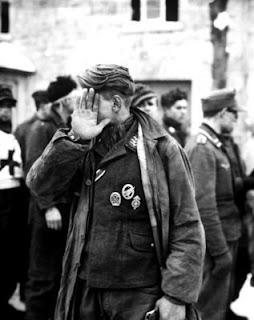
... or, for the lucky ones, option #2, captivity.*

Nevertheless, as Villahermosa documents, what fragments of these units survived the fairly cataclysmic defeat in Normandy were recycled and reorganised, and continued to fight in Holland, Belgium, Germany and elsewhere. The frankly appallingly wasteful loss of life, limb and property, visited not only on combatants but also the picturesque landscapes and people of Normandy and elsewhere is obviously terrible. But it makes for very compelling historical drama!

I loved reading this book, and would highly recommend this to those interested the Fallschirmjager, their leaders, and this period/theatre of WWII.


NOTES:

[1] Mention is made of the other Allies' involvement (British, Canadian, Polish, French) where appropriate. But in the main this is U.S. vs. Germany. Mention is also made of the German use of Ost-truppen and other foreign elements.

[2] I meant to note where this occurred, but didn't, and can no longer locate it. But, in fairness to the author, it's not representative of the solid writing throughout, so I'm not bothered, frankly.

[3] And, of course, many Germans were fighting more for their comrades and homeland than Hitler's racist agenda. But Villahermosa doesn't dodge the fact that, like most German elite forces, such as the SS, being an ardent Nazi was both more usual and approved of in such organisations. Ramcke, for example, inordinately vain according to his British jailors, is described by the author as a 'fanatical, diehard Nazi, hard-core anti-Semite, and blatant racist.' Sadly for all involved, the Germans, and especially those most in thrall to Hitler's mania for the 'triumph of the will' concept, were those least able to see the inevitability short lifespan of the supposed Thousand Year Reich.

* Sometimes I illustrate my posts with pics from the book under review, and sometimes with pics not found in the book, occasionally using both. In this instance all the images I've used are also in the book.


Monday, 8 July 2019

Film Review: Ill Met by Moonlight, 1957


I decided to re-watch this classic WWII 'true-life' thriller having just read Nigel West's Secret War, a history of the SOE

Ill Met by Moonlight, based on the memoirs of the same name by former SOE agent Stanley Moss is, fortunately, a Powell and Pressburger film, and that means excellence.


A nice old edition of Moss' book.

Stanley Moss and Leigh Fermor in their German disguises. [1]

Set on Crete, SOE agent Patrick Leigh-Fermor forms an ambitious plan to kidnap General Friedrich- Wilhelm Muller, the German commander on Crete, notorious for his brutality [2]. However, in typical SOE style (see West's book for more on this theme), by the time the mission goes ahead, Muller has been replaced by Kreipe. Rather than abort, the mission goes ahead, only now with a different target.

This small but significant detail is omitted from the film, which starts, after a brief visual and musical intro to the themes of Cretan freedom fighters and the beauty of the island, by introducing us to Leigh-Fermor, catching a local bus toting a sack of potatoes! Very soon, however, he's planning the op with a local Cretan resistance chap on the terrace of a saloon.


You'll want to visit Crete after watching this.

To the filmmakers' credit the island itself, its ruggedly arid mountainous topography having a rather savage beauty and grandeur, is as much a character in the film as any of the human (or animal*) players. In this respect this film reminds me of They Who Dare, which is also set under the scorching Mediterranean sun. Music is also used very well, mixing typically filmic atmospherics (I adore the mournful piano and clarinet theme played as the guerillas trek through the countryside) with Cretan folk styles - including a frantic 7/8 motif - to great effect.

The film celebrates the enthusiastic amateurs of SOE as plucky Brits, very much public schoolboys up to their japes, and looks rather quaintly dated in this respect. West's book on the SOE is at pains to point out that for numerous reasons, typically including both internal political wrangling and brutal German reprisals, locals weren't always as cooperative or fond of such Brit adventurers and interlopers as is suggested here.

A useful map, from the book. The film uses maps to help as well.

The bulk of the film is given over to first the abduction itself, which is a terrific bit of real life James Bond type derring-do, and then the eighteen day trek through the mountain wilderness before a hoped for extraction. The drama throughout is superbly done. And we grow to love all the major protagonists, from our plummy heroes and their salt of the earth local sidekicks to Kreipe, who isn't such a bad egg.

I've yet to see a Powell and Pressburger film I don't like - Colonel Blimp is an out and out masterpiece, in my view - and Ill Met by Moonlight is one of several excellent WWII era films (another I re-watched recently being Battle of the River Plate, about the sinking of Graf Spee) they made. The only reason I dock half a 'kreuz is on account of the 'jolly hockey sticks' style sanitisation of these purveyors of state sanctioned murder and mayhem. [3]


Kreipe in the tender care of his Cretan abductors, movie style.

The real Maj. Gen. Kreipe.

NOTES

* Perhaps to emphasise the rustic nature of the island and it's people a few animals - dogs, goats, donkeys - feature in a prominent and endearing manner!

A short documentary on Kreipe's abduction can be viewed here, on YouTube. Rather amazingly, the Gerneral and his kidnappers were reunited on a Greek TV show, in 1972. A brief clip from this can also be found on YouTube. 

[1] The taking of the photographs from which this example is drawn is a scene that features in the film. These and numerous others can be viewed online, here.

The actual abduction team.

[2] Known as the 'Butcher of Crete', Muller committed atrocities against civilian and military targets throughout the war, in numerous locations, eventually being tried and executed for these actions by the Greeks.

[3] The expected German reprisals for Kriepe's abduction and other similar/related partisan style actions were in turn subject to partisan reprisal. SOE operatives, including Moss, being implicated in the murder of a number of German soldiers who had surrendered after being ambushed.


Leigh Fermor and Dirk Bogarde, who plays him in the movie.

Christopher Lee has a brief cameo.

Friday, 10 May 2019

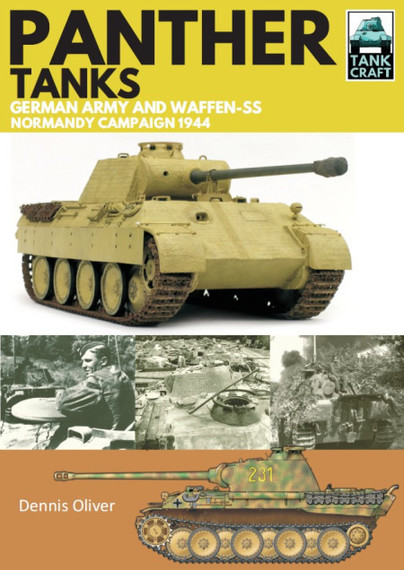
Book Reviews: Panther Tanks, Normandy '44, & Defence of the West '45, Dennis Oliver


Taken together these two titles, numbers 3 and 18 in the Tank Craft series, give a very decent account of the Panther tank, as deployed on the Western Front circa '44-45. One might immediately think 'what then of the Panther's history and development before this, and it's service on the Southern and Eastern Fronts?' I'll return to these thoughts in due course.

As ever with Dennis Oliver, he deploys his own particular approach, utilising maps, timelines, organisational schematics, unit histories, and so on. Where he follows the standard Tank Craft template is in the central three segments: Camouflage and Markings, Model Showcase, and Modelling Products.

A Panther pauses on a French road, Normandy, '44. [1]

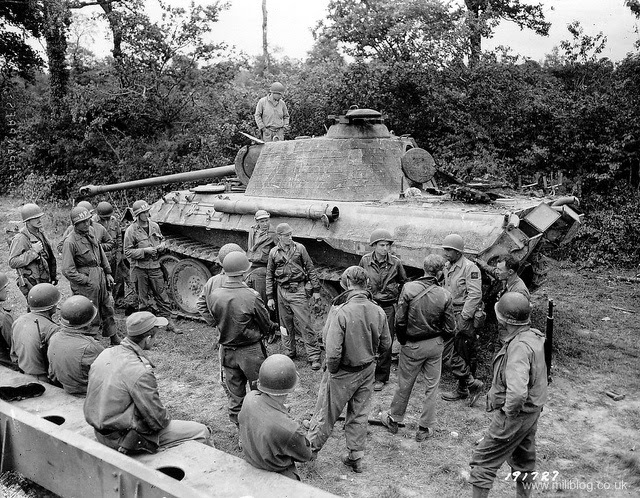
U.S. troops gathered around a disabled Panther.

The Normandy title features five models, all in1/35, and all very impressive. The Defence of the West  book, on the other hand, has just two 1/35 models and a single 1/48 example, the latter getting more pages than are normally given over to any one model in the Showcase section. Between the two books that's eight models, all bar one in 1/35. I'd have liked to have seen at least one bigger kit, in 1/16, perhaps, and one or two smaller models, in 1/72 or 1/76.

The colour profiles in the Camouflage and Markings chapter are nicely done, and are both fascinating and exciting. The range of styles and approaches the Germans employed, despite a palette of just three basic colours (which admittedly varied in themselves) was very diverse and, I find, endlessly intriguing. My only gripe on this front is that either the work of the illustrator, or perhaps the printing process, has rendered the core trio of colours less than 100% satisfactorily.

Panther in 'ambush' camo' scheme with infra-red sight.

Fabulous Panther Ausf G, by Lim Kian Guan, aka ChefLim. [2]

This is particularly noticeable with the green. The Dunkelgelb and Rotbrün, whilst only approximate, are near enough. But the green is way too light and bright. This is exaggerated even more in the bottom of the two cover images, shown at the top of this post (the Defence of the West one, sourced from Pen & Sword's own website listing for the book), where the green is almost fluorescent marker-pen bright! The actual books are closer colour-wise to the very top Normandy Campaign cover image.

Panzer graveyard with Panthers in the foreground.

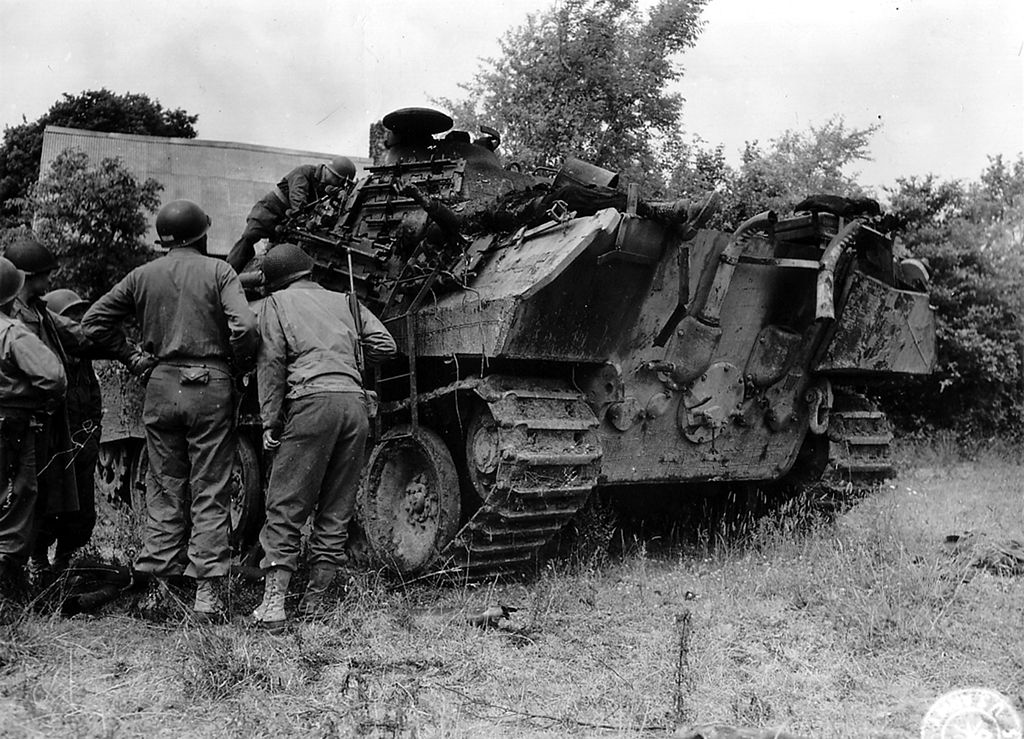
A grimmer graveyard scene. Is this 'Ursula' again? [3]

It's this colour issue that leads me to dock half a balkenkreuz. Whether Oliver's obsessively detailed coverage is a blessing or a curse - what of Panthers in Italy and Russia, and prior to '44? - depends on how much hardcore info you can take, and whether you can stretch to buying so many titles on the one vehicle.

At an RRP of £15 a time (£14.99 to be exact), they aren't exactly cheap! NB: at the time of posting this review both titles are available at reduced prices, at Pen & Sword's website. I'm lucky in that the publishers have been generous enough to send me copies gratis, for review. Otherwise I'd be lusting after these whilst lamenting the lack of brass in my pockets! Anyway, as regards useful info and inspiration, etc, these books are fab. And I'd highly recommend them.

----------
NOTES:

Note on photos/pictures: in this post I've tried to use images that do appear in the books under review.  The two exceptions are the final black and white image above, and the colour picture of ChefLim's model, which is from his website.

[1] This picture appears in a smaller/cropped format.

[2] This superb model appears in the Showcase section of the Defence of the West title.

[3] The more eagle-eyed might notice that a charred corpse lies atop the rear deck of this knocked out tank. In fact more than one German soldier died on the back of this particular Panther - which may be 'Ursula', a Panther featured in Oliver's book on several different occasions - as other pictures I found online show clearly. A grisly reminder of the true nature and costs of war.

Friday, 22 February 2019

Book Review: The Americans On D-Day & in Normandy - Brooke S. Blades


Another excellent title from the very useful Images of War series. The pictures are terrific, as one would hope they would/should be in a series with such a title. The text is pretty good. At first I wasn't too sure, re the latter, as in places it's very dense with unit numbers and movements. But overall the text is actually pretty good.

Blades treats the subject to a mixture of chronological and themed chapters, starting with preparations in England, and then moving via airborne troop drops to the beach landings. So far so chronological, but then comes a chapter titled Soldiers, Prisoners and Civilians. The action then moves further inland, before we're given chapters on the wounded, the dead, and the battlefields then and now.

There are some minor issues with the text, like references to characters (usually the photographers) by one single name, with no other contextualising info. And at times the density of unit/movement info can get near headache inducingly opaque. With so much to cover this could've been a mess. But it works pretty well overall. And the pictures are fab.

The best of these Images of War books are really great resources for wargamers, modellers and military history buffs when, as here, they're packed with great photos, accompanied by illuminating text. The pictures are admittedly all black and white - and the US was one of the few participants, alongside Germany - to make frequent use of colour film in WWII. But it's really nice, as well as useful, to have such rich visual material as this to hand in print form, as opposed to trawling the web for it.

I'd definitely recommend this to anyone with more than a passing interest in the U.S. role in D-Day and beyond.

Thursday, 27 September 2018

Film Review: A Time To Love & A Time To Die, 1958


A Time To Love And A Time To Die is one of a very small group of American films made during the 1950s, i.e. only very shortly after WWII itself, that explore the human side of the German experience of that epic conflict.

The only other similar film, in this particular respect, that I've seen thus far is Decision Before Dawn. The latter is a black and white movie, as much espionsge thriller as war film, set on the Western and Home Fronts, whereas A Time To Love is more melodrama and romance, is set on the Eastern and Home Fronts, and is in bright Technicolour.


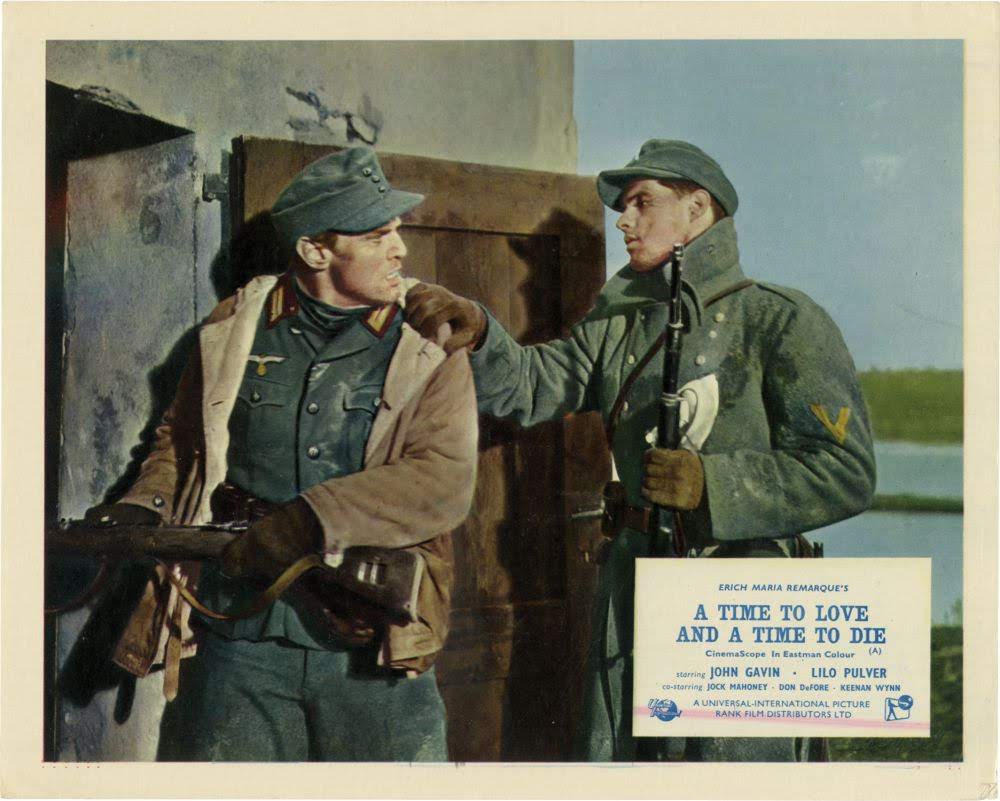
Those groovy old lobby cards...

... have a certain period charm...

... don'tcha think?

Both depict decent young Germans as central characters, and both find these men back in Germany, struggling to reconcile their consciences with their roles in the war, and their relationships to the Fatherland and it's peoples. This film is based on a book of the same name by German author Erich Maria Remarcque (of All Quiet On The Western Front fame*), and director Douglas Sirk was himself also of German extraction, so it has a personal resonance for two of the key figures behind it.


A somber looking version of the book.

An earthier pulpier interpretation.

Despite their roles in the making of the film, which one hopes bring some authenticity to it, I found the choice of male lead, Frank Gavin, who plays German soldier Ernst Graeber, rather problematic. Decision Before Dawn's Oscar Werner was both actually German, and an excellent actor, making for a very convincing character. I found Gavin too hammy and all-American (he's actually of Hispanic/Latin-American extraction) to be very plausible. I was more than half expecting him to blurt out, 'Gee, ain't the Fatherland swell, baby!' at some point.

Having said this, both films explore in different ways the moral compromises and complexities facing basically decent young men fighting on behalf of a toxic ideology. In Sirk's movie this theme ought perhaps to feel even more central, inasmuch as the film starts and ends in that infernal crucible of the Nazi quest for 'lebensraum' (a horrifically ironic misnomer, as it transpired, in that it was always as much charnel-house as living space), the Eastern or Russian Front.


Gavin, good looking? Unquestionably. Charismatic? Possibly. Germanic? Nope.

Gavin and his love-bird, Lisalotte Pulver.

It's really only the poignancy of this thread that prevents this film from being somewhat cornball, thanks to the rather hammy home-front roles of several chief actors, including Gavin himself, and his female opposite lead and love-interest, Lisalotte Pulver, a Swiss actress who was at least a star of German cinema of that era.

Amidst the ruins of the German homeland we see how civilians cope or go under, and the paranoia of the regime is evoked (the nosey conformist 'house-frau' is suitably repellent). We even meet a Jew in hiding, who's temporarily sheltered by Professor Pohl, played by Erich Maria Remarque himself, whose conscientious behaviour has predictable results.


There's not much Ostfront war footage...

... but what little there is...

... is pretty good.

The ending is sad but predictable, and whilst it helps make one of the films central points, about the senseless waste of war (another thing it has in common with Decision Before Dawn), it still feels less convincing or weighty than perhaps it wants to.

When the credits rolled I must confess I felt somewhat disappointed by this film, especially as it's packaged and marketed by Eureka as part of their Masters of Cinema line, and would have given it just three balkenkreuz. However, in the course of writing this review I begin to think that, whilst Sirk's melodramatic style and the Yankee-doodle feel of some of the acting seem at odds with the subject, it is an interesting if uneven film, and worth watching.

Graeber is a principled grunt, going back to the front...

... whilst others play a morally looser game.

* As a result this film was sometimes referred to as All Quiet On The Eastern Front

PS - In addition to the author making a cameo, it's interesting that Klaus Kinski also has cameos in both Decision Before Dawn and this film.

Wednesday, 20 June 2018

Film Review: Attack, 1956


It's 1944, and somewhere near Aachen a platoon of American troops of Fragile Fox company [1] are attacking a German pill-box. Jack Palance plays Lt. Costa, whose 'boys' get badly chopped up by machine gun and mortar fire, their promised support never materialising.


Capt. Cooney (Eddie Albert) is the vacillating, non-committal commander responsible for the debacle. Confronted with a challenge, he simply freezes. Holding his rank by dint of his father's society connections - daddy is a judge (and bully) - his costly failures look remarkably like rank incompetence, perhaps even cowardice. [2]


Lt. Joe Costa (Palance, right), can't stand Capt. Erskine Cooney (Albert, left).

After the initial opening battle sequence, we spend a while behind the lines. Capt. Cooney prepares to receive Lt. Col. Bartlett (Lee Marvin), who he knows from pre-war days, at HQ. A card game with booze and cigars is laid on. Cooney and Bartlett each intend to milk the occasion, laced with Southern bonhomie, for their own careerist ambitions. Cooney wants to win disapproving daddie's approval, by returning home as a decorated war hero; Bartlett seeks postwar office, with Daddy and Cooney Jr. as backers.


But rankling grievances that have been festering just below the surface erupt, and things turn sour. Costa simply cannot contain his anger over the Aachen affair. And it's soon clear that morale in the unit as a whole is close to breaking point, thanks to Cooney's lacklustre leadership. Lt. Harry Woodruff wants Costa to back him up in getting Cooney 'kicked upstairs'. Costa's too jaded to even try. And Bartlett manages to fob Woodruff off, saying that it's 100-to-1 they'll be pulled off the line.


A great still, looking very like a documentary photograph.

Instead, they're caught up in the Battle of the Bulge. Bartlett gives Cooney and Fragile Fox co. the task of taking and holding the strategically important town of La Nelle. Cooney requests Costa's platoon take the key initial position, on the edge of town. 


Like the pill-box near Aachen, it's a dirty dangerous job. But Costa reluctantly if fatalistically agrees, telling Bartlett that if the promised back up doesn't arrive this time, and promptly, and if he loses any more men as a result of Cooney's incompetence, he'll come back and shove a grenade down the Captain's throat and pull the pin!


Pulling the pin on a grenade is an image key to the film's pent-up violence.


Well, it's pretty clear what's going to happen. Exactly how it unfolds, however, is very well handled. Palance is just great, so ruggedly masculine you feel he might well be made of granite! Albert is also excellent, as the less than sympathetic Cooney. Marvin, another amazing looking fellow, is also reliably rugged, but with an added layer of viciously smooth careerist snakeskin. 


Costa is a man who drives himself over the edge, Cooney one who never finds his footing, and Bartlett cracks the whip, as they teeter on the brink. Amongst the officers only Harry retains any balance and composure. Or does he? The film promoted itself with the tag 'rips open the hot hell behind the glory', and has been described as cynical. Certainly it's not a straightforward 'heroes of America fight and defeat their evil foe' type affair.


Palance and friend during filming.


Actually I think it's a quite remarkable film. Palance really is great. His character, whilst extremely charismatic, in a homely yet gung-ho way, is damaged by the war. Yet we sympathise with him. Ultimately we may even sympathise with and feel pity for Cooney, who's the wrong man in the wrong place at the wrong time. Desperate to win the approval of a bullying father, but fully aware he hasn't the character to achieve his goal.


What transpires, over several well managed scenarios, is the evolution of this toxic set-up, under the rigorous strains of modern armed conflict. Us war buffs might grimace at the incorrect matériel - in particular the rather poxy looking M3 Stewart Light Tanks [3] standing in for magnificent panzers - but the film is good enough to surmount such limitations.

Palance prepare to bazooka a 'Panzer'.

Indeed, whilst on some levels this could be seen as a run of the mill WWII potboiler, in others, it clearly isn't. Palance's performance is almost Tolstoyan in intensity, but with a touch of neo-operatic grindhouse ham. There are some familiar faces, like Richard Jaeckel, and some low-budget workaround shots. But there's also an almost Francis Wolff (of Blue Note records, the famous jazz label) aesthetic to the black and white photography, and the opening title sequence. [4]

And in addition to a gripping well performed story, there's the moral complexity and the compromised systems of values that interplay. The denouement is appropriately messy and confused, much like the fighting depicted. Mixing the homely with the brutally cynical, it depicts a sad reality, in which humanity seems to oscillate under the polar lures of compromise and integrity.

Lee Marvin, as the jaded and cynically practical Lt. Col. Clyde Bartlett.

All told, I love this film. Lee Marvin is great, Palance is like some kind of pagan deity in the flesh, attractively primitive and dangerously, combustible volatile, Eddie Albert plays an unattractive role with real vigour and credibility, and William Smithers (who I didn't know prior to this) is the Everyman, trying to fathom his moral compass on the storm-tossed seas of war. Fab!


Smithers as Woodruff, the Everyman character.

----------
NOTES

[1] The film is based on a play, originally titled Fragile Fox.

[2] In fact actor Eddie Albert was a decorated veteran of WWII!

[3] Aldrich had to buy his own tank, and rent another, to make the film, as the US military refused to cooperate in the making of the film.


[4] It turns out it was graphic design maestro Saul Bass who did the superb title sequence.