Showing posts with label maps. Show all posts

Monday, 23 September 2019

Book Review: Hitler's Paratroopers in Normandy, Gilberto Villahermosa


This excellent book is a compelling and fascinating account of Hitler's Fallschirmjagers in their latter-war role as elite infantry defenders, as opposed to their early-war role of airborne attackers, and more specifically the part played by II Parachute Corps in the Normandy '44 campaign.

Numerous actions are covered, ranging from the better known, such as the rather muddled loss of Carentan and the more determined defence of St. Lô, to the more obscure, such as St.-Côme-du-Mont, Hill 192 and the defence of Sainteny/Sèves Island. The largest actions are the siege of Brest and the encirclement and collapse of the Falaise pocket.

How things started... *

In all these events the primary focus is on the involvement of the fallschirmjager, with a secondary theme being a look at their leadership, in figures such as Ramcke, Schimpf and most particularly Eugen Meindl. In a book written by a modern American military man about German soldiers who were fighting, for the most part, his own countrymen [1], author Villahermosa is admirably balanced in his treatment of his subjects.

The maps, grouped together at the beginning of the book, could've been better. Some are nigh on illegible. Standardising the design and image quality of the maps (whilst some are pixellated and poor, others are very clear), and having the appropriate maps nearer the pages where the actions are related, might've improved the readers chances of following the often geographically challenging scenarios.

... and how they ended, option #1... *

Whilst there are copious footnotes to sources, and a list of equivalent U.S. and WWII German ranks, there's no glossary. It's my firm belief every specialist book in our niche areas of interest ought to have one! There are even a few instances of quotes being repeated/recycled (in one instance identical words being attributed to two different German commanders [2]), and some minor editorial mistakes.

But overall it's an excellently balanced and exciting account. Very well written in the main, it also appears to me (admitted enthusiastic amateur that I am) well constructed and researched. The more I read on this theatre, the more it strikes me that the German's were in the grip of a 'Lost Cause' mindset comparable in some ways to the Confederates in the ACW: fighting for a morally bankrupt racist vision against an enemy of vastly superior resources in men and material; their ultimate defeat looks, both at the time and in retrospect, inevitable [3].
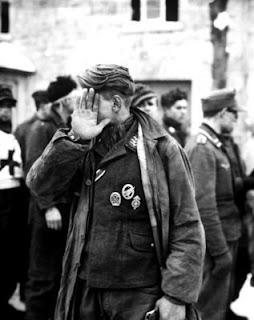
... or, for the lucky ones, option #2, captivity.*

Nevertheless, as Villahermosa documents, what fragments of these units survived the fairly cataclysmic defeat in Normandy were recycled and reorganised, and continued to fight in Holland, Belgium, Germany and elsewhere. The frankly appallingly wasteful loss of life, limb and property, visited not only on combatants but also the picturesque landscapes and people of Normandy and elsewhere is obviously terrible. But it makes for very compelling historical drama!

I loved reading this book, and would highly recommend this to those interested the Fallschirmjager, their leaders, and this period/theatre of WWII.


NOTES:

[1] Mention is made of the other Allies' involvement (British, Canadian, Polish, French) where appropriate. But in the main this is U.S. vs. Germany. Mention is also made of the German use of Ost-truppen and other foreign elements.

[2] I meant to note where this occurred, but didn't, and can no longer locate it. But, in fairness to the author, it's not representative of the solid writing throughout, so I'm not bothered, frankly.

[3] And, of course, many Germans were fighting more for their comrades and homeland than Hitler's racist agenda. But Villahermosa doesn't dodge the fact that, like most German elite forces, such as the SS, being an ardent Nazi was both more usual and approved of in such organisations. Ramcke, for example, inordinately vain according to his British jailors, is described by the author as a 'fanatical, diehard Nazi, hard-core anti-Semite, and blatant racist.' Sadly for all involved, the Germans, and especially those most in thrall to Hitler's mania for the 'triumph of the will' concept, were those least able to see the inevitability short lifespan of the supposed Thousand Year Reich.

* Sometimes I illustrate my posts with pics from the book under review, and sometimes with pics not found in the book, occasionally using both. In this instance all the images I've used are also in the book.


Wednesday, 1 November 2017

Book Review: To The Gates of Moscow - Türk/Urbanke


NOTE: the images in this post are from the book, and are used with the publisher's permission. They are not to be copied or reproduced elsewhere. [1]

Wow! What a fantastic book. I'm really interested in both the Napoleonic and the German invasions of Russia, and have quite a lot of books on both campaigns. This large landscape format hardback is easily one of the best on the latter.

Türk (at left) and his men in their Horch 901, WH 95712 (14th July, 1941)

A rest stop, Türk, sitting centre, has been wounded (21st July, 1941).

Like Napoleonic soldier and war artist/diarist Albrecht Adam, who returned from the ill-fated expedition of 1812 long before the end of that disastrous campaign, medical officer Herman Türk returned to Germany, due to a serious leg wound received outside Moscow, long before the end of the Nazi debacle in Russia. So this is necessarily a truncated account of what went on to become an appallingly epic conflict, of far longer duration than Napoleon's ill-fated campaign.

Although this is only a partial account, for reasons already mentioned, it is nonetheless an epic tome, at 468 pages. There are 444 photos, most of them taken by either Türk or one of his associates of which 244 are in colour (he had two cameras, one using black and white and the other colour film); a truly fantastic record. The text, in both German and English, is based on Herman Türk's diary entries, starting with departure from Berlin for the Barbarossa jumping off point, and then, moving near the spearhead of the attack, almost all the way to Moscow.

The wounded doc's field surgery, (August 4th, '41).

Wehrmacht concert, Palitskaya (7th August, '41). [2]

As well as Türk's diary entries and photographs, there's an accompanying text, by Axel Urbanke, which helps contextualise the day by day detail of Türk's story, and lots of colour maps. Sadly the map captions are in German only. All in all this an amazing resource for those whow, like me, have a stronger than average interest in this most cataclysmic of conflicts. The photographs, both black and white and colour, are a real treasure trove. Even though they are of varying quality, some being quite blurred, nevertheless they are - the colour pics in particular - incredibly evocative.

They also cover things one doesn't usually see in books on this subject: thanks to Herman Türk's role as a medic, we both read about and see more of death and injury than in other accounts. It might seem odd to note this, but I've often been surprised myself at how little photographic evidence there is of the sanguine aspects of what was, after all, one of the bloodiest theatres of war in the world's bloodiest conflict ever. Urbanke points out that, whilst in WWI photographers were more or less free to picture whatever's they saw, during WWII official German policy was to not document death and suffering, for fear of effects on morale. I believe this was true of the Allies as well.

A typical Russian earthen road; what, when in military usage, Germans called a 'Rollbahn' 
(10th August, '41).

The interior of Türk's Horch 901 (August 10th) [3].

At the time of posting this I've just finished reading Türk's diary and the accompanying text. It's been intriguing to see how the darker side of the war on the Ostfront is dealt with. Right near the beginning Türk and several officer colleagues visit the Warsaw ghetto, where about 400,000 Jews were being kept in appalling conditions, prior to many of them being sent to even more terrible fates. Türk and his associates are shocked and disgusted by what they see, but there is no sign of any real sympathy/empathy, nor any deep-seated anti-Semitism.

Brief reference is occasionally made to the summary execution of the odd Russian prisoner or 'saboteur'. But the more hardcore stuff, what Alan Clark called 'the septic violence of Nazism', is notably absent, until, perhaps, they reach Tula, near the gates of Moscow. Summary executions and a policy of no quarter start to set in at this point. It's clear that Türk and his comrades in arms find this traumatic. But, as you'll often see depicted in more contemporary war films and documentaries, such normalisation of atrocities during war is not uncommon. [4]

Türk at work; replacements get their cholera injections.

Still early in the campaign, but look at the state of the roads! (August 31st, '41)

Indeed, not only Türk does not mention - until right at the end of his narrative (more on this later) - the 'not so much medieval as ... pre-Roman barbarism' (Clark), which undoubtedly occurred on a massive scale on the Ostfront, but instead he actually gives evidence that local contact was, initially at least, frequently quite friendly. This was a fairly widespread phenomenon in the early days of the campaign, and was perhaps even more so in Türk's case, due to his being in a medical unit.

In terms of the savage side of war, in general terms, what comes across most profoundly is the high level of suffering and loss within the German forces, and quite naturally so, given Türk's position as a German medic. Losses in units frequently reach near enough 100%; relatively early on in the campaign Türk's own unit, down to about 70 men, receives 500 replacements, to take the unit back to its original (albeit still understrength) numbers.

One might be surprised - I was - at how many photos in this book depict German graves. Türk doesn't only photograph these places where his fallen comrades are buried when they happen to be near at hand. He also goes out of his way to visit the graves of men he knew particularly well, and pay his respects. I wanted to include one of these grave pictures, but I was already pushing the envelope in terms of getting picture permissions with the ten pics I'm using here.

By October roads were truly appalling; teams of men haul trucks through 'rasputitsa' mud.

25th November, the snow starts to bite.

Having said all of this, as they near Moscow, towards the tail end of the book, things do get nastier;  Russian resistance stiffens, whilst concurrently the overextended German advance bogs down in the extreme Russian conditions, and due to very high rates of physical and mechanical attrition. Where before Russians were surrendering en masse, now Commissars, NKVD, and 'barrier' troops are executing 'cowards', and no quarter is given on either side in the particularly fierce fighting over Tula.

And where previously prisoners were interrogated and then sent to the rear, now the summary execution of captives starts to take over. Ironically this sort of thing frequently spirals in wartime, as much as a perceived tit for tat policy as a conscious embodiment of racist hatred. And once the spiral is initiated it tends to escalate.

Russian POWs (this pic is not from the book).

This is a nasty business, which Türk clearly dislikes, but does not necessarily disapprove of, excusing it as reprisals for Russian execution and mutilation of prisoners,and what many German troops refer to as Russian 'gangster methods', such as pretending to surrender and then shooting your would be captors, or hiding underground and only firing from very close when german troops have passed.

Retailing for around £70, plus or minus a bit - I got my copy in Folkestone, a the Euro Military Expo model show, for a whisker over £60 - this isn't cheap. But sometimes an expensive book is worth a higher than normal price. That's true of the gigantic and incredible Taschen complete works of Michelangelo, which we bought from Amazon for about £100. And it's also true of this very different but very compelling window into one of WWIIs most brutal campaigns.

----------

There are many grave site pics in this book (but this isn't one of them!).

NOTES:

[1] Normally I might've worked on them in Photoshop, to lesson the three-colour print process effects. But as I'd been asked by the publishers, Luftfahrtverlag Start, to add watermarks, I did so, and the left the pics as they appear here. They are in fact far nicer in real life!

[2] As noted in the body of my review, relations with locals weren't too bad at this point. And such seemingly innocent activities as communal musical festivities, or church services - both of which the Germans did indulge in whilst campaigning (there are pics of several church services!) - were not allowed in Stalinist Russia. Or, another way to look at it: not only did the Germans inflict their toxic racial policy on the natives of the Ostfront, they even forced their ghastly martial 'oompah' music on the hapless populace.

Oompah! (Not a pic from the book)

[3] The book is chock full of great pics for modellers to refer to when thinking of detailing, or dioramas.

[4] The complicity of the Wehrmacht in Nazi German racial crimes is not a topic this book explores. Nor do I, in my review of the book. Aside from the visit to the Warsaw Ghetto, and one or two references to the Commissar Order', such facets of the war in the East for lebensraum are nigh on invisible. That's not to say the Wehrmacht weren't at times and in places complicit, or that the crimes themselves didn't happen. Of course they did. And more so on the Eastern Front than anywhere else. But at the same time, I think we ought to have a balanced and open enough approach to sources such as Türk's diary, as presented here, to not tar all German's equally and all the time with the Hitler brush. It's clear from several comments in the diaries that Türk admired Hitler, and admired and trusted his military leaders. I'm currently reading Beevor's Stalingrad, in which Model is portrayed as an unpopular martinet. Maybe he went on to become one. But in the Türk diaries one gets the impression he's seen as a calm, unflappable soldier, and respected and admired by those under his command, who are often close to him. History is such a fascinatingly nuanced and complex topic!

Sunday, 3 September 2017

Misc: Carte de Ferraris, 1777


Carte de Ferraris (Carte de Cabinet des Pays-Bas Autrichiens) 

I love old maps. And this old map is one of the most amazing I've ever seen. Not only that, it also happens to be amongst the maps Napoleon and his adversaries used in the Waterloo campaign. The Dutch wiki has a page on it here. [1]

Mont St. Jean.

The map is currently only available in two forms, so far as I can find out: as an inordinately rare and obscure hardback (published by Lannoo, in 2009), pictured at the top of this post. Used copies for sale online are priced between £150-£500! The other option, an online version, is free, and can be viewed here. Sadly the latter is not downloadable, so far as I can tell.

Wavre.

A thing of tremendous visual beauty, and very useful for the Napoleonic wargamer, I would dearly love to get the Lanoo editions book. Best start saving!

----------
NOTES:

[1] The Dutch wiki also has a page about the Comte de Ferraris, for whom the map was made.

Joseph, Comte de Ferraris

Saturday, 11 July 2015

A Damned Serious Business - Waterloo 1815, the Battle & its Books (Cambridge University Library)


I'm really revelling in all the stuff that's currently going on to mark the bicentenary of Waterloo. 

It's especially nice when there's something good to see locally. Earlier in the year there was the excellent show of prints at the Fitzwilliam Museum (click here to read my post about that exhibition), and now there's another print heavy show - A Damned Serious Business - this time at the Milstein Exhibition Centre, in the basement of the very austere Cambridge University Library [1].

Cambridge University Library.

I ended up spending nearly two hours at this small one room show. It's small, yes, but it's also jam-packed with excellent stuff. 

Unsurprisingly, given the exhibitions subtitle and the fact it's taking place in a library, the exhibits are predominantly drawn from books published during the period, with an emphasis on printed matter. 

There are some terrific books on display here, and it's so nice for ordinary members of the public to have access to stuff that's generally only looked at (and that very rarely) by scholars.

One of the largest and most de-luxe of the books, whose partial title is 'The campaign of Waterloo : illustrated with engravings of Les Quatre Bras ... and other principal scenes of action' is credited to Robert Bowyer. The notes on this particularly impressive exhibit go on to say:

'The artist of the original drawings for the plates in this large-format volume of The campaign of Waterloo is not named, but appears to have visited the site in the weeks following the battle. Bowyer acknowledged an obligation to Captain Wildman, an aide-de-camp to the Marquess of Anglesea (the former Earl of Uxbridge, Wellington’s cavalry commander at Waterloo), for the ‘accuracy and fidelity’ of the ‘grand view of the battle’ which forms the centrepiece of the volume.'

Below is an embedded version of the CUL online image browser for the show, which allows you to zoom in in the artwork (and others from the same book) described above:


This beautiful image, when opened out as a double page spread, is about a metre across. Looking at this image using the CUL picture browser - embedded above - allows one to zoom in and admire the detail and skill. Terrific!

An attractive map, published 1814, showing Napoleon's new domain, upon his first abdication, the island of Elba.

There are quite a lot of maps, such as that shown above, most of which are terrifically beautiful. Sadly they've chosen not to display any of the actual original maps from Siborne's history of the campaign, which used a special technique to achieve a 3-D effect. 

One of these maps is reproduced on one of the info boards (but the 3-D effect is diminished), and several are shown in one of the accompanying videos. In the pan-and-scan shots of these maps they look both 3-D and phenomenally beautiful. 

It would have been great to have seen one of these incredible maps on display. Especially if it were to be lit directionally, from above the top of the page, so as to show off the 3-D effect.

One of Siborne's amazing maps (this is one of two depicting the battle of Ligny). The 3-D effect is exceedingly cool, and the overall detail and quality are stunning.

The books and other items on show already make this a terrific little exhibition, but it's made richer still thanks to several interactive elements.

Two of these were, I felt, particularly good: firstly, there's an enormous rectangular screen, like a very large flat screen telly, but laid more or less flat, on which you can flick through electronically scanned versions of four of the books that are on display; secondly, there's a much smaller screen (an iPad in fact), with attached headphones, on which you can watch three short films. 

The first of these allows one to see scans of all the pages from four of the books displayed in the show, in addition to whatever spreads the curators have chosen to display using the actual physical book. 

Blucher's fall at Ligny.

The second, the three short films, are all good - the first of them is hopefully viewable at the top of this post - being very interesting and surprisingly well done. 

The longest of these films is presented by the curators of the show, Mark Nicholls and John Wells, who also wrote the texts for the presentation boards - which are referred to on the exhibition website as 'themes' - that tell the story of the show as you go around the room (also reproduced in a handsome if small booklet that accompanies the exhibition). 

Then there's one featuring Bernard Simms, Cambridge academic and author of several books on the period, including the short but superb The Longest Afternoon, about the Hanoverian defence of the farm of La Haye Sainte. 

The shortest of the three is about maps. Once again this last is, whilst very good and very interesting, not as good as it could have been, had they looked at and talked about Siborne's maps.

Ponsonby's demise at Waterloo.

There are, in addition to all the books, handbills, broadsheets, and a number of letters, some written by such famous central protagonists as Wellington, and others by less well known folk, and other ephemera, including a musket ball and other 'relics' or battlefield mementoes.

A nice print of Austerlitz.

This online image in no way conveys the utter gorgeousness of what is a massive print in a huge book! [2].

One exhibit - Napoleon's own copy of the writings of Montaigne, from his library in exile on St. Helena - is both book and relic! Astonishingly beautifully bound, in a marbled calf-skin binding that almost looks like burred walnut, adorned by the imperial 'N' and those cutely regal gilt Napoleonic bees, Napoleon's Montaigne is almost talismanic. 

It's also a reminder that whilst we now have an abundance of cheap mass-market books, making us a far more literate society than existed 200 years ago, for those with the money (then or now) some books are of a completely different order, as works of art and craftsmanship.

Then there are the several enormous books, with prints that are both huge and utterly exquisite, or the bizarre but amazing fold-out depiction of Wellington's funeral procession (twenty-two yards, if fully extended!). These, like Napoleon's edition of Montaigne, are also clearly as much status symbols as utilitarian objects.

This film shows the whole of the extended fold-out artwork, as depicted in the remarkable prints in the book illustrating Wellington's funeral procession (source: the National Portrait Gallery.)

An image from a book by Guibert, showing concentration of firepower from three bodies of troops deployed in line.

It's not all about Waterloo either, the exhibition beginning with stuff produced by ultra-loyalists during the British invasion scare of the early 1800s, and containing all kinds of things covering all sorts of aspects of the period, from manuals depicting the drills for the complex battlefield manoeuvres (see above), to depictions of other battles and campaigns, from Austerlitz to the Russian 1812 campaign. 

And neither is it all serious, the superb artist George Cruikshank, for example, contributing his fantastic artistic skills to both straight and satirical works in this show.

Title page of The Life of Napoleon, a Hudibrastic Poem in Fifteen Cantos. Illustrated by George Cruikshank.


One of the last Cruikshank illustrations to the Hudibrastic Poem.

I feel I have to say that I was a little surprised and disappointed to see an exhibition at such an illustrious academic institution being rather obviously and overtly partisan, in respect of their negative judgement on Napoleon, who is ultimately portrayed here as a warmonger, and even, via a borrowed summary quote, a 'bad man'. 

They do concede that British triumphalism wasn't always welcomed, even at home, never mind abroad. It's even very subtly suggested that whilst the Duke of Wellington's generalship helped win Waterloo, and his moderate conciliatory actions ushered in a welcome half century of European peace, nevertheless his conservatism wasn't all good news, either in terms of domestic British social politics, or even in terms of his military legacy. 

This is very vaguely alluded to in terms of domestic British politics, but more concretely so militarily, via a scribbled sketch by Lord Raglan. 

[insert Raglan sketch!?]

This very sketchy scrawled image, perhaps the  ugliest exhibit in the whole show, nevertheless speaks volumes. It does so because it illustrates how the conservatism that dominated the British army at the time resulted in the infamous debacle of the charge of the Light Brigade, which is what Raglan's sketch depicts. 

Essentially this was old-fashioned Napoleonic cavalry manoeuvring dashed to pieces on the teeth of evolving technology. Napoleon, artilleryman that he was, was instrumental in this evolution even as the wars that bore his name progressed. Admittedly the charge was a result of several errors, but that it could happen at all was the result of a certain post-Waterloo culture. 

That the early Victorian British army ossified as it did under Wellington's influence is shocking but fascinating, given that it was the result, in part, of deference and hero worship in relation to a man who helped defeat Napoleon by learning from him. But such are the twists of fate!

Prussian cavalry captures Bonaparte's carriage.

But returning from judgements on Wellington to those on Napoleon, it's somewhat sad to see, in this exhibition, that despite the efforts of such a high profile historian and author (and now TV and radio presenter to boot) as Andrew Roberts, the British establishment - this also remains true of the National Army Mueseum's treatment of the Siborne 'large model' (and that in spite of the works of writers like Hofschröer and others) - remains entrenched in what I'd describe  as a very deep-rooted old-fashioned 'High Tory' type conservative reading of Napoleon Buonaparte, as the Corsican upstart, and disturber of the peace, etc. [3]

Nevertheless, despite a potentially jaundiced position, and even considering that they could've enriched the show very significantly by including some of Siborne's original books and maps, this remains a terrific little exhibition. One that I would thoroughly and unhesitatingly recommend to all Napoleonic history nuts.

The exhibition runs till September 16th (Monday to Friday 9-6, Sat. 9-4.30), and is free.
---------------

APPENDIX - Some interesting related matter.

The Siborne maps:


After writing this article I went online to try and find out what the name of the technique that Siborne employed for his 3-D type maps. At the time of adding this postscript I still haven't found out what that technique was called (can anyone enlighten me?), but I did discover that the CUL have put all the maps from Siborne's accompanying 'folio' up online. Bravo! They can be found here:

Siborne maps

The Life of Napoleon:

As another interesting footnote, an original 1st Edition copy of the book from which some of the Cruikshank images are derived is on sale, here:

Life of Napoleon, a Hudibrastic Poem in Fifteen Cantos

A far cheaper way to see the great artworks, however, is to visit this link:

Cruikshank's Life of Napoleon (a Hudibrastic Poem, etc)  at pastnow blog.

Edward Orme:

One of the books from which several images in the exhibition are derived is entitled 'Historic, Military, and Naval Anecdotes, of Personal Valour, Bravery, and Particular Incidents Which Occurred to the Armies of Great Britain and her Allies, in the Long-contested War, Terminating in the Battle of Waterloo' by Edward Orme, published in 1819. At the link below is a listing for the sale of a copy at Bonham's. A snip at £2,375!

'Particular Indcidents ... Terminating in the Battle of Waterloo'

----------

NOTES:

[1] Designed by the architect Giles Gilbert Scott, of K2 phone box fame, who also designed such iconic structures as Battersea and Bankside power stations, the latter of which now houses Tate Modern.


[2] I've said elsewhere (e.g. in a TMP post publicising this post) that the online experience of this exhibition is as good, possibly even richer - for having more material available from archives - than the actual show 'in the flesh', so to speak. Well... not in all respects! Some of the more lavish prints and other objects really need to be seen in situ to be properly appreciated.

[3] Roberts, a thorough going modern Tory, points out an interesting change that's taken place since Napoleon's own times: originally Napoleon was the doyenne of the radical left, and it was the conservative right that sought continually to tear him down. Nowadays he's as likely to be vilified by liberals and leftists as old-fashioned conservatives, and more likely to find support on the right, whether it be from the moderate (ish) right of a Thatcherite like Roberts, or the scarier extremes of the right such as Hitler.