Showing posts with label Ostfront. Show all posts

Thursday, 22 October 2020

Film Review: Enemy at the Gates, 2001


The first time I watched this I quite enjoyed it. The second time, I couldn't even finish it. It irritated the feck out of me! My major issue with it is the Hollywood himbos/bimbos casting: Jude Law, Joe Fiennes and Rachel Weisz are all just too g'damn pretty for Russian proles. And the whole thing winds up being, despite the dirtiness and blitzed settings, too clean and soft.

The production is pretty impressive, and I love war movies set on the Ostfront, just for their subject alone. They have to annoy me quite badly, as this has wound up doing, to put me off multiple viewings. Ed Harris is better and more believable as ruggedly Aryan German sniper, Major König. And there are several cameos from actors I sometimes dig, like Ron Perlman and Bob Hoskins. But neither shines here.

Pretty boys, er... I mean comrades... at war.

The real Vasili Zaitsev.

I think what's worst about this film is the foisting onto it of the whole romantic schtick, with the love triangle 'twixt peasant sharpshooter Vasily Zaytsev (Law), bespectacled intellectual Commisar Danilov (Fiennes) and Tania Chernova* (Weisz). It kind of spoils a film that perhaps should've concentrated on the military side of things, as Shaving Ryan's Privates did. It's a real pity, as there are a number of great scenes/set-pieces. On that topic, this link is interesting, as it shows a few images pertinent to the production side.

* I like it better that way... (titter)

The basic setting of this movie, amidst the ruins of the siege of Stalingrad, and how we meet Law's Zaytsev character (based, albeit very loosely, on a real Red Army sniper), and the duelling snipers element, are all good. But the movie fails to deliver on its grittier promises, descending into a schmaltzy romance, and seriously turning me off. Don't get me wrong; I find Weisz attractive, just not in this context. 

I'll probably give it another try some time. But the last viewing put me of so strongly I don't see it being any time soon. Very disappointing.

Action man Ed Harris... now that's better!

Amazingly Harris like 1/6 action 'doll' of Major König!


Tuesday, 15 October 2019

Book Review: The Fall of Berlin, Ian Baxter (Images of War)


Symbolically the fall of Berlin seems like end of WWII in the West, even though combat actually sputtered on in numerous other places. This latest Images of War title starts with the Russian Vistula-Oder offensive, so actually some way from Berlin, moving through the Defence of the Oder and the Battle of the Halbe. 

Each of these forms a chapter, with a brief synopsis of events from Ian Baxter and sections of black and white photos. It's not till the fourth chapter that we actually get to the Battle for Berlin. At the end there's an Order of Battle appendix, listing German and Russian forces.

The text is ok, but the captions for the pictures recycle the body text too often for my liking (not at all would be best). The pictures are by and large ok, but some are rather poor, including several so poor I don't think they should've been used. Neither the best nor the worst in this very useful series, this is still a good bit of reference material for those of us who like collecting such material on WWII.

Wednesday, 7 August 2019

Film review: Road To Berlin (Дорога на Берлин), 2015


I just watched this for what I think is the second time. Certain scenes struck me like I'd definitely seen them before. But overall it was like watching the film for the first time. Strange!

Lt. Ogarkov, as we first see him.

A very brief synopsis: young lieutenant Ogarkov is sent to deliver a message to the 341st Division, fighting at the front. However, the Germans are scything throughout the Russians, and Ogarkov gets caught up in a battle, failing to deliver the message. The 341st is annihilated, and Ogarkov becomes the fall guy, sentenced to death by firing squad. 

The feeling of deja vu might in part have been caused by this being a very similar situation to the pretty awful film Battle of Warsaw, that I watched on Monday (also to be reviewed here as soon as time allows!). But the similarities end, more or less, with this familiar filmic trope: before sentence can be carried out on the hapless and unfortunate Orgakov, the enemies' precipitate advance comes to his rescue.

Taciturn Dzurabaev does his duty, Ogarkov looks suitably doleful.

However, the sentry assigned to guard Ogarkov - no doubt seeing what happens to those in his charge deemed to have disobeyed orders - a Kazakh private named Dzurabaev, takes it upon himself, come hell or high water, to deliver his charge to HQ. Despite nobody knowing where that is, in the crumbling oft-surrounded 'front', which is mostly in headlong retreat anyway!

The Russian steppe, vast and inhospitable yet beautiful.

Sometimes the two of them are alone in the vastness of the Soviet Steppe, at other times they cross paths with German or Russian troops, or civilians. As their journey continues a strange fraught relationship grows between the two men. And it's this that is at the heart of this unusually humane war film.

The odd chemistry 'twixt these two lifts this film.

Overall the quality of acting is good. Ogarkov and Dzurabaev in particular being very convincing in their respective roles. Nor is it, like many films in this genre, Western, Russian or otherwise, either overly simplified, or nauseatingly patriotic or romantic. The insanity of war, the Ostfront in particular, is represented (but not overdone), and a couple of women feature, leading one to expect corny romances to bloom, but such temptations are resisted, admirably.

Cornball romantic subplots rear their head, but are avoided.

If I did see this before, I suspect I was half watching it, whilst model-making or painting figures, something I have got into the habit of occasionally in recent years. Giving it my full attention I found it to be really rather excellent, and in the end very moving. The title is bit misleading, frankly. But I'll let you discover exactly why for yourself.

The attention to uniforms, weapons, materiel etc, helps the film.

Some Eastern European WWII (or other war) films are awful, some average, a few really brilliant. I'd have to say that I rank this one pretty highly: it's beautifully filmed, attention to detail re uniforms and equipment is better than average, as is the acting, script* and direction. Definitely recommended.


* This might be partly due to the source material, which is, according to IMDB 'based on a novella by the well-known Stoviet writer who served on the front, Emmanuil Kazakevich, Two in the Steppe, and the war diaries of Konstantin Simonov', with Kazakevich also writing the film's script/screenplay.

Tuesday, 28 November 2017

Book Review: Stalingrad, Antony Beevor


Antony Beevor has a talent for writing military history that reads almost like an action novel. His account of the demise of the German 6th Army - the largest in the entire Wehrmacht at the time - during the fight for Stalingrad, is gripping.

The colossal scale of war on the Ostfront, and the barbarism of both sides, driven by pitiless ideologies, make this theatre particularly and ghoulishly fascinating. And, as is often said, Stalingrad is commonly viewed as the turning point both in this conflict, and the war at large.

A saluting skeleton greets German troops arriving in Stalingrad. [1]

The Germans pressed all available resource into their service.

Hitler and Stalin both became maniacally obsessed with imposing their will in this contest, neither permitting their beleaguered troops to give up or retreat. The profligacy of lives on both sides is truly appalling. Beevor, like the reader, is clearly enthralled by the carnage.

It strikes me that Hitler allowed himself to be deflected from his original goal of securing the breadbasket of the Ukraine and the oil of the Caucuses, and was lured into a wasteful concentration on prestige targets, namely cities: Leningrad, Moscow, and Stalingrad.

Germans dug in beneath a knocked-out T-34.

A famous pic. of German troops amidst the rubble of Stalingrad.

These battles favoured the Russians, as they denied the Germans the undoubted advantages of their mobile 'blitzkrieg' tactics, drawing them into static battles of attrition, in which the weight of Soviet numbers could be used to wear the Germans and their sometimes less than enthusiastic allies (Italians, Romanians, Hungarians, etc.) down.

The detail of the battle itself is well conveyed. Although I'd have liked a few more maps to have helped track how things developed. And Beevor manages to move pretty deftly around the theatre, from the action amidst the rubble to developments elsewhere on the flanks, without spoiling the narrative flow.
Soviet troops fighting in the ruined City..

You can easily see how arduous such street-fighting must've been.

He also moves smoothly through the various gears, from the top brass, with their concerns of ideological and personal prestige, down the chain of command to the God-forsaken 'grunts', fighting for their lives in a Dantean inferno, the hellishness of which is made all the worse by the inhumanity of the political ideologies that drove this conflict.

On that topic, one thing that really strikes me, the more I read about Russian history during Stalin's reign, is that - whilst Hitler singled out certain groups, in particular the Jews, for merciless persecution - 'Uncle' Joe seems, whilst preserving a glacially cool exterior (unlike the often apoplectic Führer), to have been a psychotic mass murderer of a far more wide-rangingly brutal and paranoid type.
Russian POWs who starved to death in Stalingrad captivity.

Stalingrad literally became a blitzkrieg graveyard.

Another striking thing is how many Russians sought to join the Germans. Some might well have done so just as a means to survive. But many, especially those persecuted under Communism (e.g. Kulaks, Cossacks, Poles, Ukrainians) initially saw the Germans as liberators from the Stalinist/Communist yoke.

According to Beevor the NKVD, part of Stalin's internal police/terror apparatus, were shocked and appalled when they discovered how many Russians were collaborating with the German invaders. These 'Hiwis' (from 'Hilfswillige') in places made up as much as 25% of German forces, and some estimates - unsurprisingly uncertain in the fog of war - run as high as 80,000 for the battle at Stalingrad itself.

The pitiful remains of VIth Army, passing into captivity.

Young aryans of the vaunted 'master race', reduced to troglodytes.

In typically Stalinist fashion, such people became 'former Russians'. Caught between two such appallingly inhumane ideologies the sufferings of all concerned were, frankly unimaginable. But Beevor does a damn good job of trying to convey how things were, and it makes for terrifically gripping reading.

----------
NOTES:

In researching images for this post I found a really cool post (click here) on abandoned German armour at Stalingrad. Some great images/info!

[1] Little did they know how prophetic this macabre roadside attraction would prove to be.

Wednesday, 1 November 2017

Book Review: To The Gates of Moscow - Türk/Urbanke


NOTE: the images in this post are from the book, and are used with the publisher's permission. They are not to be copied or reproduced elsewhere. [1]

Wow! What a fantastic book. I'm really interested in both the Napoleonic and the German invasions of Russia, and have quite a lot of books on both campaigns. This large landscape format hardback is easily one of the best on the latter.

Türk (at left) and his men in their Horch 901, WH 95712 (14th July, 1941)

A rest stop, Türk, sitting centre, has been wounded (21st July, 1941).

Like Napoleonic soldier and war artist/diarist Albrecht Adam, who returned from the ill-fated expedition of 1812 long before the end of that disastrous campaign, medical officer Herman Türk returned to Germany, due to a serious leg wound received outside Moscow, long before the end of the Nazi debacle in Russia. So this is necessarily a truncated account of what went on to become an appallingly epic conflict, of far longer duration than Napoleon's ill-fated campaign.

Although this is only a partial account, for reasons already mentioned, it is nonetheless an epic tome, at 468 pages. There are 444 photos, most of them taken by either Türk or one of his associates of which 244 are in colour (he had two cameras, one using black and white and the other colour film); a truly fantastic record. The text, in both German and English, is based on Herman Türk's diary entries, starting with departure from Berlin for the Barbarossa jumping off point, and then, moving near the spearhead of the attack, almost all the way to Moscow.

The wounded doc's field surgery, (August 4th, '41).

Wehrmacht concert, Palitskaya (7th August, '41). [2]

As well as Türk's diary entries and photographs, there's an accompanying text, by Axel Urbanke, which helps contextualise the day by day detail of Türk's story, and lots of colour maps. Sadly the map captions are in German only. All in all this an amazing resource for those whow, like me, have a stronger than average interest in this most cataclysmic of conflicts. The photographs, both black and white and colour, are a real treasure trove. Even though they are of varying quality, some being quite blurred, nevertheless they are - the colour pics in particular - incredibly evocative.

They also cover things one doesn't usually see in books on this subject: thanks to Herman Türk's role as a medic, we both read about and see more of death and injury than in other accounts. It might seem odd to note this, but I've often been surprised myself at how little photographic evidence there is of the sanguine aspects of what was, after all, one of the bloodiest theatres of war in the world's bloodiest conflict ever. Urbanke points out that, whilst in WWI photographers were more or less free to picture whatever's they saw, during WWII official German policy was to not document death and suffering, for fear of effects on morale. I believe this was true of the Allies as well.

A typical Russian earthen road; what, when in military usage, Germans called a 'Rollbahn
(10th August, '41).

The interior of Türk's Horch 901 (August 10th) [3].

At the time of posting this I've just finished reading Türk's diary and the accompanying text. It's been intriguing to see how the darker side of the war on the Ostfront is dealt with. Right near the beginning Türk and several officer colleagues visit the Warsaw ghetto, where about 400,000 Jews were being kept in appalling conditions, prior to many of them being sent to even more terrible fates. Türk and his associates are shocked and disgusted by what they see, but there is no sign of any real sympathy/empathy, nor any deep-seated anti-Semitism.

Brief reference is occasionally made to the summary execution of the odd Russian prisoner or 'saboteur'. But the more hardcore stuff, what Alan Clark called 'the septic violence of Nazism', is notably absent, until, perhaps, they reach Tula, near the gates of Moscow. Summary executions and a policy of no quarter start to set in at this point. It's clear that Türk and his comrades in arms find this traumatic. But, as you'll often see depicted in more contemporary war films and documentaries, such normalisation of atrocities during war is not uncommon. [4]

Türk at work; replacements get their cholera injections.

Still early in the campaign, but look at the state of the roads! (August 31st, '41)

Indeed, not only Türk does not mention - until right at the end of his narrative (more on this later) - the 'not so much medieval as ... pre-Roman barbarism' (Clark), which undoubtedly occurred on a massive scale on the Ostfront, but instead he actually gives evidence that local contact was, initially at least, frequently quite friendly. This was a fairly widespread phenomenon in the early days of the campaign, and was perhaps even more so in Türk's case, due to his being in a medical unit.

In terms of the savage side of war, in general terms, what comes across most profoundly is the high level of suffering and loss within the German forces, and quite naturally so, given Türk's position as a German medic. Losses in units frequently reach near enough 100%; relatively early on in the campaign Türk's own unit, down to about 70 men, receives 500 replacements, to take the unit back to its original (albeit still understrength) numbers.

One might be surprised - I was - at how many photos in this book depict German graves. Türk doesn't only photograph these places where his fallen comrades are buried when they happen to be near at hand. He also goes out of his way to visit the graves of men he knew particularly well, and pay his respects. I wanted to include one of these grave pictures, but I was already pushing the envelope in terms of getting picture permissions with the ten pics I'm using here.

By October roads were truly appalling; teams of men haul trucks through 'rasputitsa' mud.

25th November, the snow starts to bite.

Having said all of this, as they near Moscow, towards the tail end of the book, things do get nastier;  Russian resistance stiffens, whilst concurrently the overextended German advance bogs down in the extreme Russian conditions, and due to very high rates of physical and mechanical attrition. Where before Russians were surrendering en masse, now Commissars, NKVD, and 'barrier' troops are executing 'cowards', and no quarter is given on either side in the particularly fierce fighting over Tula.

And where previously prisoners were interrogated and then sent to the rear, now the summary execution of captives starts to take over. Ironically this sort of thing frequently spirals in wartime, as much as a perceived tit for tat policy as a conscious embodiment of racist hatred. And once the spiral is initiated it tends to escalate.

Russian POWs (this pic is not from the book).

This is a nasty business, which Türk clearly dislikes, but does not necessarily disapprove of, excusing it as reprisals for Russian execution and mutilation of prisoners,and what many German troops refer to as Russian 'gangster methods', such as pretending to surrender and then shooting your would be captors, or hiding underground and only firing from very close when german troops have passed.

Retailing for around £70, plus or minus a bit - I got my copy in Folkestone, a the Euro Military Expo model show, for a whisker over £60 - this isn't cheap. But sometimes an expensive book is worth a higher than normal price. That's true of the gigantic and incredible Taschen complete works of Michelangelo, which we bought from Amazon for about £100. And it's also true of this very different but very compelling window into one of WWIIs most brutal campaigns.

----------

There are many grave site pics in this book (but this isn't one of them!).

NOTES:

[1] Normally I might've worked on them in Photoshop, to lesson the three-colour print process effects. But as I'd been asked by the publishers, Luftfahrtverlag Start, to add watermarks, I did so, and the left the pics as they appear here. They are in fact far nicer in real life!

[2] As noted in the body of my review, relations with locals weren't too bad at this point. And such seemingly innocent activities as communal musical festivities, or church services - both of which the Germans did indulge in whilst campaigning (there are pics of several church services!) - were not allowed in Stalinist Russia. Or, another way to look at it: not only did the Germans inflict their toxic racial policy on the natives of the Ostfront, they even forced their ghastly martial 'oompah' music on the hapless populace.

Oompah! (Not a pic from the book)

[3] The book is chock full of great pics for modellers to refer to when thinking of detailing, or dioramas.

[4] The complicity of the Wehrmacht in Nazi German racial crimes is not a topic this book explores. Nor do I, in my review of the book. Aside from the visit to the Warsaw Ghetto, and one or two references to the Commissar Order', such facets of the war in the East for lebensraum are nigh on invisible. That's not to say the Wehrmacht weren't at times and in places complicit, or that the crimes themselves didn't happen. Of course they did. And more so on the Eastern Front than anywhere else. But at the same time, I think we ought to have a balanced and open enough approach to sources such as Türk's diary, as presented here, to not tar all German's equally and all the time with the Hitler brush. It's clear from several comments in the diaries that Türk admired Hitler, and admired and trusted his military leaders. I'm currently reading Beevor's Stalingrad, in which Model is portrayed as an unpopular martinet. Maybe he went on to become one. But in the Türk diaries one gets the impression he's seen as a calm, unflappable soldier, and respected and admired by those under his command, who are often close to him. History is such a fascinatingly nuanced and complex topic!

Friday, 2 June 2017

Film Review: Liberation, 1969-71

The DVD I bought on Amazon.

A contemporary Russian poster.


LIBERATION (Russ: Освобождение, Translit: Osvobohzdenie) I - The Fire Bulge, II - Breakthrough, III - The Direction of the Main Blow (parts I & II), IV - The Battle of Berlin, V - The Last Assault.

Wiki: 'The films are a dramatized account of the liberation of the Soviet Union's territory and the subsequent defeat of Nazi Germany in the Great Patriotic War, focusing on five major Eastern Front campaigns: the Battle of Kursk, the Lower Dnieper Offensive, Operation Bagration, the Vistula-Oder Offensive, and the Battle of Berlin.'

A rather snazzy French poster for the films.

I was made aware of these films thanks to a long time buddy, Dan (thanks Dan!), who tells me he saw 'Fire Bulge' - what a title! - whilst flying on a work trip. Kind of an odd in-flight movie! This was several years ago now: I googled it, and found it on YouTube, in Russian, sans subtitles. I found that version difficult, on account of the lack of being able to follow dialogue/exposition, of which there appeared to be rather a lot. But it looked mighty interesting.

Some years later, I decided to look again, only this time on Amazon. Lo and behold, the film was available, as part of the complete Liberation set; 5 films, all crammed into a single double-sided DVD! (As detailed at the top of this post.) There are succinct and reasonable synopses of each films'  content here, on the Wikipedia page for the series. So I won't go over it all here.

Tzvetaev is one of the main characters we follow through this epic..

On some levels this is pure Communist propaganda, so one has to bear that in mind whilst watching these films. But in many ways these are just fantastic war films. It's certainly a very welcome thing, in our global village, that we can see how Russia told its own story of what has to be one of the most apocalyptic campaigns of the previous century.

The set pieces are properly epic...

... often emotionally charged ...

... and sometimes even quite beautiful.

An official Mosfilm production, which involved the collaboration of the Russians, East Germans, Yugoslavs, and even Italy (Dino de Laurentis again!), the series is both enormously lavish, and highly expository - one can easily imagine it being played in classrooms, everywhere from schools to military academies - and nothing like the later independent Ukrainian film 'Come And See', which has a very specific focus on the horrors of conflict, as perpetrated in this virulently racist war for 'lebensraum'.

The Germans attempt to recruit a Russian unit from prisoners. [1]


So neither Nazi, nor, for that matter, Soviet atrocities feature here. And in fact portrayals of many characters of many nations, from Roosevelt to the Yugoslavian partisans, and even most of the Germans, seem pretty balanced and moderate. Indeed - aside from the ever-ranting Hitler - only Churchill seems to be blatantly viewed (and to some extent understandably so, given historical events) as something of an 'ideological enemy'. [2]

Mussolini meets Hitler, after being rescued by Skorzeny.

Ike and Uncle Joe chatting amiably at Yalta.

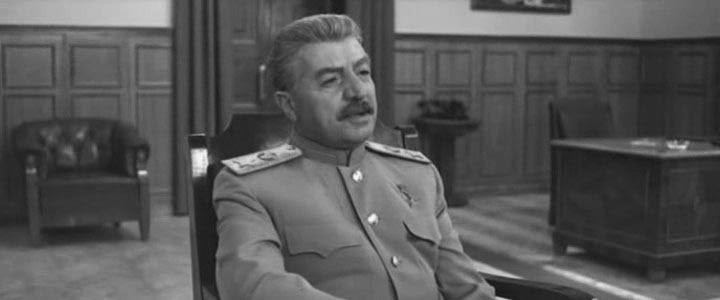
One point worthy of note is how incredibly good, particularly in terms of physiognomy, many of the 'world leader' actors are: the guys playing Hitler, Roosevelt and, most especially, Stalin, are dead-ringers. Churchill, as well as being the least sympathetically portrayed, is also the least successful face/body double. Even many of the secondary figures (generals, etc.) are close likenesses. As to the behavioural mannerisms, one feels one is dealing - especially with the perpetually ranting Hitler and the ever avuncular 'Uncle Joe' - with popular stereotypes.

The strikingly handsome Tzvetaev, played superbly by Nikolay Olyalin.

Always smiling, Valery Nosik is utterly charming as the 'tankist', Dorozhkin (left).

Throughout the five films, we follow events on a series of levels, from top brass - the world leader sequences are in black and white for some reason - to operational and strategic (with much reference to maps and explanation of manoeuvres!), down to the tactical, i.e. the sharp end, where the lowly soldier faces the storms of steel. Artilleryman Tzvetaev (Nikolay Olyalin), nurse Zoia (Larisa Golubkina), and 'tankist' Dorozhkin (Valero Nosik) as  are all very engaging. Following their fates is compelling.

Tzvetaev in combat at the front, as Kursk begins.

Having met Tzvetaev, we soon meet Zoia, a nurse.

All in all it's pretty amazing; starting at Kursk, the five component films follow the phases in which the Russians roll the Germans, all the way back to Berlin. No expense has been spared: the battlefields are huge, the materiél involved stupendous. One minor gripe is that they repeatedly dwell on this epic aspect, with lengthy fly-overs of various battle scenes. If you've seen Sergei Bondarchuk's Waterloo (or his War and Peace), you'll have seen something similar.

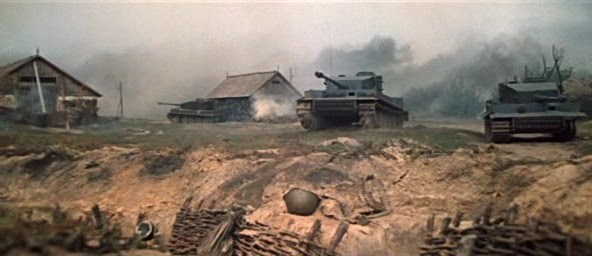
A Tiger I. Pretty good! [3]

More Tigers. Also visible, Russian T-62 tanks. Not so good! [4]

Apparently this is an IS-2, masquerading as a Panther. Pretty Poor!

Gear nuts will be both impressed to see fairly convincing faked up Tigers, and genuine German half-tracks, etc. But disappointed also, I imagine - I was - that sometimes (although captured enemy gear would be used by both belligerents) a lot more/better fakery wasn't achieved.

This was a colossal conflict, and these five films in one package represent an impressively colossal attempt to tell the Russian side of this utterly fascinating episode in recent history. Ok, it's didactic and propagandistic, but there's a lot of good acting, many characters we can genuinely take an interest in - from the groundlings to the demagogue dictators - and some incredible battles.

A T-34 charges across the battlefield.

There are lots of aerial long-shots of battles, like this.

This T-34 wants to join the air-force!

And not only does this series cover the Russian campaigns from Kursk to the capture of Berlin, but there are also numerous sub-stories, from the paratroop rescue of Mussolini, to the bomb-attempt on Hitler, or the Yalta conference, and the partisan war in Yugoslavia.

The English subtitles aren't perfect. In fact sometimes they're pretty hilarious! But having the film available in a form those of us who don't speak Russian can appreciate is terrific. Not perfect, but worth the full five balkenkreuz nevertheless.

----------
NOTES:

Hitler after the assassination attempt at the Wolf's Lair.

Bukhuti Zaqariadze's resemblance to Joseph Stalin is spooky!

[1]  This is the only German camp scene. Considering what both Germany and Russia did to themselves, each other, and the hapless civilians in the war zones, this is omission is a biggie, but not altogether surprising.

[2] For example, Churchill is portrayed as pleased that the attempt to assassinate Hitler at the Wolf's Lair fails, fearing that a success might lead to Soviet dominance of Europe.

[3] Built on a Soviet T-44, according to the (very useful) IMFDB.

[4] T-62s weren't introduced until, er... '61!

The view from a T-34 in combat at Kursk.

Clearly no expense was spared.

All those T-34s... fab!

Tzvetaev in fighting takes cover behind an SdKfz 7.

Mikhail Ulyanov as Zhukov.

Panzer attack!

Celebrating Soviet style.