Showing posts with label propaganda. Show all posts

Wednesday, 14 August 2019

Film Review: They Fought For Their Country (Они сражались за Родину), 1975


I became aware of this movie, starring and directed by Sergei Bondarchuk, of War And Peace and Waterloo fame, whilst researching a post on Road To Berlin. Folk at the Kinokultura website, a place specialising in modern Russian cinema, didn't like the latter, comparing it unfavourably with this. Hmm? Well, having watched both now, I still prefer Road To Berlin. Never take the experts at their word, I say. Always make your own mind up!

This said, it might simply be that the version I saw was fatally marred by certain things: firstly the subtitles were frequently very out of sync' with the film, and secondly, the soundtrack was appalling. It sounded as if it had been recorded entirely separately and in the studio, just as many dubbed films are. So, for example, the dubbed version of Stalingrad is, for me, unwatchable bad. Whilst the German OST transforms it into a masterpiece. 

Is there a version of this with a good/better soundtrack? If so, I'd like to see it. As it is, the disembodied ultra-flat soundscape of this version completely kills the film. Or it does for me at least. There are numerous other issues however, such as a large proportion of the key cast being 40 or 50 year olds. There may have been some old folks in the Russian army. But this gives the impression they were the backbone of the Soviet forces!

A rather nice montage, giving a flavour of the film.

And then there's the whole 'Russian Soul' thing [1]. On the one hand this is quite good, as it means much more dialogue and character based narrative than many a gung-ho action packed Hollywood style drama. And Hollywood this most definitely ain't. It's pure Russian/Kremlin. And in that latter remark I allude to a further problem, related to the leaden Russian Soul element, which is myth, or more properly in this context, propaganda.

The characterisations wobble between caricature and propaganda, only occasionally connecting with the intended humble reality of the ordinary fighting men this is clearly meant to be a homage/testimony to. This also leads to the Russians becoming like an army of philosopher saints, whilst the Germans are like Injuns in an old Western, automaton cannon fodder. From my reasonably wide reading on the Ostfront Russia was more profligate with their troops' lives than the Germans.

The action unfolds on the Don Front, which, if it's anything like it's depicted here, was a very dusty, sandy, rocky region, and takes place in 1942. The Russians are retreating, and the troops we follow are acting as a rearguard, whilst the main Russian armies retreat across the Don to regroup. The film is pretty epic in scale, something of a speciality with many Bondarchuk productions. Indeed, it's so big and long it's split into two films!

Battle scenes are pretty impressive.

Towards the end of the first film Bondarchuk's character appears to die as the German's overwhelm the Russian line, in a very implausible scene. But no, he's rescued by a female child nurse, who drags him back to the lines. An interminable hospital scene comes over almost comically, as he raves endlessly on, in long indulgent hammy monologues. If I'd been the surgeon I've either sedated the windbag or cut an artery. Anything to shut him up!

It does have some good points, however. I do like films that take their time. And this certainly does. For a war film it's very slow paced, with more character based interaction than battle scenes. But there are battle scenes, and they're quite impressive in certain respects, such as sheer scale. Lots of planes are used, some apparently even bring crashed. And large numbers of T-34s or similar masquerade reasonably well as Pz IV type tanks. 

Also the whole troops at march or in camp side of things is pretty well done, and you really get a sense of place. Indeed, the landscape is almost treated as a protagonist, as befits a film in which the country/nation/land is part of the title and subject. So, all in all? Something if a mixed bag, perhaps on account of the dubbed soundtrack. Not great, as is. But certainly worth watching.


Some more pictures:

Looks like the film was part of a 30th Anniversary commemoration.

Bondarchuk in battle.

The company's chef, post bombardment.

Vasily Shukshin as Piotr Lopakhin.

Suitably rugged and cool!


Saturday, 25 May 2019

Misc: La Bête est Morte, WWII bande-dessinée.

This morning I got an email from Bovington Tank Museum, under their 'Tank Times' banner, which had an interesting link regarding a recent book donation (read more here). This is something I'd definitely like to know more about; a bit of 'googling' lead me to unearth the following images:

Cover of the first in the two-part edition.

A scene depicting French liberation.

The German war machine invades France.

Here we see the two editions.


The artist who's supplied the illustrations, Calvo, is obviously superb. He's clearly influenced in these artworks by Disney's contemporary style. But despite this obvious indebtedness, the artworks remain fabulous in their own right. 

The British Bulldog bites Hitler's arse!

Some spreads are a series of frames...

... whilst others are fantastic double-page spreads.


At the time of posting these are in a random order, as I found them online. I'll probably return to edit this into a more sequential order at some future juncture. I've captioned the most obvious content. But there are numerous images I need to study more. I've seen originals online for crazy prices. I'm hoping that there are affordable English editions!? Perhaps it's even still in print? Does anyone know?

Churchill's Bulldog vs. Hitler the crazed Wolf!


It looks like all theatres are addressed; here we see North Africa.

Hitler, Goering and Goebbels.


As this shows, the comic doesn't pull any punches.


A small detail from a larger and superb pastiche of Delacroix.


Nazi training.


The global view.

I'll definitely be looking to acquire this. Probably in an English language version, to be honest. It looks utterly fantastic.

Tuesday, 25 September 2018

Book Review: With Hitler In The West, Heinrich Hoffman


Fascinating reprint of contemporary Third Reich blitzkrieg/Führer propaganda.

NB - Except for the cover picture, above, pretty much all the images - of the publication, that is - illustrating this review are actually from the original German version (they were easier to find online!). The Pen & Sword edition is in English.

As anyone who visits this blog will quickly find out, I'm somewhat obsessed with WWII. And particularly with the German side of things. This Pen & Sword title is basically a modestly sized reprint of a piece of early WWII German propaganda, similar in feel, right down to the snappily bombastic captions, to the materials from German magazines of the time such as 'Signal', which shared the same morale-boosting purpose.


Happy Hun: victorious 'Landser' march and sing.

Left, a prototypical Hoffman propaganda photo,
of a handsome beret-wearing tank commander.
At right, a French tanker surrenders. 

The photos are by Henirich Hoffman, and there's an intro by Keitel, one of Hitler's more fawning generals. Being propaganda, it's not an objective record. But if you know that, you can bear it in mind as you read and study the pictures. It really is fascinating for showing how positive the Germans obviously felt at this stage. And no wonder, after the eighteen day campaign in Poland, and similarly quick work in Norway and the Low-Countries.


Hitler chats with his troops as he tours the conquered territories.

Visiting WWI battlefield memorials,
a reminder of Hitler's former service,
and the roots of WWII in WWI.

Hitler in Paris; at right, visiting Napoleon's tomb.


Aside from the focus on the victorious German forces, and Hitler himself, France is the centrepiece of this presentation. And the Gallic capitulation proved to be yet another remarkably quick affair. This time against the potentially much stiffer opposition of the French army - then the largest army in western Europe - and their English allies. Interestingly the images and accompanying texts relating to French and British troops and materiél, whilst crowing over the huge graveyards of the latter, aren't as overtly jingoistic as one might have anticipated.


The back cover of an original paperback edition,
showing Allied prisoners.

Various shots, including the devastation wrought upon the French forces.

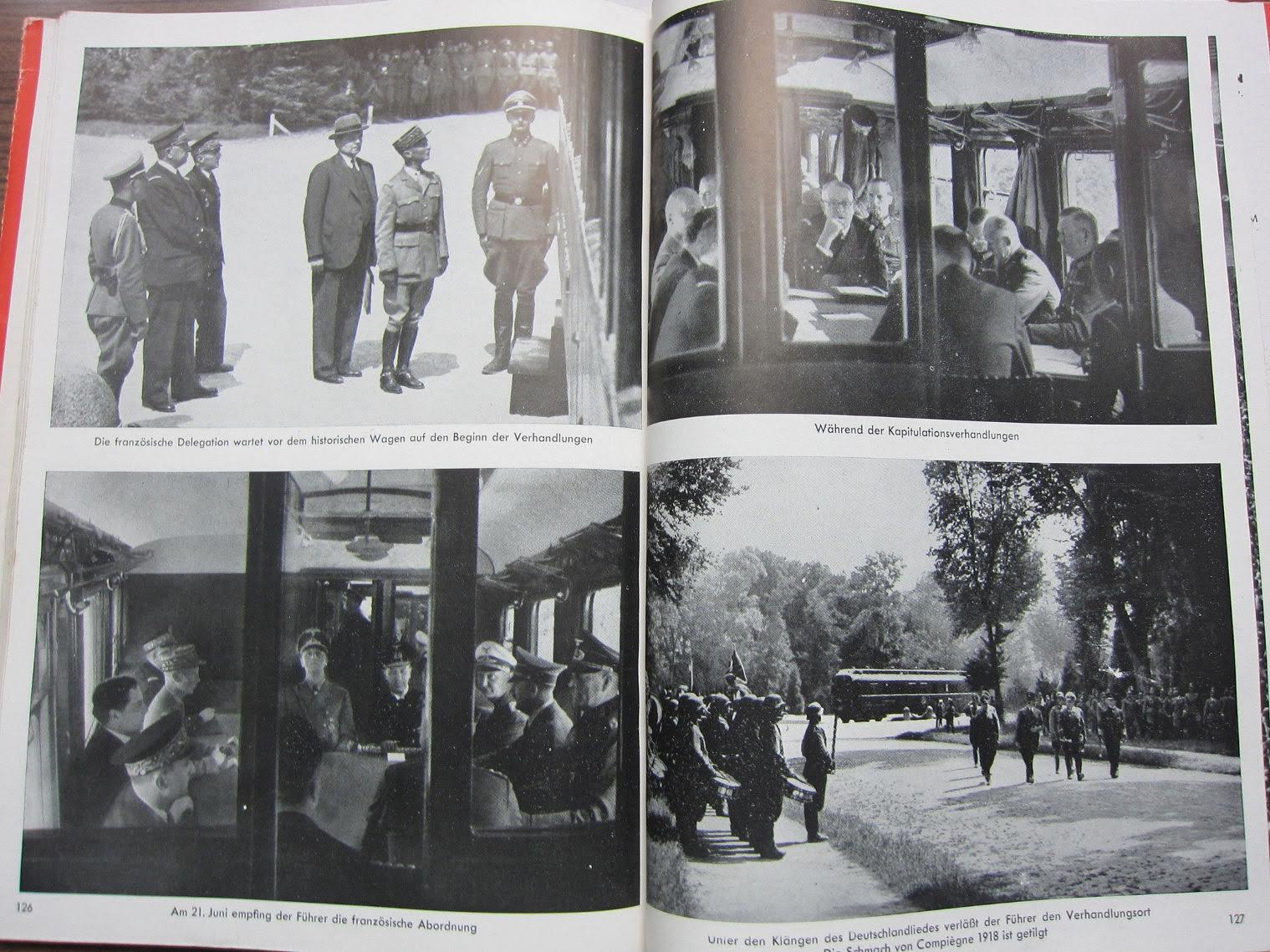
Hitler presides over the French surrender, Compeigne.


As the title makes clear, this is also about Hitler as commander in chief. So there are lots of pics of 'der Führer', including him visiting WWI battlefields and monuments, and signing the French capitulation in the famous railway carriage at Compeigne, reversing the roles of the 1918 humiliation which had played such a large part in both Hitler's personal and Germany's national myth of the 'stab in the back', which held that Germany was betrayed from within, rather than defeated from without.


The Wehrmacht in action.


Big guns!


The historical value of such a reprint is, I think, pretty strong, and quite obvious. Although given the nature of the Nazi regime it's also a vexed issue. And it's perhaps a little surprising that Pen & Sword didn't choose to add anything to the book explaining the context of it's production, and the intents for its function. For those of us fascinated by this era, in part at least, as an aspect of our mini-military hobbies, it's a visual goldmine.


All in all, a welcome and fascinating addition to the WWII obsessive's collection.


The cover of an original paperback edition.

Heinrich Hoffman.

Hoffman's Munich studio (where Hitler first met Eva Braun).


Thursday, 7 June 2018

Film Review: Dunkirk, 1958


I could swear I've already written a review of this? Still, I can't find it anywhere, so here goes... Oh, and BTW, I last watched this several years ago - I really ought to watch it again before posting this! - and this is written almost entirely from my memories of that viewing.

Mills as Cpl. 'Tubby' (?) Binns, left, and Lee as newspaperman Charles Foreman, centre.

Dickie Attenborough, at left, as John Holden, manufacturer of buckles!

The first thing to say is that I far prefer it to the 2017 Nolan film.

But it does have its faults. Two of these, which really do hurt the film for me, are John Mills' rather poor Cockney accent, and Bernard 'M' Lee's frankly poor acting, particularly at one crucial moment. Having said this, this film captures far better the 'Dunkirk Spirit', both in the panic and meltdown on the battlefront and beaches, and in the heroic/nostalgic propaganda sense that immediately grew up around this celebrated defeat.

Mills relaxes...

... filming at Camber Sands

Seascapes were often filmed indoors, at Ealing Studios!

Above are a few pictures showing how it was done, pre CGI. Beach scenes were filmed at Camber Sands, and we see Mills relaxing as the crew buzzes around, and filming with Lee. Some of the sea-scenes were filmed indoors, at the Ealing Studios, as can be seen in the bottom of these three pictures.

This film is rather quaintly old-fashioned in feel, and, in places, rather too propagandistic for my liking. That said, it's also quite dark, really. And perhaps surprisingly negative, inasmuch as it does depict confusion and pessimism, both at home and on the beaches. 

Certainly it totally outperforms the 2017 film in conveying far more sense of context, for example in contrasting the lives of those at home in Blighty, where the war was still perceived as 'phoney', with the fighting in France, a perception those at the 'sharp end' would and did hotly dispute!

Cpl. Binns is slow to accept responsibility for his small ragtag band of demoralised, disorganised men.

The 'armada' of little boats is also better evoked. And there's even the story of a young boy joining the rescue flotilla against the wishes of his elders, as reprised in the 2017 version. In this 1958 version Sean Barratt plays Frankie, Holden's young apprentice. Pop trivia fans might know/recall that The Smiths used a picture of him from the film on a record sleeve!

The older movie also does a better job with the battle for Dunkirk itself, in which Mills and his fellow soldiers are a demoralised and disorganised bunch, retreating in a haphazard manner and losing men, and certainly acting far from heroic. Which is good, as it balances the more propagandistic elements of the film somewhat.