Showing posts with label Adolf Hitler. Show all posts

Sunday, 17 March 2019

Book Review: Images of War, Hitler's HQs, Ian Baxter


N.B. This is one of those occasional archival posts I do, started ages ago, and then forgotten about. Having subsequently read and reviewed another Ian Baxter Images of War title, I thought I'd return to the unfinished draft of this and get it done and online.

Having only just read Hugh Trevor Roper's book on Hitler's last days, I picked up a copy of this book cheap (I believe I paid £5), at a model show, some while back. If I'd paid the full retail asking price, I'd have been a bit miffed, for several reasons. So let's get the critical stuff out of the way.

The first thing that struck me was how many pictures here aren't of the subject, but are just general WWII German stuff, only very tenuously connected to the books subject, if at all. That was after a first glance through the pictures. The second was the catalogue of typos, lumpen prose, and even captioning mistakes, when I came to read the text. There are, sadly, times when specialist literature such as this seems to slip through the editorial net. One does have to wonder, in an instance such as this, if an editor even looked at it.


Hitler sitting outside/beside his train, Amerika.

Nice colour photo of Amerika, showing the loco' and a flak carriage.

On the positive side, there is a good deal of info here on Hitlers numerous HQ, including a number of decent pictures, and this is a very fascinating topic. As well as the static installations, Hitler's trains are covered (although more and better info on this latter would've been good). Another plus is the then and now contrast, where the author shows some more recent images of what's become of some of these installations. Sadly, and creating historical lacunae, due to the toxicity of Hitler's racial/ideological policies, these fascinating and historically important sites are not being conserved (for fear they'd become celebrated/shrines to the Führer, etc.), in fact quite the reverse.

Personally speaking, I think this instalment of the often very good Images of War series needs re-doing: editorially it needs correcting and tightening up, and pictorially it needs to be 'on topic' in a more focussed way. Plans of the various HQ, for example - surely they must exist? - would be a good addition.


Hitler and staff at Wulfschanze, East Prussia.

This arrival scene shows how heavily wooded the Wolf's Lair was.

Bombed out remains at Obersalzberg, in the Bavarian Alps, 1945.


Baxter includes some of his own pictures, similar to the one above, showing Wolfschanze as it is now. The installations were gutted, dynamited, and left to be reclaimed by nature.

Tuesday, 25 September 2018

Book Review: With Hitler In The West, Heinrich Hoffman


Fascinating reprint of contemporary Third Reich blitzkrieg/Führer propaganda.

NB - Except for the cover picture, above, pretty much all the images - of the publication, that is - illustrating this review are actually from the original German version (they were easier to find online!). The Pen & Sword edition is in English.

As anyone who visits this blog will quickly find out, I'm somewhat obsessed with WWII. And particularly with the German side of things. This Pen & Sword title is basically a modestly sized reprint of a piece of early WWII German propaganda, similar in feel, right down to the snappily bombastic captions, to the materials from German magazines of the time such as 'Signal', which shared the same morale-boosting purpose.


Happy Hun: victorious 'Landser' march and sing.

Left, a prototypical Hoffman propaganda photo,
of a handsome beret-wearing tank commander.
At right, a French tanker surrenders. 

The photos are by Henirich Hoffman, and there's an intro by Keitel, one of Hitler's more fawning generals. Being propaganda, it's not an objective record. But if you know that, you can bear it in mind as you read and study the pictures. It really is fascinating for showing how positive the Germans obviously felt at this stage. And no wonder, after the eighteen day campaign in Poland, and similarly quick work in Norway and the Low-Countries.


Hitler chats with his troops as he tours the conquered territories.

Visiting WWI battlefield memorials,
a reminder of Hitler's former service,
and the roots of WWII in WWI.

Hitler in Paris; at right, visiting Napoleon's tomb.


Aside from the focus on the victorious German forces, and Hitler himself, France is the centrepiece of this presentation. And the Gallic capitulation proved to be yet another remarkably quick affair. This time against the potentially much stiffer opposition of the French army - then the largest army in western Europe - and their English allies. Interestingly the images and accompanying texts relating to French and British troops and materiél, whilst crowing over the huge graveyards of the latter, aren't as overtly jingoistic as one might have anticipated.


The back cover of an original paperback edition,
showing Allied prisoners.

Various shots, including the devastation wrought upon the French forces.

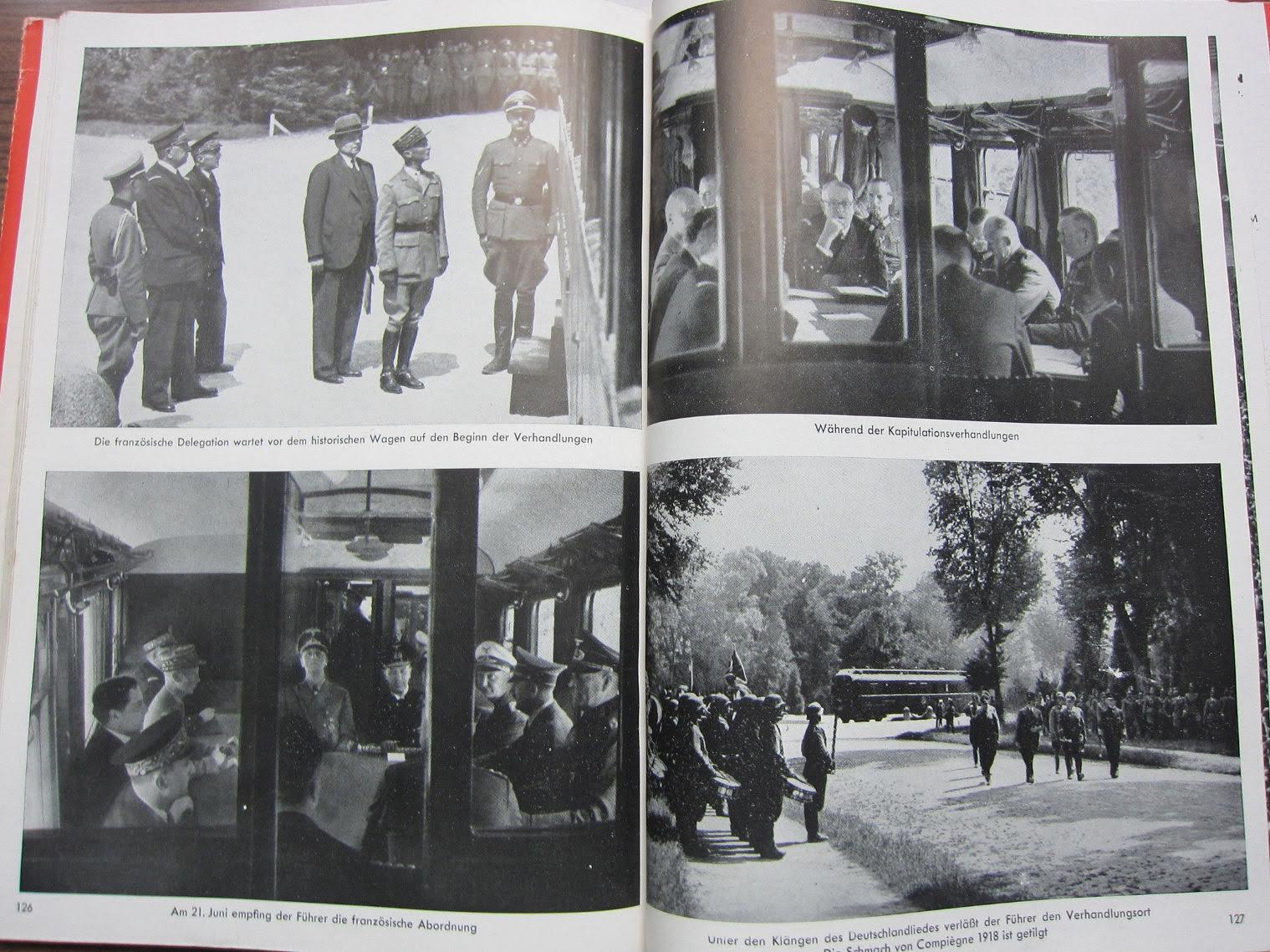
Hitler presides over the French surrender, Compeigne.


As the title makes clear, this is also about Hitler as commander in chief. So there are lots of pics of 'der Führer', including him visiting WWI battlefields and monuments, and signing the French capitulation in the famous railway carriage at Compeigne, reversing the roles of the 1918 humiliation which had played such a large part in both Hitler's personal and Germany's national myth of the 'stab in the back', which held that Germany was betrayed from within, rather than defeated from without.


The Wehrmacht in action.


Big guns!


The historical value of such a reprint is, I think, pretty strong, and quite obvious. Although given the nature of the Nazi regime it's also a vexed issue. And it's perhaps a little surprising that Pen & Sword didn't choose to add anything to the book explaining the context of it's production, and the intents for its function. For those of us fascinated by this era, in part at least, as an aspect of our mini-military hobbies, it's a visual goldmine.


All in all, a welcome and fascinating addition to the WWII obsessive's collection.


The cover of an original paperback edition.

Heinrich Hoffman.

Hoffman's Munich studio (where Hitler first met Eva Braun).


Monday, 16 January 2017

Book Review: The Last Days of Hitler - Hugh Trevor-Roper

This is the edition I have.


Hugh Trevor-Roper's reputation as an expert on Hitler took a knock when, as Lord Dacre (he was made a life peer by Margaret Thatcher) he appeared to endorse the forged 'Hitler Diaries', which were actually the work of a certain Konrad Kujau. This whole farrago is the subject of the very interesting and entertaining British TV series Selling Hitler.

Oops! Hugh endorses the fake Hitler diaries.

Trevor-Roper in his Army Intelligence togs.

But way back in 1945 Trevor-Roper, as a British military intelligence agent, was commissioned, largely in response to Russian (or rather Stalinist) myth-mongering, to get to the bottom of what really happened to Hitler. After stating the facts pretty much as they were, Stalinist Russia was looking to exploit Hitler's downfall, and began to take the line that the Western powers were keeping the former Fürher in captivity, for some darkly malevolent bourgeois purposes. [1]

Trevor-Roper's task was to marshal all available intelligence - and he had access not just to documents, but surviving captive participants - and tell the sorry tale of Hitler's ultimate demise, in the Götterdammerung of the collapse and, as it transpired, the literal self-immolation of the supposed thousand year Reich. Such a 'Viking funeral', as he describes it, 'is the natural end of a chapter in history; the history, it seems, of a savage tribe and a primitive superstition.'

Hitler Youth jump over a Solstice bonfire. [2]

Torches at Nuremburg. [2]

I've read The Last Days of Hitler twice now, and thoroughly enjoyed the read on both occasions. Trevor-Roper is not just knowledgeable on his subject, but he is also a very entertaining and adroit writer. He's as witty as he is well-informed. Indeed, his wit can be quite caustic. The subject - words like enjoyable and entertaining seem almost blasphemous in the face of the horrors this coterie of sinister clowns were responsible for - is not an easy or straightforward one. But he handles it about as adroitly as one could hope for.

Having said this, I'm withholding half a balkenkreuz for his indulgence in his own shorthand characterisations, which in some instances (see below) don't just border on, but march in and annexe, caricature. Another theme that might not stand too much scrutiny - and something that he shares with Kenneth Clarke in his magnificent series Civilisation - is his characterisation the Germans themselves, and Southern Germans in particular - in a way that does smack of the same kind of oversimplification of racial/tribal (stereo-)types that the Nazis so obviously took too far.

Hitler originally decreed that this man, Herman Goering, should be his successor. [3]

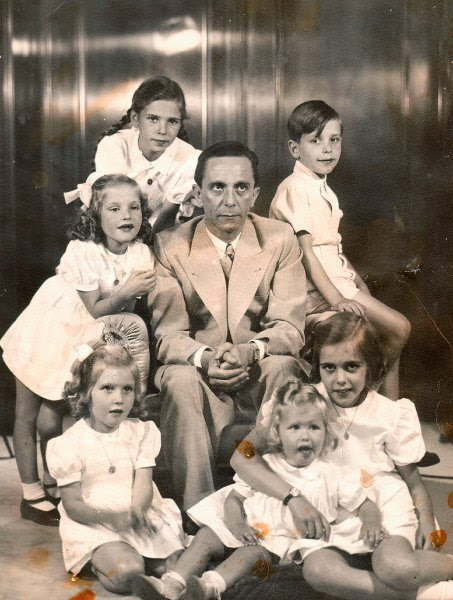
Goebbels, the family man.

Despite these provisos, the portraits that emerge are very compelling: Hitler himself is deemed to powerfully support the 'great man' idea, inasmuch as it was his dark charisma (to use a more modern historian's term) that was the catalyst for the terrible events of these years. Even isolated in the Berlin bunker, his word was Holy Writ. And indeed, he could even command from beyond the grave, as witness the performances of many of his former cronies, at Nuremburg.

In the Byzantine labyrinthine internecine world of Nazi power-politics, Himmler built the SS Empire. 

Bormann, the omnipresent intriguer, always at Hitler's elbow.

Himmler and Bormann both emerge as strange nonentities, able to rise to enormous power purely as ciphers or channels for the dark lord's will. When he goes, they effectively cease to exist. Some characters are portrayed as outright buffoons, like Schwerin von Krosigk, or Schellenburg, whilst others, Goebbels and Speer in particular, have rather more to them. But all depend on and breath the bizarre 'metaphysical' air of Nazism.

Hitler outside the bunker, 1945. [4]

And in the cramped isolation of the bunker, it's a stifling gaseous aura of neurosis, as euphoric dreams persist, and alternate, like the stormy weather of Hitler's volatile emotional character, with the bleakly nihilistic gloom that is, for Trevor-Roper, the core and lasting testimony of Hitler's fundamentally negative ideology.

Oberwallstrasse, near the bunker, as it looked after the fall of Berlin, 1945.

As Trevor-Roper points out, Hitler understood the power of myth. And whilst this book is an attempt to put the lid on the dangerous genie of Nazism, 'myths are not like truths; they are the triumph of credulity over evidence.' And, lest we get too smug, he adds 'When we consider upon what ludicrous evidence the most preposterous beliefs have been easily, and by millions, entertained, we may well hesitate before pronouncing anything incredible.'

Inside the bunker, at the end.

US press examine the grave Hitler and Braun were cremated in. [5]

----------
NOTES:

[1] Whilst publicly proclaiming such balderdash, Stalin's agents were in fact compiling a huge dossier on Hitler, which became a 'book' of sorts, expressly put together for Stalin to digest. It's subsequently been published in English as The Hitler Book.

[2] I include these pictures to evoke the pagan ceremony aspect of Nazism, as also suggested in Trevor-Roper's 'Viking Funeral' statement. There are some pictures on the web purporting to show the burnt corpses of Herr and Frau Goebbels, and their six children. But in the interests of keeping this a family friendly blog, I refrained from including them.

[3] But by the time of the period this book covers, Goering had long since ceased to be either a favoured or a credible successor.

[4] Pictures of Hitler in 1945 seem to be quite a rarity. This one is allegedly a photo of an event depicted in the film Downfall, in which Hitler decorated a number of Hitler Youth, in the Chancellery garden, just outside the bunker. The cover image of the Pan edition I have might also have been taken at this same event.

[4] The Russians, first on the scene as they were, told these guys that this was where they'd found the burned remains that they believed to be Hitler and his wife.

Monday, 20 June 2016

Film Review: The Desert Fox, 1951

An older more dramatic poster for the film. As misleading in its visual content as the film's title!

A more contemporary DVD cover (same as mine). Less dramatic, but more in keeping with the content.


This is an odd film. For starters, the title is misleading. Only a very small portion of the movie is set in North Africa, where Rommel got his nickname of 'Desert Fox'. Most of the story unfolds in Europe, during the defence of France after D-Day.

James Mason is excellent in the title role, portraying Rommel as a suave, gentlemanly professional soldier. Also worthy of note is Leo G. Carroll, as von Rundstedt, who also portrays his character in a light many modern viewers might find surprisingly sympathetic.

The film is based on the literary and historical detective work of Desmond Young, who also portrays himself in a cameo role in the film, as a prisoner of war who gets a glimpse of Rommel at one point, and believes he owes his life to him. I won't go into the details, as I don't want to spoil it for those who haven't seen it.

Young's glimpse of Rommel.

Author Young appears in the film as himself.

One of the more striking cover designs for Young's biography.

Young became intrigued by the mystery surrounding Rommel's demise, and decided to investigate, which eventually lead to the publication of a book, and this film is built upon that book. The film itself starts with a brief depiction of Operation Flipper, a 1941 commando raid, the purpose of which was Rommel's assassination. [1]

One of several instances where footage shot for the movie is either superimposed over or intercut with stock newsreel footage from the war itself.

Most of the combat portions of the film, save only a flashback coda at the end, utilise real WWII footage, which, whilst adding authenticity, looks a bit weird to the modern eye. This was in fact quite a common practice at the time. But here it's handled a little heavy-handedly, in my view, with the result that it makes the transitions between such segments a bit clunky, and disruptive of the narrative flow of the dramatic element of the film.

Like so much to do with the war, and perhaps especially to do with Hitler and Nazism, much relating to the 'facts' are still hotly debated, and parts of the scenario this film is predicated on are contested, of particular relevance being the issue of whether Rommel was involved in the 20th July bomb-plot. This event, when Stauffenberg succeeded in placing a suitcase bomb in the 'Wolf's Lair', is depicted in a scene in the film.

Luther Adler as Hitler, giving Rommel a stern pep talk.

This scene is cut from the version I watched, but it's content is alluded to.

This is a good point at which to note that Luther Adler's portrayal of the Führer is pretty convincing, even in its very melodrama. [2] There's a very interesting scene - whether such a scene took place in real life I don't know - where Rommel meets Hitler, and attempts to make him see reason regarding the situation on the crumbling western front. Hitler continues to place his apparently unshakeable faith in himself, and the new V-weapons. It's a fascinating scene.

It was widely believed at the time that Rommel died of wounds received when his staff car was strafed. This film portrays a very different end to the general's career. I will, not wanting to spoil it, leave it here without giving too much away. What I will say is that this film's dramatic power crystallises around the ending, and is quite moving.

Von Rundstedt (Carroll) and Rommel (Mason).

Mason and his subject.

Interestingly it appears that Young's desire to clarify the story of Rommel has, in the longer term, failed. The 'Rommel myth', something this film is credited as being a key contributor towards, remains contested. It's also said of this film that it helped contribute to reconciliation between former enemies, by depicting some Germans as 'worthy foe', as opposed to caricature Krauts, Huns, Bosch, or whatever.

The Desert Fox doesn't explain why Rommel had such a good reputation as a general, that's taken as written, and pertains to a period prior to that covered in this biopic. What it does give is a portrait of the human side of a man struggling with his professional duties and his conscience, in a very tricky and unenviable position. And it's in respect of that theme that the film is most interesting and successful, whatever its relation to the truth of the events depicted.

Rommel with his wife and son.

Saying goodbye to his son in the movie.

----------
NOTES:

[1] Movie trivia fans might be interested to note that the commando raid is lead by Dan O'Herlihy, in an uncredited role. O'Herlihy is better known to me as General Ney, in Bondarchuk's Waterloo.

[2] Adler, an American actor, played Hitler twice; here and in a film called The Magic Face, also, coincidentally, filmed in '51. Adler's name sounds both strikingly Germanic, and yet totally Jewish. And he was indeed Jewish, performing in both Englsh and Yiddish, and best remembered in the US for his Broadway appearances in Fiddler On The Roof!