Showing posts with label Berlin. Show all posts

Thursday, 27 September 2018

Film Review: A Time To Love & A Time To Die, 1958


A Time To Love And A Time To Die is one of a very small group of American films made during the 1950s, i.e. only very shortly after WWII itself, that explore the human side of the German experience of that epic conflict.

The only other similar film, in this particular respect, that I've seen thus far is Decision Before Dawn. The latter is a black and white movie, as much espionsge thriller as war film, set on the Western and Home Fronts, whereas A Time To Love is more melodrama and romance, is set on the Eastern and Home Fronts, and is in bright Technicolour.


Those groovy old lobby cards...
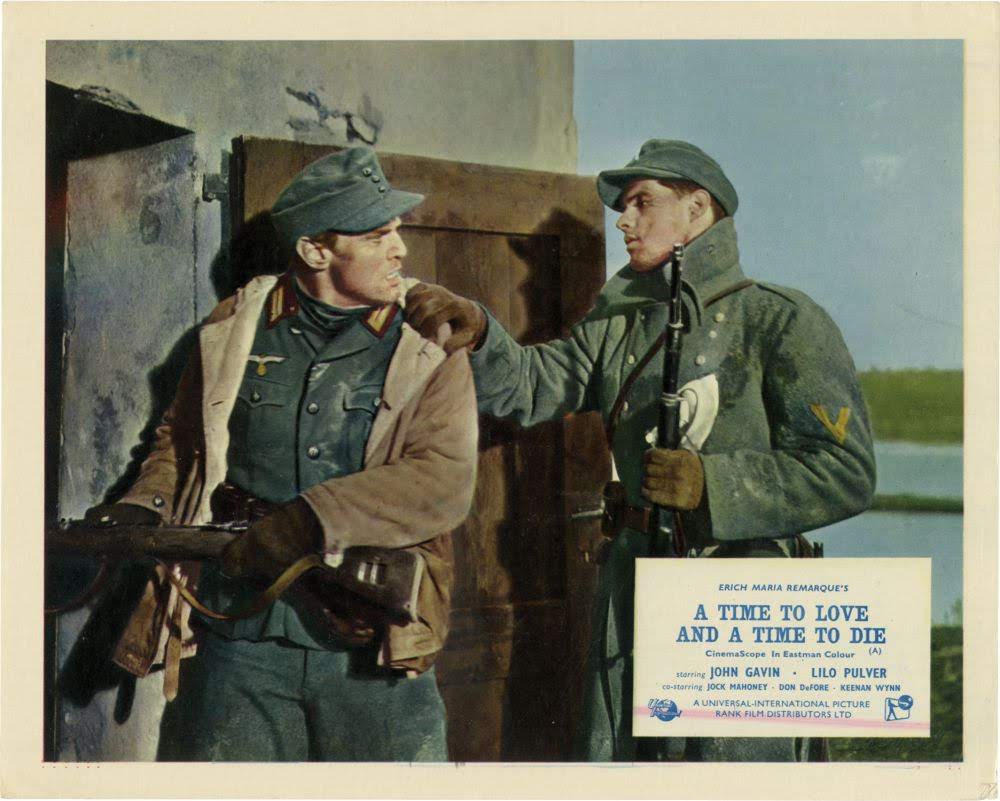
... have a certain period charm...

... don'tcha think?

Both depict decent young Germans as central characters, and both find these men back in Germany, struggling to reconcile their consciences with their roles in the war, and their relationships to the Fatherland and it's peoples. This film is based on a book of the same name by German author Erich Maria Remarcque (of All Quiet On The Western Front fame*), and director Douglas Sirk was himself also of German extraction, so it has a personal resonance for two of the key figures behind it.


A somber looking version of the book.

An earthier pulpier interpretation.

Despite their roles in the making of the film, which one hopes bring some authenticity to it, I found the choice of male lead, Frank Gavin, who plays German soldier Ernst Graeber, rather problematic. Decision Before Dawn's Oscar Werner was both actually German, and an excellent actor, making for a very convincing character. I found Gavin too hammy and all-American (he's actually of Hispanic/Latin-American extraction) to be very plausible. I was more than half expecting him to blurt out, 'Gee, ain't the Fatherland swell, baby!' at some point.

Having said this, both films explore in different ways the moral compromises and complexities facing basically decent young men fighting on behalf of a toxic ideology. In Sirk's movie this theme ought perhaps to feel even more central, inasmuch as the film starts and ends in that infernal crucible of the Nazi quest for 'lebensraum' (a horrifically ironic misnomer, as it transpired, in that it was always as much charnel-house as living space), the Eastern or Russian Front.


Gavin, good looking? Unquestionably. Charismatic? Possibly. Germanic? Nope.

Gavin and his love-bird, Lisalotte Pulver.

It's really only the poignancy of this thread that prevents this film from being somewhat cornball, thanks to the rather hammy home-front roles of several chief actors, including Gavin himself, and his female opposite lead and love-interest, Lisalotte Pulver, a Swiss actress who was at least a star of German cinema of that era.

Amidst the ruins of the German homeland we see how civilians cope or go under, and the paranoia of the regime is evoked (the nosey conformist 'house-frau' is suitably repellent). We even meet a Jew in hiding, who's temporarily sheltered by Professor Pohl, played by Erich Maria Remarque himself, whose conscientious behaviour has predictable results.


There's not much Ostfront war footage...

... but what little there is...

... is pretty good.

The ending is sad but predictable, and whilst it helps make one of the films central points, about the senseless waste of war (another thing it has in common with Decision Before Dawn), it still feels less convincing or weighty than perhaps it wants to.

When the credits rolled I must confess I felt somewhat disappointed by this film, especially as it's packaged and marketed by Eureka as part of their Masters of Cinema line, and would have given it just three balkenkreuz. However, in the course of writing this review I begin to think that, whilst Sirk's melodramatic style and the Yankee-doodle feel of some of the acting seem at odds with the subject, it is an interesting if uneven film, and worth watching.

Graeber is a principled grunt, going back to the front...

... whilst others play a morally looser game.

* As a result this film was sometimes referred to as All Quiet On The Eastern Front

PS - In addition to the author making a cameo, it's interesting that Klaus Kinski also has cameos in both Decision Before Dawn and this film.

Monday, 16 January 2017

Book Review: The Last Days of Hitler - Hugh Trevor-Roper

This is the edition I have.


Hugh Trevor-Roper's reputation as an expert on Hitler took a knock when, as Lord Dacre (he was made a life peer by Margaret Thatcher) he appeared to endorse the forged 'Hitler Diaries', which were actually the work of a certain Konrad Kujau. This whole farrago is the subject of the very interesting and entertaining British TV series Selling Hitler.

Oops! Hugh endorses the fake Hitler diaries.

Trevor-Roper in his Army Intelligence togs.

But way back in 1945 Trevor-Roper, as a British military intelligence agent, was commissioned, largely in response to Russian (or rather Stalinist) myth-mongering, to get to the bottom of what really happened to Hitler. After stating the facts pretty much as they were, Stalinist Russia was looking to exploit Hitler's downfall, and began to take the line that the Western powers were keeping the former Fürher in captivity, for some darkly malevolent bourgeois purposes. [1]

Trevor-Roper's task was to marshal all available intelligence - and he had access not just to documents, but surviving captive participants - and tell the sorry tale of Hitler's ultimate demise, in the Götterdammerung of the collapse and, as it transpired, the literal self-immolation of the supposed thousand year Reich. Such a 'Viking funeral', as he describes it, 'is the natural end of a chapter in history; the history, it seems, of a savage tribe and a primitive superstition.'

Hitler Youth jump over a Solstice bonfire. [2]

Torches at Nuremburg. [2]

I've read The Last Days of Hitler twice now, and thoroughly enjoyed the read on both occasions. Trevor-Roper is not just knowledgeable on his subject, but he is also a very entertaining and adroit writer. He's as witty as he is well-informed. Indeed, his wit can be quite caustic. The subject - words like enjoyable and entertaining seem almost blasphemous in the face of the horrors this coterie of sinister clowns were responsible for - is not an easy or straightforward one. But he handles it about as adroitly as one could hope for.

Having said this, I'm withholding half a balkenkreuz for his indulgence in his own shorthand characterisations, which in some instances (see below) don't just border on, but march in and annexe, caricature. Another theme that might not stand too much scrutiny - and something that he shares with Kenneth Clarke in his magnificent series Civilisation - is his characterisation the Germans themselves, and Southern Germans in particular - in a way that does smack of the same kind of oversimplification of racial/tribal (stereo-)types that the Nazis so obviously took too far.

Hitler originally decreed that this man, Herman Goering, should be his successor. [3]

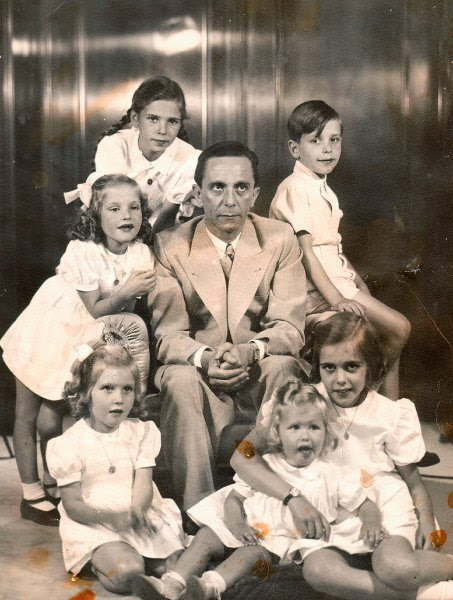
Goebbels, the family man.

Despite these provisos, the portraits that emerge are very compelling: Hitler himself is deemed to powerfully support the 'great man' idea, inasmuch as it was his dark charisma (to use a more modern historian's term) that was the catalyst for the terrible events of these years. Even isolated in the Berlin bunker, his word was Holy Writ. And indeed, he could even command from beyond the grave, as witness the performances of many of his former cronies, at Nuremburg.

In the Byzantine labyrinthine internecine world of Nazi power-politics, Himmler built the SS Empire. 

Bormann, the omnipresent intriguer, always at Hitler's elbow.

Himmler and Bormann both emerge as strange nonentities, able to rise to enormous power purely as ciphers or channels for the dark lord's will. When he goes, they effectively cease to exist. Some characters are portrayed as outright buffoons, like Schwerin von Krosigk, or Schellenburg, whilst others, Goebbels and Speer in particular, have rather more to them. But all depend on and breath the bizarre 'metaphysical' air of Nazism.

Hitler outside the bunker, 1945. [4]

And in the cramped isolation of the bunker, it's a stifling gaseous aura of neurosis, as euphoric dreams persist, and alternate, like the stormy weather of Hitler's volatile emotional character, with the bleakly nihilistic gloom that is, for Trevor-Roper, the core and lasting testimony of Hitler's fundamentally negative ideology.

Oberwallstrasse, near the bunker, as it looked after the fall of Berlin, 1945.

As Trevor-Roper points out, Hitler understood the power of myth. And whilst this book is an attempt to put the lid on the dangerous genie of Nazism, 'myths are not like truths; they are the triumph of credulity over evidence.' And, lest we get too smug, he adds 'When we consider upon what ludicrous evidence the most preposterous beliefs have been easily, and by millions, entertained, we may well hesitate before pronouncing anything incredible.'

Inside the bunker, at the end.

US press examine the grave Hitler and Braun were cremated in. [5]

----------
NOTES:

[1] Whilst publicly proclaiming such balderdash, Stalin's agents were in fact compiling a huge dossier on Hitler, which became a 'book' of sorts, expressly put together for Stalin to digest. It's subsequently been published in English as The Hitler Book.

[2] I include these pictures to evoke the pagan ceremony aspect of Nazism, as also suggested in Trevor-Roper's 'Viking Funeral' statement. There are some pictures on the web purporting to show the burnt corpses of Herr and Frau Goebbels, and their six children. But in the interests of keeping this a family friendly blog, I refrained from including them.

[3] But by the time of the period this book covers, Goering had long since ceased to be either a favoured or a credible successor.

[4] Pictures of Hitler in 1945 seem to be quite a rarity. This one is allegedly a photo of an event depicted in the film Downfall, in which Hitler decorated a number of Hitler Youth, in the Chancellery garden, just outside the bunker. The cover image of the Pan edition I have might also have been taken at this same event.

[4] The Russians, first on the scene as they were, told these guys that this was where they'd found the burned remains that they believed to be Hitler and his wife.