Showing posts with label Pacific. Show all posts

Friday, 25 October 2019

Book Review: Japan Triumphant, 1941-42, Philip Jowett


I was a little surprised and somewhat disappointed that this was such a broad account, as the title lead me to expect a more Japanese focus.

But having now gone through the entire book that looks as much a virtue as a failing; stuff is included here that's often passed over more or less completely, such as the Dutch involvement in this theatre. Still, the eye-catching title and cover image are rather misleading, in my view. And the subtitle, The Far East Campaign 1941-1942 actually better conveys the content.

The whole Pacific theatre, whether it be the US island-hopping to Japan, or the more mixed Allied fighting in the Asian archipelago, is one I'm less au fait with than the NW European or Ostfront theatres. This is a very solid account by Jowett, amply illustrated, as befits the Images of War series. I felt I learned a lot. A very useful resource.

Wednesday, 23 October 2019

Film Review: Flat Top, 1952


Reading John Grehan's Battle of Midway got me very interested in USN aircraft carriers. I tried to find a WWII movie on the subject, and discovered Flat Top. Made in 1952, and starring Sterling Hayden, an actor I really dig, whilst in truth not a classic film, it is pretty much exactly what I wanted.

Sterling Hayden, a man's man in a man's world!

Great footage of USN carrier operations.

What I was looking for was a film that would show aspects of the operational and tactical life of such a vessel, and her crew. And Flat Top, whilst a bit thin and, pardon the pun, flat as a drama or character study - the drama is okay, but the characters are rather 2-D and clichéd - clearly takes pleasure in showing the multifarious aspects of life and operations aboard a WWII USN aircraft carrier.

The entire film is one long flashback, as Hayden's Cmdr. Dan Collier character recalls his WWII service aboard the same carrier in which we find him, which starts with his being given command of a new batch of raw recruit pilots. The well-worn cliché of the by-the-book hardass who ultimately comes to be loved by his men is then played out over a series of scenarios. 

Heavy use is made of real WWII stock combat footage, both of fleet activity and even more so aerial combat. The contrast of the gung-ho mirth of the pilots with the anonymous Japs being so easily and merrily dispatched is a bit disconcerting. Indeed, the enemy remains an abstracted nonentity until quite late in the film, when we start to occasionally see the human cost to both sides.

Several sequences, such as this one ...

... show how the arrestor wires work.

I suppose this was a propagandist movie, made  as it was during the Korean War, the opening scene showing jets landing on the carrier. In that respect it is a bit cornball. But what I like about the film is seeing operational stuff, like the maintenance and fuelling/arming of planes, above and below decks. Take offs and landings (the latter showing arrestor wires in use), with 'ground crew' at work, and the inter-deck elevators in action.

There's quite a lot of footage like this...

showing deck crew servicing planes...

... loading various armaments, etc.

We also see how the officers and men live, the former in their own private but box-like quarters, the latter in dorms full of bunks. There are meals in the mess, pilot briefings (in surprisingly large/luxurious looking chairs!), and red-lit acclimatisation for night combat/flying.

Below deck crew follow the action in an ops room type setting.

One of the more timeworn themes is that old chestnut of individual vs. group. This is less grating than the wafer-thin characterisations of the protagonists - a election of Everyman types, from jocks to poets, musicians to lawyers, etc. - and is, in this film as in life, difficult to square/resolve. Hayden's character does so in no uncertain terms. His immediate subordinate has a softer approach (albeit eventually conceding he's 100% wrong!). The overt message here is 'it's the team that wins'. But a certain amount of rugged individualism does sneak in.

So, not a great film, by any means, frankly. But certainly well worth watching if you're fascinated by the maritime and airborne aspects of the war in the Pacific.

One of the few glimpses we get of the Japanese enemy.

Friday, 11 October 2019

Book Review: Battle of Midway, John Grehan (Images of War)


This is an excellent book. Well written, with a great selection of photographs. Although I'm more interested in WWII in Europe by and large, I found this a fascinating and compelling read.

For someone, like me, with a very limited and sketchy knowledge of the War in the Pacific, this is pitched perfectly, giving enough info to stimulate deeper interest, but not so much as to overwhelm. And the clear and concise text is brought to life by the images, which cover the whole event in an admirably comprehensive and evenly balanced way.

Should I revisit the '76 movie?

Materiel and personnel of both sides are shown, as are all the major events. Learning more about such famous events as the destruction of USS Yorktown was fascinating. Having read this I feel the urge to re-watch the classic old 1976 Midway movie. And maybe to even take a chance on the more recent film?*

* Due out in the UK in early November.


Tuesday, 12 February 2019

Book Review - Images of War: M7 Priest, David Doyle


I'm beginning to gather a reasonable collection of these Images of War titles. When I bought Sherman Tank, by Gavin Birch, to support my concurrent 1/72 kit builds, I was a bit disappointed , as it was mostly Shermans in British service (which the title didn't make clear), and whilst the images were okay, the text was less so.

This time around I got the book first and, loving it, then went out and bought a couple of kits. First off, this is a better put together book anyway, being better written, very clearly, simply and well structured, and appropriately (not to mention copiously/richly!) illustrated. As befits a title from a series called Images of War, the pictures are fabulous.

M7 firing on German positions near Ribeauville, on the Rhine, France, Dec' '44.

Carentan, France, 1944.

The text and images start with a written introduction to the subject, followed by pictures and history of the first trial type (a model of which I intend to build, based on the superb visual ref contained herein). Words and imagery then move through the various production models/variants, based around the various orders placed by the US military with several contractors, before moving to descriptions, written and photographic, of the M7 in the field.

The M7 saw service in North Africa, Italy, the Invasion of Europe and the Pacific, and there is excellent material here from all theatres. There's one rear-view pic of a British mortar carrying variant, and mention of the Kangaroo personnel-carrier type, but no. pics of the latter. The Priest's development and deployment by the US continued into the Korean War, in the early '50s, which Doyle covers. 

An M7 in Luzon, The Phillipines, June, '45.

A nice colour pic from '43, showing a Priest firing during training.

As well as a few WWII colour pics there are a generous selection of crisp full colour photos of surviving examples, adding to the already rich arsenal of visual reference. The evolution of this vehicle is superbly and compellingly communicated. This has, quite unexpectedly (as I generally favour German WWII stuff) become my favourite title, thus far, in the Images of War series.

I liked it so much I immediately went out and bought a couple of Revell 1/76 kits of the M7 Priest, from a friendly local model seller. 

Okinawa, May, 1945. Note the spare track used as armour.

M7 Priest dug in, to achieve higher gun elevation, Kleinblittersdorf, Germany, Dec. '44.

---------------
 More Pics!

This is not David Doyle's first book on this subject. Pictured below is the cover of a Squadron Signal publication he did on the same subject.

A previous publication by Doyle on the same topic.

As mentioned above, I enjoyed this so much I went out and bought some models, and during research for my model and this review, I came upon a load more pics not used in the books, some of which come from the same series of pics used here.


Preparing artillery rounds for firing.

Inside the fighting compartment.

Disembarking a Priest from a landing craft.


Hosing down the vehicle.

Nice view of the manned machine gun.

Bogged down in mud.


What are these doodads?

This appears to be a still from a colour film of an M7 Priest.

A nice view of a Priest's driver.

The Priest featured in Life magazine.

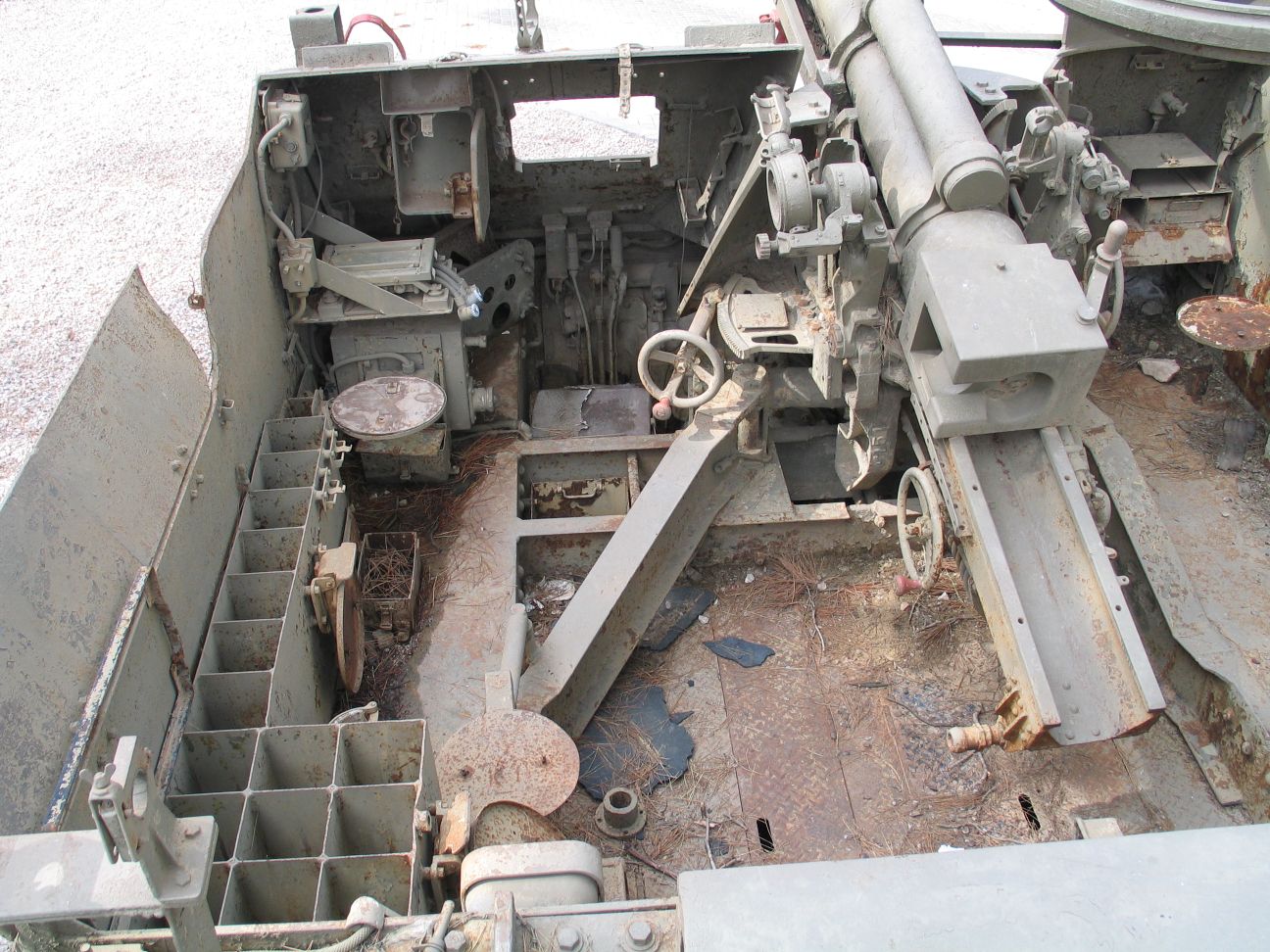
Contemporary photo of a surviving M7 Priest's interior.


Amphibious training in California.

An M7 Priest alongside a recovery vehicle.

A Priest being serviced during firing.

In Action in Italy.


Wednesday, 20 June 2018

Film Review: Hacksaw Ridge, 2017


Mel Gibson returns - or comes in from the cold, you might say [1] - with a film that revisits his twin obsessions, Christian faith and bloody gore. Remember his Passion Of The Christ? Well, this is obviously rather different, but Christian faith and ultra-violence are just two of the themes these films share.

The movie as 'true story' is a long favoured formula, and perhaps never more so than in the war genre, with WWII having spawned huge amounts of films 'based on real events'. How close such films steer to the truth, insofar as we can know it, is a moot point. Step forward Gibson's own depiction of William Wallace in Braveheart, as exhibit A.

The real life Desmond Doss.


Hacksaw Ridge tells the tale of conscientious objector Desmond Doss, pictured above, who wanted to serve his country in time of war, but without compromising his religious beliefs, specifically 'thou shalt not kill'.

Doss' story certainly makes for a gripping film in Gibson's capable hands. By turns both homely and epic, it is also certainly hugely cathartic, in its depiction of the triumph of one man's convictions in the face of both the psychological and institutional opposition of his own army on the one hand, and the physical weapons and soldiery of the 'banzai' era Japanese Imperial enemy on the other.

Ironically, perhaps, in the light of director Gibson's statements, re this film being about real heroes, as opposed to spandex-clad superheroes, Andrew Garfield, who plays Doss, achieved super-stardom as just such a superhero, Spider-Man! But in this role Garfield overcomes his pretty boy Hollywood star status to deliver a very involving and moving performance.


Garfield is very convincing in the role of Doss.


Hugo Weaving* depresses everyone with his grim WWI reminiscences.

Hugo Weaving is great as Doss' damaged WWI-vet father, and Teresa Palmer [3] is fine (in every sense) as his sweetheart and war-bride. Indeed, there are strong performances from all concerned. Until seeing this film I always found Vince Vaughan too one-dimensionally macho. He's cast here according to type, as Doss' Captain. But he plays his part well, and at last achieves some more rounded humanity (at least in my eyes). 

For us war film buffs this is yet another instalment of 'Americans in the Pacific' - the Yanks [4] seem to favour this more all-American theatre of the war [5] - but it's done superlatively well, and focuses on an action I don't believe I've seen depicted (unless it features in HBOs Pacific?) before. The terrain fought over is pretty extreme, fully deserving of the brutal sounding epithet that gives this film its name.


The paradox of the bravest soldier being the one without a gun.


Gibson and Garfield on set during filming.

At the heart of the story is the idea that the apparently paradoxical soldier-without-a-weapon might be the bravest man on the battlefield. And the catharsis of seeing a man successfully stand by his convictions, in the face of seemingly insurmountable odds is very powerful. I don't think you need share either Gibson's or Doss' religious views to understand and admire that. 

Is Mel Gibson a racist, misogynist, religious crackpot? Certainly he's been portrayed that way, allegedly in his own words, by the media. I don't know the truth of those allegations, and have never looked deeply into it. Is Hacksaw Ridge a terrific film that tells an amazing story? That I can attest to. Yes!

* Better known, perhaps, as Elrond in LOTR, or Agent Smith, in The Matrix.


NOTES

[1] It's ten years between this and Apocalypto, his previous film as director. And in the meanwhile there's been much controversy over his personal life and views. 

[2] At first his hillbilly accent annoyed me a little. The Americans seem to treat a Southern accent almost as shorthand for an honest-to-God, salt-of-the-earth nature; a little dumb perhaps, but genuine. But it does also happen that Doss was a southern boy. 

[3] And I never knew that my wife had a career in Hollywood! 

[4] Gibson is often thought of as Australian. But he was born in New York, and is American. And even if he weren't, despite his troubled episodes, he's as good as Hollywood royalty these days. And besides, this is obviously an American story and film! 

[5] Of course Commonwealth forces also fought in the Pacific. But compared with the European theatre, the Pacific was much more an American 'show'.