Showing posts with label naval. Show all posts

Tuesday, 29 October 2019

Film Review: The Sea Shall Not Have Them, 1954


Having recently read Coastal Convoys, 1939-45 (my review of that book here), by Nick Hewitt, I wanted to watch this again, as it's based on exactly the same subject. It does a pretty good of showing the awful conditions that the naval and airborne arms had to endure whilst operating on, above, and sometimes in the cold cruel seas.

To those familiar with this era of movie-making there will be a number of recognisable faces, like Michael Redgrave and Dirk Bogarde [1] and several others (Victor Madeern, Joan Sims, etc.). Some of the faces I didn't recognise, such as the Yank pretending to be a Canadian, Bonar Colleano (what a name!), turn out to have been reasonably big names in their day. But all acquit themselves pretty well, albeit in familiar postwar war-film cliché type moulds.

The plot boils down to four men in a downed plane (a Lockheed Hudson bomber, perhaps?) winding up in a dinghy, drifting through E-boat Alley and minefields towards the occupied European coast. Three are the crew of the plane, the fourth is brass with a vital dossier of info on 'Jerry's' latest wunderwaffen missiles. Coastal Command seeks to recover the men and their prized intelligence, their efforts hampered by poor weather, and simultaneously seeking to calm worried ladies left back home.

It's fascinating to see life/operations aboard an RAF Coastal Command rescue plane (is it a Walrus I, or a Sunderland?) and what I believe is probably at Type II boat, the aerial and seaborne mainstays of naval rescue. It's also interesting to see how a downed Luftwaffe pilot is treated. Whilst this is certainly not the best WWII movie, or even the best 'wet WWII' film, it is a moving and stirring tribute to all concerned, and shines a welcome light on what Hewitt in his aforementioned book justly describes as an overlooked aspect of WWII at sea. 


The book on which the film is based.

[1] An amusing bit of trivia: Noel Coward reputedly said, referring to the film's title in relation to the two main male leads - Redgrave said to be bisexual, and Bogarde homosexual - 'I don't see why not; everybody else has'!

Sunday, 27 October 2019

Book Review: Battlecruiser Repulse, John Roberts


This is the second one of these Seaforth 'original plans' books I've got, the first being on the German WWI-era battleship Helgoland. Like that, this is astonishingly detailed. Many stunning diagrams are beautifully reproduced, including several four page spreads. Some of the latter are, I believe, scaled down from original draughts as much as 12 feet in length!

I'm not an expert on matters maritime. Books like this are therefore, for me, both splendid, feeding a growing interest in naval warfare, and somewhat bewildering or overwhelming, in the degree of detail. This book is slightly easier to digest than the Helgoland one simply because the original draught sources are in English, not German.

Repulse, 1916.*

Two sets of draughts detail how Repulse was fitted out at two points in her life, the first in 1916 (with later amendments taking her up to 1921), and the second in 1936. A Renown class vessel, built according to the visions of Admiral Lord Fisher, she was intended to be fast and heavily armed. This was accomplished, however, at cost of overly light armour. Indeed, the draughts are very largely a record of the continual up-armouring of this WWI-vintage ship.

As with the Helgoland book, this is mainly a technical description, both textually and visually, with the emphasis on the latter, via the diagrams. There's plenty about the historical context as well, especially re the naval philosophies that lead to the Repulse being designed and built as she was. But, again as with Helgoland, there's less about her actual service; it'd certainly have been nice to have had a few images of her in action.

Repulse, 1936.*

Whereas Helgoland was scrapped after WWI, Repulse was subjected to the renovations covered herein. She even took part in the famous pursuit that lead to the eventual loss of the Bismarck. But, due to that infamous lack of armour, and despite all the upgrades, she was sunk in '41 by the Japanese. This book shows her in incredible detail, and is a real gem reference wise. Definitely recommended.

* Neither of these images appear in the book; it's all just 'Admiralty draughts', i.e. diagrams.

Wednesday, 23 October 2019

Film Review: Flat Top, 1952


Reading John Grehan's Battle of Midway got me very interested in USN aircraft carriers. I tried to find a WWII movie on the subject, and discovered Flat Top. Made in 1952, and starring Sterling Hayden, an actor I really dig, whilst in truth not a classic film, it is pretty much exactly what I wanted.

Sterling Hayden, a man's man in a man's world!

Great footage of USN carrier operations.

What I was looking for was a film that would show aspects of the operational and tactical life of such a vessel, and her crew. And Flat Top, whilst a bit thin and, pardon the pun, flat as a drama or character study - the drama is okay, but the characters are rather 2-D and clichéd - clearly takes pleasure in showing the multifarious aspects of life and operations aboard a WWII USN aircraft carrier.

The entire film is one long flashback, as Hayden's Cmdr. Dan Collier character recalls his WWII service aboard the same carrier in which we find him, which starts with his being given command of a new batch of raw recruit pilots. The well-worn cliché of the by-the-book hardass who ultimately comes to be loved by his men is then played out over a series of scenarios. 

Heavy use is made of real WWII stock combat footage, both of fleet activity and even more so aerial combat. The contrast of the gung-ho mirth of the pilots with the anonymous Japs being so easily and merrily dispatched is a bit disconcerting. Indeed, the enemy remains an abstracted nonentity until quite late in the film, when we start to occasionally see the human cost to both sides.

Several sequences, such as this one ...

... show how the arrestor wires work.

I suppose this was a propagandist movie, made  as it was during the Korean War, the opening scene showing jets landing on the carrier. In that respect it is a bit cornball. But what I like about the film is seeing operational stuff, like the maintenance and fuelling/arming of planes, above and below decks. Take offs and landings (the latter showing arrestor wires in use), with 'ground crew' at work, and the inter-deck elevators in action.

There's quite a lot of footage like this...

showing deck crew servicing planes...

... loading various armaments, etc.

We also see how the officers and men live, the former in their own private but box-like quarters, the latter in dorms full of bunks. There are meals in the mess, pilot briefings (in surprisingly large/luxurious looking chairs!), and red-lit acclimatisation for night combat/flying.

Below deck crew follow the action in an ops room type setting.

One of the more timeworn themes is that old chestnut of individual vs. group. This is less grating than the wafer-thin characterisations of the protagonists - a election of Everyman types, from jocks to poets, musicians to lawyers, etc. - and is, in this film as in life, difficult to square/resolve. Hayden's character does so in no uncertain terms. His immediate subordinate has a softer approach (albeit eventually conceding he's 100% wrong!). The overt message here is 'it's the team that wins'. But a certain amount of rugged individualism does sneak in.

So, not a great film, by any means, frankly. But certainly well worth watching if you're fascinated by the maritime and airborne aspects of the war in the Pacific.

One of the few glimpses we get of the Japanese enemy.

Monday, 14 October 2019

Film Review: USS Franklin, Honor Restored, 2011


Having recently read about the battle of Midway, and the fate of USS Yorktown, an interest in American aircraft carriers of WWII was ignited in me. I bought the Tamiya 1/300 model of Yorktown CV-5, and watched Flat Top, starring Sterling Hayden. The latter wasn't about the Yorktown specifically, so much as operational life aboard this class of fascinating and gigantic maritime war machine.

Searching for more on the subject I discovered the documentary, USS Franklin, Honor Restored, narrated with the familiar Southern accent of go-to military man for Hollywood, ex-Marine Dale Dye. It tells the incredible story of the 'the ship that wouldn't die'. This is exciting enough in itself. But the drama is further compounded by the actions of its commander at the time, Captain Gehres.

A superbly dramatic photo of the listing inferno that was USS Franklin.

Note men visible amidst the maelstrom of fire and smoke in the hangar decks.

I won't say any more about these stories here. This review is more just a signpost intended to direct people towards watching this film, or reading about the topic. It's a fairly typical WWII documentary, style and execution wise: portentous music plays (almost too much, I found) as former crew members and military history experts are interviewed, intercut with WWII footage, some of which is of USS Franklin, and some of which is generic Pacific War footage that those interested in the theatre will often recognise from elsewhere.

This image* conveys the scale of vessels like CV-13.

The USN eventually fielded - if that's the appropriate term; deployed, perhaps? - over 100 aircraft carriers in the Pacific theatre alone. A staggering figure! The ultimate fate of USS Franklin, given her story, is rather sad. But I won't give too much away here. Whilst Honor Restored is not an out and out classic of its type, it is nevertheless a very compelling story solidly told. Definitely worth watching.


A website devoted to the vessel and her crew is maintained here.

* USS Franklin, listing 13°, with USS Santa Fe alongside.

Dye talks about narrating the story of USS Franklin.


Friday, 11 October 2019

Book Review: Battle of Midway, John Grehan (Images of War)


This is an excellent book. Well written, with a great selection of photographs. Although I'm more interested in WWII in Europe by and large, I found this a fascinating and compelling read.

For someone, like me, with a very limited and sketchy knowledge of the War in the Pacific, this is pitched perfectly, giving enough info to stimulate deeper interest, but not so much as to overwhelm. And the clear and concise text is brought to life by the images, which cover the whole event in an admirably comprehensive and evenly balanced way.

Should I revisit the '76 movie?

Materiel and personnel of both sides are shown, as are all the major events. Learning more about such famous events as the destruction of USS Yorktown was fascinating. Having read this I feel the urge to re-watch the classic old 1976 Midway movie. And maybe to even take a chance on the more recent film?*

* Due out in the UK in early November.


Monday, 30 September 2019

Book Review: Coastal Convoys, Nick Hewitt


I'm torn between giving this four or five stars. In some respects it's fantastic. And I have really enjoyed reading quite a lot of it. 

But, rather like the conditions of the conflict it describes, there are moments of, well... if not boredom, perhaps ennui? In part this is due to a degree of repetition and duplication (probably nigh on impossible to avoid given the subject), and in part because the narrative kind of fizzles a bit around mid-war, mostly as a result of delayed reactions to first Operation Barbarossa, and the subsequent Eastward shift in German attention, and then the entry of the US, and another seismic shift of maritime operations (on the global scale) to the Pacific.

But, on the positive side, throughout the whole war Britain, who initially stood alone (sort of, remembering of course our Empire/Commonwealth resources, etc), had to 'keep the home fires burning'. And it was essentially this (as well as other domestic and international stuff), the supply of coal in particular, that drove the coastal shipping Hewitt covers in this mostly very fascinating and informative account.

A photograph taken from what I guess is a destroyer escort, of a typical east coast convoy.

The book and its jacket blurb make much of the gap-filling nature of this account, pointing out that it's a largely ignored aspect of the British naval war, overshadowed primarily by the convoys and conflicts of the Atlantic. Ironically I've now read more (i.e. this book!) on this 'neglected theatre' than I have yet to read - I have Dimbleby's 'War in the Atlantic' (unread) - on it's more oft-covered cousin.

Hewitt makes heavy and mostly very good use of all sorts of 'primary' sources (heavily footnoted, etc.), which can and does make some of this very compelling and, as several heaping praise on it in the blurb note, very human. This unglamorous traffic of, in the main, 'dirty little coasters' was essential to Britain's survival: coal came down from the north, to the energy-hungry more heavily populated south; and trade, both domestic and international, had to go on.

The 'dirty little steamer' visible here is typical small fry of the coastal convoys.

Having geared up for submarine warfare, WWI style, WWII instead saw increased use of mining, air power, and E-Boats, with U-boats only occasionally intruding, meaning Britain started at something of a disadvantage. It's the drama associated with initially coping with and then more or less overcoming these challenges that makes the first half of the war (and the first two-thirds of this book) most interesting.

As much as I enjoyed this, and I really did, and as valuable an addition to the maritime history of WWII as it appears to be, I felt I had to go with four stars on my Amazon review. Here on my blog, however, I can give this four and a half stars, so I do.


This famous bit of footage is mentioned in the book.


Sunday, 19 May 2019

Book Review: Liberty's Provenance, John Henshaw


Subtitled The Evolution of the Liberty Ship from its Sunderland Origins, John Henshaw's new book on these vitally historically important vessels aims, in his own words, to 'once and for all' settle the issue of their provenance. Whether or not he succeeds in this once and for all aim, this is without doubt a fascinating and beautifully presented account of the evolution of a particular maritime lineage, during a very generally exciting and interesting period of world history.

I'm no expert on things nautical, but I'm finding my interest in the logistical side of both real military history and my mini-military stuff is leading me, seemingly inexorably, towards a deeper interest in sea warfare generally, and The Battle of the Atlantic in particular. As Henshaw notes, Churchill said the war on the oceans was the 'dominating factor throughout the war. Never for one moment could we forget that everything happening elsewhere, on land, at sea, or in the air, depended ultimately on its outcome.'

And in keeping with this perspective, it's salutory to remember that whilst other theatres of conflict would have short periods of intense activity and longer periods of stasis or inactivity, the war at sea lasted the entire duration.

The fantastically named Hog Island shipyard. [1]

The level of detail here is quite daunting to a landlubber like me. Fortunately there's a glossary. The glossary is very helpful - they should be a mandatory standard feature in specialist books, in my view - but could've been better. E.g. the nautical meaning of terms such as beam and draught are given, but sheer isn't. And whilst many of the acronyms used are expanded and defined, not all are.

The book begins by looking at how in WWI a similar project was undertaken at more or less wars end, the ships made not seeing wartime service at all, and overproduction contributing to postwar shipbuilding slumps. Also late in coming was the adoption of convoys. In contrast, in WWII these projects were set in motion much earlier, and a mission to the US headed by the very young Cyril Thompson, of Sunderland shipbuilders Thompson's, was integral to the story told here, of the development of the Liberty ships.

Henshaw dedicates his book to Cyril Thompson, the 'unsung hero in the evolution of the Liberty ship', and extols their virtues by not only clearly tracing their lineage, but also highlighting how they not only met but exceeded their original brief, doing the job intended for them, and then going beyond that, forming the basis of numerous variants, and often surviving and serving long after WWII.

Liberty ship EC2-SC1.

There are plenty of photographs, liberally sprinkled throughout, many of which are great. There are also a good number of relatively poor quality. But as Henshaw explains, they're as good as he could find, and illustrate important points. Using such surprisingly scant reference material - scant when you consider over 2,700 of Liberty ships were built - Henshaw has produced what is probably the most attractive aspect of this book, the numerous line drawings.

Some of these are quite accurate, where plentiful reference such as other detailed drawings could be sourced, whilst others, as Henshaw is at pains to point out, are educated guesses based on the available evidence. I love them, and hope they might one day help me build models.

A fascinating book, well worth having/reading. 
----------
NOTES:

[1] Built expressly for the construction of these ships, and now the site of Philadelphia International airport.

This looks like a great kit. Definitely on my wish list!

As usual, when I read a book like this and find it exciting and inspiring, I want to get a model to build to further explore the interests that have been aroused. Trumpeter do a couple of 1/350 Liberty Ship models. I'd love to get and build one of those. Perhaps the SS John W Brown? This is also one of the only surviving seaworthy examples some of this once numerous class.

The real McCoy.

Friday, 26 April 2019

Book Review: In Action With Destroyers, 1939-45, Dennis, ed. Cummings


Unpublished during his lifetime, Alec Dennis' naval memoir is an interesting and easy read. From the ill-prepared early days, to eventual dominance and victory, he was everywhere, from the Med to Murmansk, the Atlantic to the Indian Ocean.

A junior senior officer (i.e. young but holding a higher echelon role!) on the Griffin, a Destroyer, he tells how this class of ship was very active, in roles from convoy escort to U-Boat hunting, and might be called upon do anything from attending to dignitaries or picking up drowning seamen. Dennis was fortunate, as most his contemporaries boats were sunk, whereas in all his postings - the longest being four years on the Griffin - he was on 'lucky' boats, and whilst hit and damaged, was never sunk. The Griffin, like Dennis, survived the war, and eventually went, again like the author himself, to Canada.

Most of his naval wartime experiences, vividly documented here, were of a quite routine sort. Although no less intense for all that, what with the constant anxieties produced by regular aerial attacks and the omnipresent threats of mines, torpedoes, etc. And even on the occasions when he took part in notable actions - from the sinking of the Scharnhorst to D-Day - he was often in a relatively peripheral position. 

He's good on the naval pecking order, and not shy of voicing his opinions on his colleagues, who range from those he clearly liked or admired to those he was less enamoured of. The times he lived through were exciting, and saw the passing of an older somewhat Victorian Imperial order. His observations of the roving life of a naval officer at large in the world at that time are fascinating.

Most of his time was spent as a second tier officer, perhaps unsurprisingly, as he was very young. Promotion came late in the war, and he was only very briefly the actual commander of a destroyer. In remarking on how the battleship HMS Belfast, a casualty of war, not only survived but was preserved for posterity, Dennis notes rather mournfully, 'It is a pity that no wartime Destroyer was thus preserved.' It's a lament he voices several times.

It might seem overly pedantic, and is perhaps more an editorial issue, but I was annoyed by the repeated spelling of fjord as 'fiord', which I've never seen before (and hope never to see again). Strangely this reverts to fjord towards the end of the book! However, this is a very minor gripe, and overall this is a terrific book. Dennis writes with an easy familiar style, in impressive detail, and with great clarity, and even a welcome touch of wit/humour. 

Definitely recommended, especially to those interested in the naval history of WWII.

Saturday, 30 March 2019

Book Review: German Destroyers, Robert Brown


Despite being a long-term 'dyed in the wool' 1/72 military modelmaker I'm currently flirting with the idea of making model ships (I have kits for a U-boat and the battleship Bismarck). I was offered this book for review, by the publishers (Pen & Sword, on their nautical imprint Seaforth), and thought 'why not?' 

Lavishly illustrated throughout, the book starts with a chapter on design. It's interesting to learn, given the German reputation for design and building excellence, that this class of ship fared pretty poorly. Many ideas that were good on paper failed to translate into real benefits. Indeed, a number of clever ideas wound up working against seaworthiness. The exposition on design is followed by a detailed look at Z39, which is done via images derived from its period of postwar American ownership.

But it's pages 17-45 that really form the core of the book, comprising two chunky, informative and well illustrated chapters, the first on available model products (both full kits and partial aftermarket detailing sets), and the second showcasing some very impressive modelmakers' works. Chris Flodberg's 1/350 Z30 (also pictured on the cover) is particularly impressive, in no small part due to the amazing rendering of a heavy sea.

Three further chapters - colour schemes, appearance and plans - add to the wealth of useful visual reference this slim but info-packed book offers. And the whole is finished with a small bibliography. I always think specialist books such as this should, as a matter of course, have a glossary (inc. any abbreviations, etc.). That's the only real omission here that a landlubbin' armour modeller like me really notices.

Anyway, all told, a very attractive and useful publication. Further grist to my mill of nautical modelmaking fantasies. Perhaps I will actually build a small Operation Sea-Lion flotilla one day... hmm!?

Saturday, 2 March 2019

Book Review: Greece 1941, Jeffrey Plowman


I've wanted to know more about the Greek Campaign of '41 since seeing the very brief but tantalising bits of footage on it in The World At War. The look of the buildings and terrain in those brief clips, I think, drew me towards this theatre.

Operation Lustre, as the campaign was known, is but a passing footnote in that epic TV series and, as the dust jacket blurb for this book says, remains 'a neglected theatre of the Second World War'. The campaigns of North Africa have taken the lions share of attention in relation to the Mediterranean. Even the subsequent battle for Crete eclipses Greece in terms of coverage in much WWII history.


Aussie troops posed, like any tourists, at sites of interest.*

Australian and Greek troops in a very staged looking pic.*

Anzac forces played a large part in this campaign, and Plowman, a Kiwi himself, judging from his special interest in NZ forces and info in his Acknowledgments section, covers everything from the larger strategic picture, to the nitty-gritty firsthand of battle. The writing is very good, let down occasionally by a few editorial oversights. 

Where the book is weaker is, despite a too brief glossary, the lack of explanation of certain acronyms or military terms, and the maps. The last is a common issue in military history literature, I find. I like to have sufficient and detailed enough maps to try and follow the action visually, as well as textually. But there are not enough nor detailed enough maps here. 


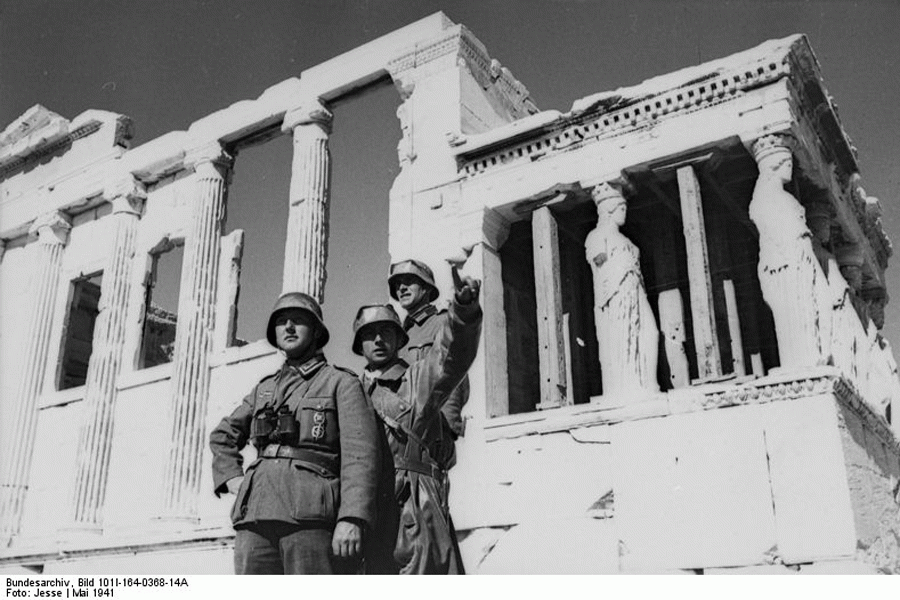
German flak against a fabulous backdrop of classical columns.*

Despite the Blitzkrieg myth a lot of Landser slogged along on foot.*

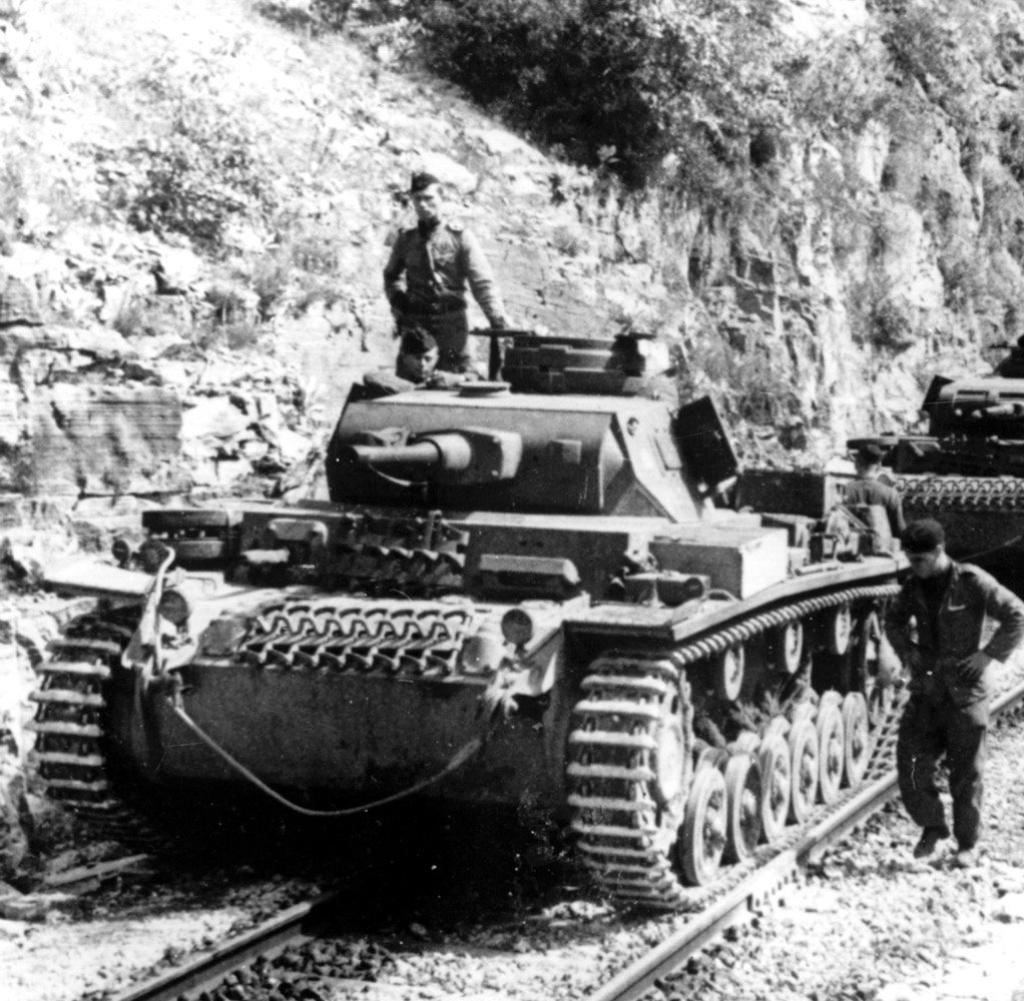
Mountainous terrain and poor roads meant rail lines sometimes doubled as highways.*

German artillery in a beautiful landscape.*

Most Greek roads were dirt tracks like these; ok in good weather, but appalling when it rained.*

However, overall Greece 1941 is well enough written to keep the reader - or this one at by rate - excited and interested. The bigger picture is sketched out at either end of the narrative, with the bulk of the book given over to the blow by blow ground level action, with excellent use of firsthand accounts keeping it very lively. This said, there are times when the barrage of unit numbers and names gets a bit tough to keep a handle on. But that's war, complex, ever-changing, confusing!

The Commonwealth forces for the Greek campaign were always under strength, and poorly equipped compared with the German invaders. [1] And to some degree the whole operation was doomed from the outset. Plowman maintains, however, that the Allied forces, even the Greek element, gave a good account of themselves. 


Amongst the NZ forces in Greece was this Maori unit.*

One of the mainstays of the Allied contingent, the Universal Carrier.

 Blitzkrieg blunted; German pioneers work to reopen supply lines.*

Soon it was the Germans turn to play tourist.*

Germans pass by and examine wrecked and abondoned Allied materiel.

I think the provocative subtitle of the book, The Death Throes of Blitzkrieg, overstates things somewhat. But Plowman's contention that this may be the first time the vaunted Blitzkrieg began to falter is a lesser and far more plausible claim. His focus is definitely more on the Commonwealth forces, but he does include Axis testimony. 

As well as regular Wehrmacht troops and materiel, there are SS, paratroopers and, of particular interest to me (I'm not sure why?), Gebirgsjager. And the campaign is doubly or triply fascinating because, due to the interesting topography, all elements/arms are involved, for all belligerents, from the ground forces to the naval and airborne contingents.


Gebirgsjager at rest in Greece.*

Gebirgsjager at work in the mountains, Greece.*

Mountainous terrain isn't ideal Blitzkrieg territory.*

The fate of much Allied materiel, abandoned and destroyed.*

This is one of those books that poses a real danger to me, in terms of a desire to build wargaming forces with which to refight elements of it. If I were to go down this avenue, I think I'd choose 1/300 scale, or 6mm, so as to be able to involve air and sea elements, as well as land warfare, and also so as to include as much topography (mountains, coast, islands, etc) as possible. Uh oh...

A thoroughly enjoyable read. I'd definitely highly recommend this.


Most Allied A10 tanks threw their tracks, or broke down one way or another.*

Retreat for the Allies and advance for the Germans was often hampered by poor roads laden with heavy traffic.*

ANZAC troops take shelter whilst waiting to be evacuated.*

Amongst those rescued by sea, these NZ nurses.*

----------
NOTES:

* I've tried as far as possible to use pictures in the public domain found online, that are not used in Plowman's book.

I suppose the image chosen for the cover (see top of this post) fits with the subtitle of the book. But as I say in my review, above, I think that's an attention grabbing overstatement. A much more representative cover image would've been an A10 that had been abandoned due to track failure! Indeed, I've a mind to make me a diorama of a scene depicting German soldiers gathered around the wreck of an A10 somewhere in Greece. That's a definite one for the the 'to do' project list!

[1] It was the actions of Mussolini's Italians that forced Hitler's hand in this theatre, at least as he saw it. But the theatre as a whole included Yugoslavia, Bulgaria and Hungary, and ramifications further afield meant that Crete, Turkey and all around the eastern and northern Mediterranean were affected by events on the Hellenic peninsula, as was Hitler's planned invasion of Russia. These other nations and their actions are often mentioned, as they relate to unfolding events in Greece itself, but don't come within the scope of this book.