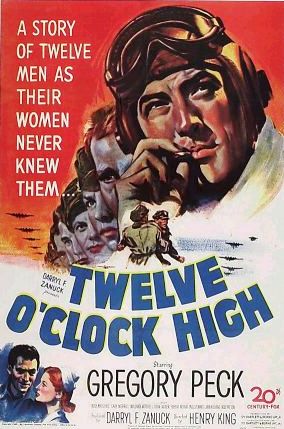
This rather attractive old poster kind of misleads regarding the feel of the film!
I usually prefer the vintage stuff, but on this occasion I like this modern cover better.
Gregory Peck stars in a superb study of morale, psychology and leadership, in the vanguard of U.S. involvement during WWII.
I watched this film last night, and was blown away by it.
Peck should've got an Oscar!
I have to admit that I have, on occasion, thought Gregory Peck a bit wooden (though not so much as Cary Grant could be), his chiselled good looks and suave calm manner reducing him to something nearing a stylish clothes-horse, if you'll pardon that unflattering description.
That might sound pretty harsh - and I certainly have enjoyed seeing him in many movies, including a number of excellent Hitchcock films - it's just that the 'perfect Hollywood leading man', which he embodies to my way of seeing things, just doesn't always seem very real or credible. But after seeing Twelve O'Clock High I'm afraid I might be as fond of Peck as many of the women who doubtless swooned over him back in the day!
Wheatcroft (Merrill), Savage (Peck), and Stovall (Jagger)
This excellent movie also benefits from strong performances from pretty much the entire cast, including Gary Merrill, as the battle-fatigued leader Cary Grant's Gen. Savage character replaces, at the 'unlucky' 918th Bomber Group. I first encountered Merrill in the superb
Decision Before Dawn. Like Grant, he has real onscreen charisma. But strangely, whilst remainibg a busy successful actor throughout a long career, he remained a second-tier 'also-starred' type guy.
The film starts with a slightly strange sequence, very low-key and totally un-military, in which American Harvey Stovall, superbly played by Dean Jagger - who deservedly won an Oscar - is shopping in London, 1949. After buying a hat, he spots a rather ugly and battered Robin Hood Toby jug, in a shop window. Asking its provenance, he's satisfied with the shop assistants answer, and despite the efforts of the latter to sell him something of higher quality, he acquires the rather naff and knackered old nick-nack, asking that it be very carefully wrapped.
After this slightly odd and slow seeming start to what purports to be an aviation themed war film, the pace slows even further, as Stovall visits a derelict airfield on his bicycle. Far from this being boring, it is in fact - at least I find it so - a tremendously moving and powerful scene, as Stovall looks over the airfield, and hears the ghostly voices of former airmen, amidst the more general noises of a busy wartime aerodrome. The camera pans away from Stovall, as he cleans his glasses whilst reminiscing, and we see the long grass blowing wildly, as the mighty engines of phantom B-17s roar in his mind.
What a way to start a film! Darryl Zanuck, I salute you.
Savage flies aboard the Picadilly Lily.
At this point the film transitions to the busy wartime version of the airfield, as a flight of B-17 bombers returns from a mission. These amazing planes could easily have been the stars of the film (think Mempis Belle!), but this is first and foremost a human story. Nevertheless, the sequence in which the bombers return to base is great, and includes a stunning scene (thankfully played silent, i.e. without histrionic soundtrack music) concerning a crew who 'caught it' on the mission. I'll refrain from saying more, as I don't want to spoil it for those who have yet to enjoy it.
Tough times test tough guys.
Stovall at work on the base.
In this opening to the 1942 portion of the film we're introduced to Col. Keith Davenport, played so well by Gary Merrill, and his tired but loyal crews. We also meet Stovall again, a major at this point, and 'Doc' Kaiser, both of whom, along with Davenport, have important roles in the film. Tempers fray in the post-mission debriefing, a routine process referred to rather ominously as 'interrogation', and then the group learns that they'll be out again the following day.
This makes for a non-stop four day run of raids, and this new one is scheduled to be flown at a suicidally low altitude, as previous missions have been ineffective. Wheatcroft and 'Doc' face the dilemma of deciding who's fit, it anyone, to fly this mission, leading to Wheatcroft remonstrating with his superiors. His immediate superior is his buddy, Savage, and above him is the 'old man', aka Maj. Gen. Pritchard (Millard Mitchell)
Just how much can a man take?
Pritchard asks Savage to take over command from Wheatcroft, a tricky job between friends. But Peck's character can handle it. And he wades into his new role with that same aggressive 'can do' attitude. But whereas he spares Wheatcrofts feelings, he rule in his place with a rod of iron, precipitating a near mutiny. How he gets through this, and how the 918th evolves under his leadership is stirring, inspiring, even moving viewing.
Savage lives up to his name, dealing out 'tough love' to those he deems aren't pulling their weight...
... assigning slackers and deadbeats to the Leper Colony!
McIllhenny gets (another) dressing-down. Note the marks on their faces where the masks and goggles were worn. Such small touches are a sure sign of quality.
Whilst the film tackles tough material, and doesn't shy away from some of the darker aspects of war, it nonetheless has a surprisingly light touch, and even numerous laughs; witness, for example, the rapport between Savage and McIllhenny, which culminates in Savage suggesting McIllhenny's sergeant stripes should be attached with zippers. Why? If you can't guess, watch the movie to enjoy finding out!
According to historian and author Paul Overy (?), the Bombing War was a very inefficient and inhumane 'blunt instrument'. It's not shown that way here. But then this is a film about the effect of the combat stresses on the bombing crews and their staffs, rather than the efficacy of the strategies and tactics they pursue, or the view from the receiving end.
Like many war films this one is based, in part, on real events. It would in turn inspire a novelisation treatment, as well as spawning a TV series.
The engines cannae take it, Cap'n...
Damn, Peck looks cool!
As with many war films made during or just after WWII, real wartime footage is used. In this instance during the final major bomb run that Savage leads. As usual, it's pretty clear what's newsreel footage and what's been shot later. This both lends veracity at the same time as undermining it, in a strange and possibly irresolvable paradox. And it's only in the use of German aerial combat footage that this film incorporates anything from 'the other side', the narrative itself remains resolutely on the Anglo/British side of the Channel.
It's tricky to exit a narrative as compelling as this, when you know that the stories of the characters you've grown to care for - and that's very much a theme in this film - will continue. But the film comes to as neat an end as one could hope for (particularly as it's also based on an amalgamation of historical source material).
A superb film, well worth catching.
---------
B-17 'All American' limps home.
Miraculously she made it back.
Whilst researching this post I discovered a fantastic story about a B-17 called All American. The pictures above show how this old bird made it back to base in a shocking condition . You can read the story, or rather stories, about this near mythical event
here.
And, if you're a big enough fan of this movie, you may, like Stovall, want to purchase a Robin Hood Toby jug, which you can do
here
The original battered old jug.
A modern reproduction!