Sunday, 10 February 2019

Kit Review: 1/72 Caesar Krupp Protze


I seem to be doing some things in threes: three Elefant, and now three Krupp Protze. This, the third of the latter, is a Caesar kit. I've bought their figures before. But this is the first kit I've bought/built from this company.

Unusual but quite nice to see black rubber tires.


It was only after I'd detached the parts for steps one to three - I tend to gather the parts for several steps, clean them up, and then blitz a few stages in one pass - that I noticed some had what looks like heat damage (i.e. melting) fresh out of the bag/box. The box itself is still pristine, and the contents were in an undamaged sealed bag. So obviously this damage has occurred at the factory, at some point. 

The single most obviously affected part is the piece shown below, where molten styrene disfigures the front right bumper and the right section of the engine hood. But I subsequently noticed, as shown in the next picture, that this issue also affected several much finer parts; two of the levers from inside the cabin are damaged, as was the steering wheel column. One piece, part 50, is missing altogether. Given this kit was bought brand new, factory sealed, etc, I do wonder if I ought to make a complaint?

Note the molten styrene on this part of the model.

Look closely, parts 48 and 49 are damaged, piece 50 is missing.

Fortunately I was able to fabricate replacement levers etc. from stretched sprue. And the damage to the fenders/hood, once cleaned up, might pass muster as dents received in the field. Still, there's the principle of it: a new model should be pristine! Will have a think about what to do re registering a complaint.

Plastic surgery: the disfigurement might be tolerable.

Also damaged, the steering wheel column; stretched sprue to't rescue.

Only the rightmost of the three levers is the original part.

Parts laid out ready for assembly.

I'd say the majority of 1/72 kits I build start with chassis/running gear. This one starts with the cab. Detail-wise it's on a par with the ICM model I recently built, only here the parts - at least the undamaged parts - are more robust. The ICM was rather too delicate in places. This is chunkier, albeit nowhere near as chunky as the First to Fight kit , but still nicely detailed

Cabin etc. assembled. Looks great!

Preparing the chassis components.

This all went together very nicely.

Today's modelling was done fitfully, around and in between watching a snooker match on the telly. At end of play Judd Trump was the champ, and £100,000 richer, and the accompanying pics show how the model looked, the spare wheels in their rubber tire glory in place. Aside from the damage to the parts, this is a really quite decent kit, of an interesting vehcle. I can't wait to continue and finish the build. Tomorrow... hopefully!?
The exhaust pipe kept its integrity, unlike the ICM kit.

Wheels and suspension laid out.

It's now tomorrow, and I'm pressing on. Now it's the turn of the running gear. This is lovely, going together better than the ICM, and b big way more detailed than the single-block First To Fight part. I'm not sure when I ought to out the tires on. Part of me says at the very end. I.e. keep 'em off whilst painting the truck. Paint and weather 'em separately, and then finally add them. Hmmm!?


Then it's the turn or the rear bodywork, which is all rather boxy. I have to stop, and go do some teaching, alas. So the model is on hold again, till this evening. But it's nearing completion, assembly wise.


Starting to look more complete.

I think it's actually my favourite of the three Krupp Protze models I've recently built, and that's in spite of the molten-atyrene issue. It has the detail of the ICM model, without being so fragile, and it goes together, by and large, with the same chunky simplicity as the First to Fight kit.

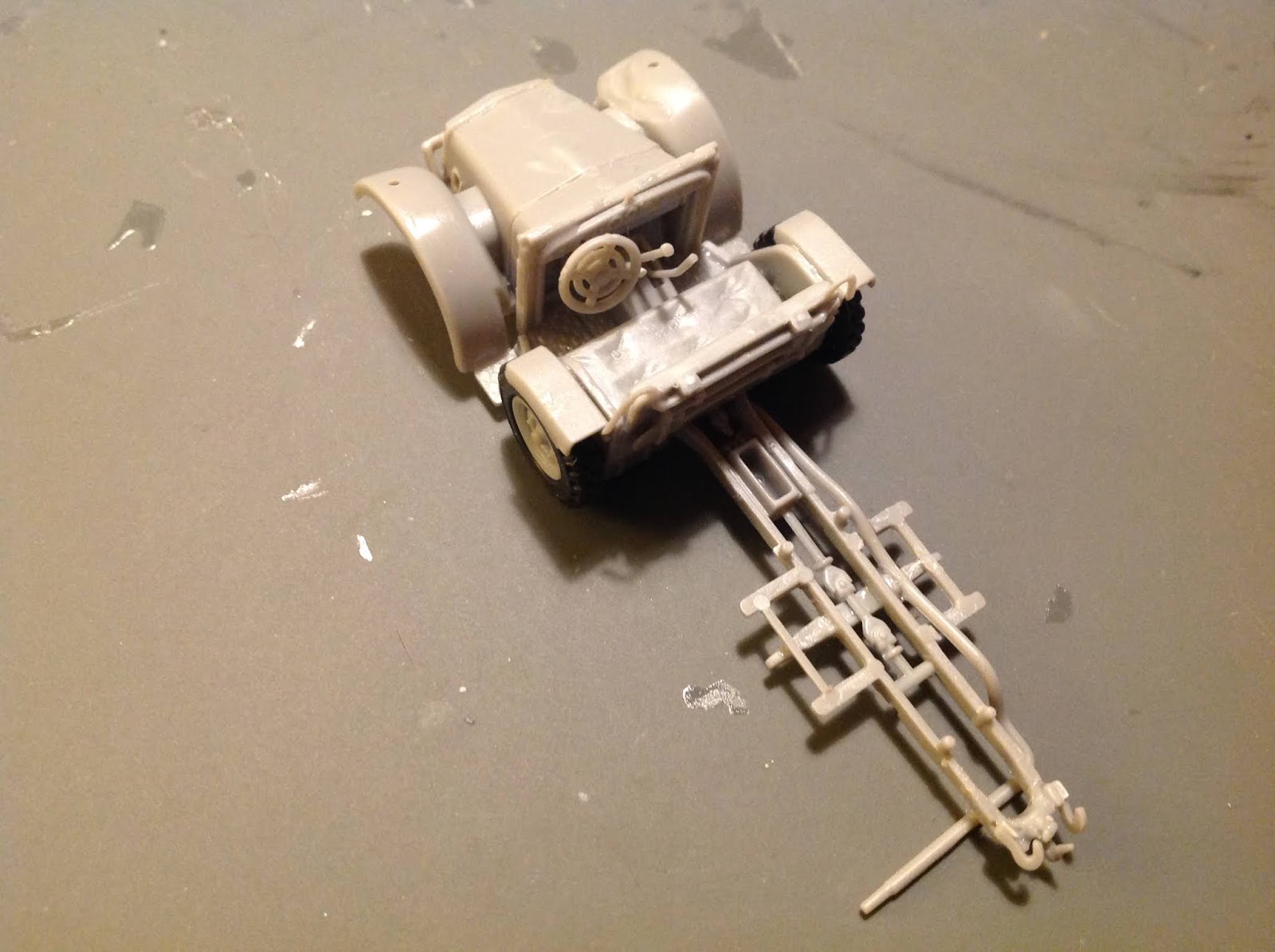
Chassis assembled.

Getting ready for the final assembly.

The spare wheel frame, etc, at rear is great.

Figure assembled...

Just tires, windshield and painting left.

Rear view... very nice!

Got back on the case when I got back from teaching. This is a great kit (aside from the damage), and I've really enjoyed building it. I think I'll look at painting up the three Krupp Protze soon, and getting decals on.

Tuesday, 5 February 2019

Book Review: Inside The Third Reich, Albert Speer


So, I'm just finishing reading this pretty hefty tome. Hitler is dead, and Speer has finally been arrested.

I'm enjoying this book a lot. Speer writes about his childhood and youth, and then his rapid rise under the wings of the Nazi Eagle, first as Hitler's chief architect, and later as his armaments minister. As a member of Hitler's entourage, and at times very much part of the Führer's inner circle, Speer has a very, er... 'privileged' view of the internal workings of this extraordinary court.

He's quite candid, both about himself and the panoply of courtiers seeking favour, advancement and reflected glory from their proximity to Adolf. Speer is articulate and eloquent, and his story is fascinating. Prior to reading this I'd mainly encountered him as a talking head in the magnificent ITV World At War documentary series. 

Speer at the typewriter in his Nuremberg prison cell.

Inevitably, written as this was during his incarceration in Spandau, after the Nuremberg trials, he reflects on his role and culpability in the whole Nazi program. And this has to include the holocaust. But he doesn't spend that much time on this subject, and tries to suggest he basically looked the other way.

Instead what he writes about chiefly are these four or five things: himself, Adolf Hitler, their work together and Speer's independently (-ish) as Hitler's architect, his struggles in the fragmented Nazi bureaucracy as chief overseer of the German armaments industry, and ultimately therefore their ability to wage war, and lastly but my no means least, the internecine strife within the febrile Nazi court.

Massive pillars and huge eagles, essential elements of the Nazi architectural style.

At one point he notes with an obvious sense of regret that his architectural style, due to its huge grandiose bombastic style, in the service of a megalomaniac dictator who sought to overawe not only his enemies, but his own cronies, and even history for the following millennia, resulted in buildings that were inherently oppressive. So much for the Reich of 1,000 years, or even the 'theory of ruins'*, Hitler's architectural legacy - and Speer's even more so - was, for the most part, completely wiped away during and after the war.

Hitler could charm. Here Speer is clearly under the spell.

There are moments of pride in his accomplishments as a technocrat: Hitler and Speer were clearly 'size queens', so to speak, it was of great importance to them that Nazi buildings be bigger, preferably in every possible dimension, than anything comparable. Speer is always rattling off lists of cubic feet, or tonnes of this that or the other. He was also very proud of his columns of light effect (using air-raid lamp beams) as famously employed at Nazi Party rallies. And he isn't shy of his obvious pride in trying to make both German industry and the German war machine as efficient and effective as he could.

This last - and his constant struggle with fragmented, competing, overlapping hierarchies of power appear to be a chief component in Hitler's management style, and an integral and predictable element in both his own and his empire's downfall - is a major theme. One of the most amazing things is how spellbound he and Hitler's other acolytes were, and remained. To those of us far removed from the corridors of power certain things might seem crassly simple or obvious. But when mired in the matrix of very real and very intoxicating power, as these men were, it's clear that reality gives way to a hall of distorting mirrors, and Speer captures this element of his story very well.

Speer, Hitler, and Breker, Paris.

Breker sculpts Speer as the Mekon of WWII German artist-intellectuals.

Speer doesn't come across as a particularly bad person at all. Sometimes his own self-satisfaction is so blatant as to be embarrassing, and this makes the sculptural portrait of him by his friend Arno Breker, which is a good likeness, but gives him a Mekon-like bulbous cranium, suggestive, perhaps, of a high (self) regard centred around a sense of intellectual superiority. Like Hitler himself, Speer saw himself as an artist dragged into politics and administration, and to some extent martyring himself in a higher, nobler national cause

And it's  in relation to this that he finally, so he claims, began to separate himself from the mesmerising grip of his master, ultimately operatingly directly counter to Hitler's Gotterdammerung style scorched earth policies, and seeking to conserve industry and infrastructure for the postwar future of Germany.

All in all, a fascinating insight into a fascinating era. A compelling and enjoyable read. Highly recommended.

1/72 Elefants...


So here is my Elefantine trio, left to right: Trumpeter (unfinished), Zvezda, and Fujimi. The Fujimi is allegedly 1/76. But it looks as big as the other two. The Zvezda model appears to be an older variant, with a rectangular commander's hatch, and no front-mounted machine-gun. I added zimmerit to the Fujimi. I think I might also add some to the Trumpeter, as I really like the effect.


I'm not sure whether to go with this camo' scheme, pictured above, in three colours, or something more like these two below, which are both in just two colours:


I have to confess my original preference was for the Zvezda two-colour, dunkelgelb and green, as pictured above. And I think that remains my favourite. Although I have to say the Bovington Elefant does get me thinking about going three-colour. Hmmm!!?

I'm also tempted to get more crew members visible. Still, first I need to finish the recent Trumoeter build. Then it's time to paint the suckers.

1/72 Krupp Protze


After thoroughly enjoying finishing the ICM Krupp Protze build, started ages ago, but only recently completed, I decided I needed a couple more of this groovy German truck. I ordered two, I don't by (?), and another by Caesar. This is the former.


The kit comes with a little full-colour magazine, all in Polish, which includes instructions, and lots more besides. It seems to be part of a 'First To Fight' game system, like a Polish Flames of War, or somesuch. Quite impressive, really. Shame it's not in English as well.


The kit itself is well designed, and goes together well. But it very definitely belongs in the chunky (?) category, of wargaming model, as opposed to finescale stuff like a Dragon, or the ICM version. Despite the overall chunkiness of this model, there are several weak point, such as where the front wheels join the axles, and the headlamp stalks and width indicators attach to the mudguards.


Compared with the superfine ICM chassis detail, this is a one-piece block. But it still looks pretty good. And once the model's assembled, it passes muster in terms of what's visible. A driver figure us included. As is so often the case, its nigh on impossible to actually get him in behind the wheel once the kits assembled. Not sure if I'll use him, or opt to use a different figure.


There's also a tarpaulin cover. Again, not sure if I'll use this. But it's good to have. And lo' she be finished, construction wise. Detailing and paint job remain to be done. Quick, easy, and fun. Not a superb kit. But functional and useful.


Saturday, 2 February 2019

Bovington Tigers, Tiger II (Porsche)


Yet another amazing iron beast from the Bovington Tiger Collection. The Tiger II is the only one of the Tigers here to be on display in two variants: the rejected Porsche design, as featured in this post, and the adopted Henschel design, as featured in one of my previous posts

I'm not sure why, but I took far fewer pics of this vehicle. I guess that's perhaps 'cause I liked it less than the others? Though it remains both huge and hugely impressive. I intend to revisit the show, before it ends in (I think?) October, 2019. Perhaps then I can do it more photographic justice?