Showing posts with label satire. Show all posts

Sunday, 12 June 2016

Film Review - Love & Death, Woody Allen (1975)


For me this film is a dream come true: I love Napoleonic history, and I'm especially fascinated with the 1812 campaign in Russia. And of course Russian literature and music offers vast riches for Woody Allen to both mock and do homage to. Then there's Allen himself - my favourite film maker - indulging in a rather silly take on all this stuff.


Released in '75, Love & Death marks the end of his run of early 'funny' films, after which he enters upon the decade that I see as the apex of his career, between Annie Hall and Radio Days. Love and Death certainly isn't his greatest film. Indeed, it's fairly dumb in places, as Allen movies go. But,  nevertheless, it's wonderful: there's no one else makes films quite like Woody Allen.


The Russian soldier, brave and resolute, faces death without fear.

The many faces - and fab outfits - of Boris Grushenko, 'scholar and coward'.


Despite the weighting towards farcical broad comedy, which often approaches slapstick, there are poignant moments, such as the opening and closing titles, where the pure beauty of landscape and music, despite Allen prancing about with the figure of death at one point, are quite intoxicating. Allen uses Prokofiev throughout, which helps with the Russian flavour, and the 'Troika' section from the Lieutenant Kijé Suite, used in the titles, is utterly perfect. 

Allen and Diane Keaton are brilliant, deadpanning a very Noo Yoik type convoluted love-affair into a cod-Tolstoyesque (or sometimes even cod-Dostoyevskyan) setting. There are some fabulous exchanges between Keaton's philosophical Sonja and Allen's wise-cracking Boris. And the supporting cast do fine as well, Keaton's first (herring merchant) husband, her unctuous piano-teacher - the first of her many lovers - and James Tolkan as Napoleon, are all noteworthy. Numerous other actors give brief but entertaining performances, such as the guy who portrays one
 of Napoleon's forgotten staff, Sidney Applebaum.


James Tolkan very much looks the part (every inch, perhaps?), as Napoleon.


As ever with Allen there's plenty of reference to such themes as existential angst and sex, which are, of course, facets of the titles themes, love and death. His encounter with and seduction of the stunning cocquette Countess Alexandrovna is very amusing. Inevitably, it being Russia in the C19th, he then has to fight a duel with Countess Alexandrovna's cuckolded lover Anton. Needless to say, the resulting duel in the snow is rather different to that between Bezukhov and Dolokhov in the many film and TV adaptations of War and Peace.

Countess Alexandrovna: 'You're the greatest lover I've ever had' 

Boris: 'Well, I practice a lot when I'm alone.'

Eventually, having become embroiled in the wars - first when Napoleon goes to war with Austria, and later when he invades Russia - very much against his will (he's a self-professed 'scholar and coward'), he finally gets together with Sonja, much against hers, only to be dragged into a plot she hatches to kill Boney. But in case you haven't seen it, I'll leave it there. 


Boris struggles with the deep moral implications of murder, and his pistol.

But, ah me... as I said above, there's no-one else makes films like Allen! So, whilst not his best, it's still a four-and-a-half bicorne affair, especially compared with the vast and seemingly endless tidal-waves of brainless, humourless dross Hollywood pumps out these days. As silly as this undoubtedly often gets, it's still packed with not just wit, but intelligence, pathos, and even reflections, albeit largely tongue in cheek, on the kind of deeper themes that Tolstoy et al loved to ruminate on.

'You luuu-rve Russia, don't you!?'

Oops, Boris chooses the wrong place to hide!

Projectile Woody. Who'd Dare accuse Allen of being a dummy? [1]

I don't recall this scene, perhaps it was cut?

Russian soldier: 'God is testing us'.

Boris: 'Couldn't he have given us a written?'

In terms of military scenes and action, whilst there's a fair bit of it, and on quite a grand scale, it's all pretty silly, from the deliberate anachronism of the bawling black U.S. Marine style drill-master, to Woody's malfunctioning weapons, and his ill-advised choice of the barrel of a cannon as a place to hide. Nevertheless, and rather like Harry Flashman, despite his own best efforts to shirk, cower and hide, Boris becomes a hero.

The first and only major military campaign depicted on film here is, as in War and Peace, the 1805 campaign, which culminatesd in Austerlitz. In this film, Allen doesn't - as mainstream American directors would undoubtedly do - signpost such references (and the film is littered with cultural cross defences), they're there for the knowing to spot and enjoy.


The second military phase is of course the 1812 invasion, but again history, military and civil, just serves as a vehicle for Allen's comedic take an everything from sex and art, to angst and philosophy. This is the segment in which Boris is not a soldier, but a would-be assassin. So it's not so much battles, as intrigue, Boris and Sonja inveigling their way into the Imperial HQ.


In a film like Bondarchuk's Waterloo, one might lament any license with history. Here, however, we are clearly dealing with a film in which historical accuracy was not paramount. Nevertheless, the uniforms and settings are, for the most part, pretty good - and certainly sumptuous and quite spectaular - but mostly it's just great fun to see a favourite era used for comedic mileage.


It looks like making the film was fun, but...

... Woody explains to readers of Esquire why making films like Love And Death isn't fun.

A nice publicity still.

A great very retro image, used in some versions of the post series for the film.

On set in Hungary. An experience which put Allen off filming abroad for about 20 years!

Monday, 25 April 2016

Film Review: Soft Beds, Hard Battles


Fascists Foiled By Fatal Flatulence In Naughty Knockabout Knocking-Shop Farce.

Not really that relevant to my wargaming interests, this, I guess, except inasmuch as it's set in WWII and it's a guilty-pleasure, perhaps!? Soft Beds, Hard Battles is an odd film; mostly pure farce, but shot through with streaks of dark absurdist humour. I think it's actually quite a bit cleverer than the blatant displays of boobs and innuendo might at first suggest.


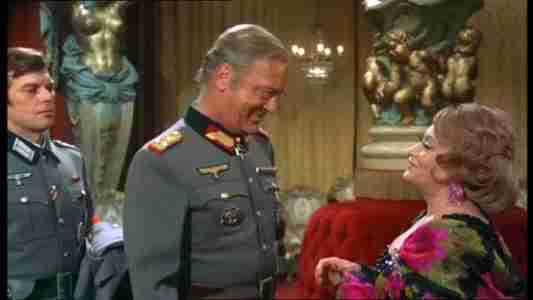
The basis of the plot is that English Major Robinson (Peter Sellers), who misses the boat for Dunkirk when his motorbike won't start, hides out in the high-class Parisian bordello he's been visiting. Very soon after this the Germans arrive, and Gen. von Grotjahn (Curd Jürgens) visits - or rather renews his acquaintanceship with - Madame Grenier (Lila Kedrova) and her charges, bringing Adolf Hitler (Sellers) and other top brass to see one of the 'highlights' of Paris.

The film has an American in a prominent role, the rather wet Alan Cassidy (Rex Stallings), and what I'll describe as a 'Voice of America' style commentary, presumably to aid the film's prospects of performing (titter) across the pond. After Robinson kills his first German officer, Cassidy and the ladies of the cathouse are gradually drawn deeper into the affair (chortle), as the Major leaves them to dispose of the bodies, with unfortunate repercussions for another regular client of the whorehouse, the French  Gen. Latour (Sellers).


Gen. von Grotjahn resuming his acquaintance with Madame Grenier.


Herr Hitler is not in any way drawn to the ladies.


Gestapo chief Herr Schroeder (Sellers), like his ultimate boss, is somewhat Puritanical, clearly abhorring what he regards as depraved, and from the outset sets out to make life hard (eh?) for the working girls and their clientele. But Jürgens interprets the Führer's orders in a different light, and is always stymying Schroeder's efforts to investigate and close the house of ill-repute.

There's a predictable but nonetheless enjoyable sub-plot, concerning the innocent young Marie-Claude (Béatrice Romand), who relatives deposit with her aunt, Madame Grenier. Inevitably she evolves from a demur innocent young country girl into a more wanton and worldly-wise woman. Predictable as the basic thrust (harumph) of this subplot is, it's done well, and in a slightly off-kilter manner. But by the end of the film she's a quite different creature, causing the French President (Sellers) to forget himself during a post-war decoration ceremony.

A disturbing likeness.


Schroeder. Gimlet-eyed Gestapo boss.


The French Premiere, engaged in his diplomatic duties.


Sellers is excellent in his multiple guises, something he clearly loved to do. Think of Dr Strangelove, for another if quite different example. This is somewhat more in the vein of Alec Guiness in the superb classic Kind Hearts and Coronets. The latter, however, was a black and white movie that aimed for a sophisticated if dark ambience. This is is in gaudy colour, and is aimed decidedly lower - about crotch level - by and large.


I've often thought, whilst watching Sellers as Clouseau, or in many other of his actually quite diverse roles, that he had the perfect physiognomy to play Hitler. And indeed, that he often portrayed characters who had an almost grotesque or absurd air of injured dignity, a quality that I think makes him psychologically suited to the role of an unbalanced dictator, working out his personal neuroses under the guise of avenging Germany, who, like Hitler (or so he feels) has been 'betrayed' by a world he detests. Watching him play der Führer, if only fleetingly, only confirms that. It's a pity he never did a full movie in the role, as opposed to what amounts to a cameo, as here.


Yep, Sellers is a ringer for the Führer.


It's true that he's playing six very broadly drawn caricatures. Sure, they deliberately play to stereotypes. But isn't that the point? And they are well observed and well played, as well as being broad-brushstroke. And in the Hitler and Schroeder characters Sellers conveys both the absurdity and menace inherent in such people. I personally think this film is as satirical as it is farcical. When I read a one-star review of the DVD on Amazon UK's website, describing it as 'soft-porn Allo Allo', whilst admitting that on one level the recveiwer's not wrong, I think they're missing the point. 


Georgian caricaturists could be very crude, violent and lewd, and were, more often than not, peddling thinly dressed-up establishment propaganda, but we recognise that there's some art and sophistication as well as ribaldry and grounds for litigation in their work. Admittedly this film doesn't have the sophistication of, say, Dr Strangelove, or the best works of Gillray, but it does have a darker side, and one that's possible to read as critical of the hypocrisy of mainstream chest-thumping war narratives. As the Padre (Vernon Dobtchev) says, 'war makes strange bedfellows'.


Rob Freeborn does Sellers' make up. Freeborn is best known as the man who created Yoda (a hybrid of himself and Einstein!), for the original Star Wars.


And, contrary to the feelings of some, who are not so impressed with this aspect of the film, I think the make-up department did a splendid job in facilitating Sellers' pre-CGI chameleon-like transformations, from his geriatric French general, to his dashing British agent. Even his Japanese make-up and character are better than the overtly low-brow tone might imply; 'you rike suck-ee?' (sake) says Prince Kyoto, to the pretty young 'nun' on her knees before him. Certainly the Sellers/Kyoto transformation is much better than Sean '007' Connery's very lame Japanese fisherman in You Only Live Twice.


According to the credits Sellers also did the narration. Although the only extra-feature on my DVD of the film casts some doubt on this: the extras consist of numerous short clips featuring parts of the original 107 minute film edited out for the 97 minute theatrical release, and have what is clearly Seller's narrating, but with a French accent. 


Did he also do the American narration? Which, incidentally, differs in content as well as delivery. Whatever the answer is, even the  American voice-over (and its satirical nature would perhaps be more overtly clear if it definitely was Sellers) - like the content it communicates - still undercuts the straight-laced 'Voice-of-America' style delivery. 


I would say that rather than being as dumb as it might at first make itself out to be, Soft Beds, Hard Battles is more absurdist. As some reviewers on the Amazon UK website have noted, life's too important to be taken too seriously, and a species that holds itself to ransom over a kettle-full of uranium... well, quite! 

Speaking of which:


Sellers as another nutty Kraut, superbly combining farcical humour with dark satire.


And then, finally and perhaps most importantly, it IS actually funny. At times very funny. There comes a point in the plot, in keeping with the flimsy silliness of the basic premise, where the 'undercovers' black-ops are stepped up several gears, by the introduction of a chemical weapon, with amusingly dire consequences for the military plans and bowels of the Third Reich. 

Fatal flatulence alone is guaranteed to make me chortle. It's a shame they edited one of the fart fatalities out. They also removed a scene featuring Hitler deciding to drop his invasion of Britain, instead opting to attack Russia, on the advice of a Nazi-gypsy lady with a crystal ball!


Prudishness or politically correct dogma could very well make this uncomfortable viewing for some, but we (my wife and I) thoroughly enjoyed it. Certainly not a classic, like Dr Strangelove, but not as bad as most review aggregators suggest, and still, in my view, definitely worth seeing. 


Thursday, 19 March 2015

Napoleon at The Fitz: An exhibition of Napoleonic themed prints at the Fitzwilliam Museum, Cambridge (UK).


Simply title 1813, this lithograph by August Raffet helps mythologise the 'little corporal'. His ADC's are busy behind him, as he stands heroically beside a bivouac fire, as some ghostly bearskin wearing grenadiers march past.

Much to this old grognard's delight, an exhibition entitled Modern Heroism: Printmaking and the legacy of Napoleon Bonaparte is currently showing in a small room at the Fitzwilliam Museum, Cambridge. 

NB: Please note, the images that appear here are, unless otherwise indicated, taken on my iPad at the exhibition, and Photoshopped a little to improve the contrast, etc. Consequently they are not of museum display quality! If you want that, go see the show!

I've always had a soft spot for The Fitz, as this wonderful museum is known to many Cambridge locals.  But in all the time that I've been visiting the museum - and that goes way back to the years of my childhood - I've never known the institution to have held a show of any size, large or small, dedicated to the Napoleonic era.


A very nice lithographic version, by an artist called Victor Adam, and here simply called Chasseur (c.1825-9), of Gericault's hugely famous 1812 work The Charging Chasseur (sometimes also known, more fully, as An Officer of the Imperial Horse Guards Charging).

As a regular visitor to this venerable institution, which really feels like a London museum, having an exhibition dedicated to a passionate interest of my own feels like a dream come true. Actually Cambridge is spoiled, in that it has way more than normal the number of museums for a town of its size, many of which punch well above the average weight of your more common parochial town museum. The Fitz is the prime exemplar of this lucky situation, looking like a scaled down British Museum of sorts, replete with an impressive neo-classical façade, and some very regal lion statues.

The sort of print that might appeal to uniform buffs. Of course it would be more helpful if in colour!

I've been told more than once that these were models for some lions in London (Trafalgar Square... are there any lions there?). However, my Google researches threw up no such connections. But I did learn that according to old folklore 'when the Church of Our Lady and the English Martyrs’ clock strikes midnight, the Fitzwilliam Lions rise from their plinths and make their way to drink from the gutters that run along Trumpington Street, a few metres from where they sit'!

Bacchants Riding on Panthers, by Michelangelo, c.1506-08. Currently being displayed at the Fitzwilliam Museum, Cambridge (until August 2015). Photo credit: The Fitzwilliam Museum

Anyway, moving on from the lions, and glossing over the much more trumpeted Michelangelo sculptures that are currently on display (pictured above; you can read about there at the museum's website, or in this Guardian piece, if you like), let's get to the Napoleonic prints. The prints are culled from the museum's extensive collection, and number amongst them such illustrious and well known names as Delacroix and Gericault, both known for famous Napoleonic imagery, and the slightly later satirist, Daumier.

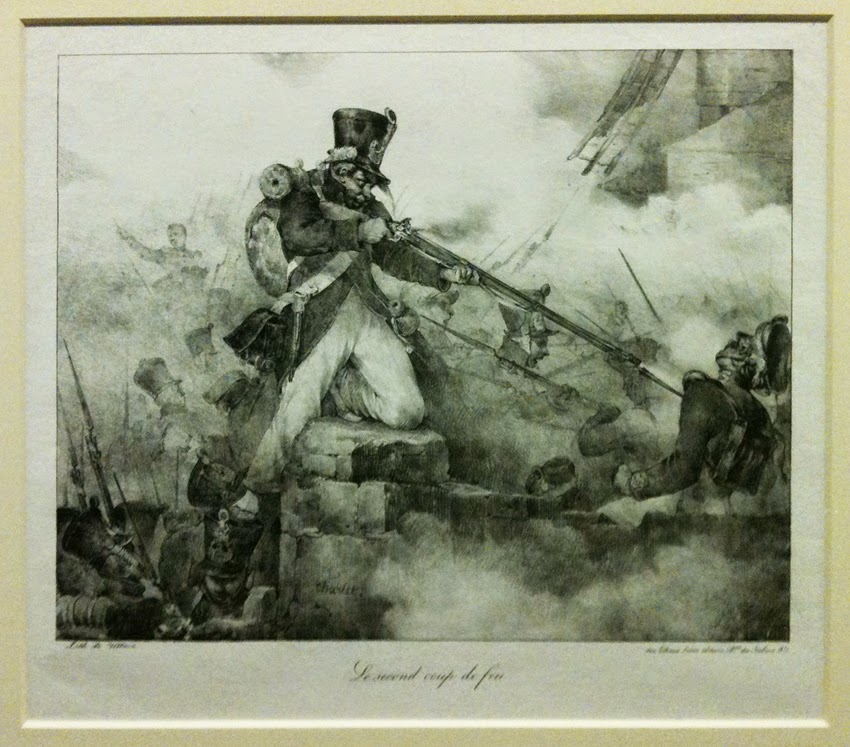
Pretty damn heroic! and living up to the exhibition title. This one's by Nicolas Toussaint Charlet, and is called At the second shot.

As much as I loved the work of these better known artists (and the British satirist Gillray even gets into the picture), the real delights for me were Charlet and Raffet, neither of whom I knew about until seeing this show. And there are of course many others.

Rather less heroic! At the first shot, by Charlet (1824). Perhaps this guy's not quite living up to the exhibitions title? [1]

Alas, the show is deemed, so it seems, to be too minor to merit a catalogue, or even any postcards. Damn shame! But the museum, which used to forbid photography, now allows it. So you can take snaps to your hearts content. I've catalogued the entire show and all the accompanying texts, for my own refence and general enjoyment, a small portion of which pics and info adorn this post.

'Serrez les rangs!' An veteran sergeant remains calm amidst the battlefield carnage. Listed at the Fitz as Close Ranks, by August Raffet (1831).

Most of these prints are actually post-Napoleonic, and some, like Le Réveil (1848), also by Raffet, clearly illustrate the sense of loss felt in France, with the passing of Imperial glory. Here a drummer summons dead soldiers to further glories in some sort of martial after-life!

The show began on February 3rd, and runs until 28th June. If you're anywhere Cambridge during this period, go and have a look. It's well worth it. If you do, drop me a line via the comments, and we can meet for a drink in the lovely café, and talk Napoleonic turkey.

The metropolitan French enjoyed print shop windows, much as their English contempories did. This one's by Pierre Nolasque Bergeret, and is called Dawdlers on the Rue Du Coq (1818).

An example of their print shop wares: this one by the famous painter Eugéne Delacroix, depicts a British soldier avec 'le bagage de campagne'!

Gillray's The Spanish bull fight, or the Corsican matador in danger (1808). Helping to prove that British satirical prints were a cut (across Boney's rump, in this instance), above French - or any other European country, for that matter - equivalents.

Each of the 30 main prints and ten supplementary prints - the 30 are ranged around the walls, the ten are in cabinets - has a small plaque conveying the basic information about it, plus there are also two general signboards, explaining basic stuff about the era, such as key dates, and simple summaries of the artisitic milieu and techniques used, etc.

It's a small but excellent show. I'd highly recommend going, should you be in or near Cambridge before the end of June.

-----

[1] Actually these two 'shot' prints were a pair: the featured soldier in both being one and the same man. In The first shot, which rather disingenuously comes second in my listing above, he's a combat virgin, cacking his breeches. But by The second shot he's become a true Napoleonic warrior!

-----