Showing posts with label memoirs. Show all posts

Wednesday, 18 November 2020

Book Reviews: The French at Waterloo; Eyewitness Accounts, vols I & II, Andrew Field


One might be forgiven for wondering why, instead of two fairly slim volumes, at £20 each, these two books weren't instead published as a single fatter book, at say £25-30. But setting aside that brief attack of penny-pinching cynicism, the actual content of these two books, both reviewed here, is superb. 


Vol I - Napoleon, Imperial HQ & Ist Corps

"I cannot get over our defeat. We were manoeuvred like so many pumpkins." Col. Marbot.

After an opening chapter on the usage/reliability of eyewitness accounts, volume one begins with three descriptions from Napoleon: the official post battle report, as dictated to Fleury de Chabalon, which appeared soon after the battle in le Moniteur, then Gorgaud's and Bertrand's accounts. All three are widely accepted as being Napoleon's own versions of events, and each one is a successively larger and more detailed reiteration of the same basic themes.

The accounts that follow, from Napleon's Household and then the Imperial HQ, unsurprisingly perhaps, largely follow their leaders' version of events. Except that is where his subordinates have incurred his blame, and then they might seek to excuse of justify themselves. All of this makes the first half or two thirds of this first volume somewhat repetitive, especially as the numerous accounts frequently recapitulate the same lists of unit dispositions and the major sequences of events.

Marcellin Marbot, in his 7th Hussar togs, c. 1815.*

Where volume one really comes to life, for me at any rate - and what makes it five bicornes, not four, or four and a half - is in the Ist Corps accounts. Especially so in those from the middling and lower ranks, whose colourful and lively narratives generally focus more closely on events the individuals concerned actually witnessed or took part in. The 'big hats', with eyes on posterity (and higher social standing to fall from) tend to give overviews coloured by hindsight, later/wider reading, and post-war politicking. 

Napoleon's own influence on the French readings of events, unsurprisingly, casts a long shadow. And yet despite this, the natural 'fog of war', and the blame games - around Ney and Grouchy in particular, but also bearing on the actions of others, like d'Erlon, Marcognet, etc. - reveal how widely the same events can be perceived or understood, not just by the antagonist nations, but within the same nation's own armies.

An excellent and fascinating collection. Essential reading for the Napoleonic/Waterloo enthusiast.

* Acc. to Wikipedia!


Vol II - IInd & VIth Corps, Cavalry, Artillery, Imperial Guard & Medical Services

"(T)his immortal slaughter." Larreguy de Civrieux.

The same standard of excellence is observed here as elsewhere in Field's terrific work on the whole French experience of the Waterloo campaign. 

A brief introduction recapitulates things he said in volume one, in particular addressing the reliability of the types of material that make up these fascinating books. He then moves through the various military bodies already listed above, citing numerous extracts from the memoirs of participants, mostly from the upper echelons - i.e. officers - with, as per volume one, brief biographical notes about the person concerned followed by their recollections of these momentous events and their parts in them.

First of all it's terrific that we are gradually getting access to more of this French material, after two centuries in which the English tradition of Waterloo historiography has been pretty one sided. There is something of an irony in this respect, re the fate of Capt. Siborne and his researches, which occurred so soon after the battle, and which sought to include accounts from all sides. There are several interesting books on Siborne, his dioramas, and the research he undertook in order to build them, as well as Siborne's own writings (which I have, but as yet haven't read; they're reputedly rather tough going!). [1]

Sylvain Larreguy, c. 1828.

But returning to the accounts in hand themselves, they are great, adding a lot of colour and interest to this much written about (most written about?) of epoch-ending/making battles. I won't go into great detail about any specific accounts contained herein. But it is interesting to note how they differ from traditional Anglo-centric accounts, on things ranging from relatively minor actions that don't appear in English histories, to more controversial claims, such as the frequently repeated claim that the French took and even held Hougoumont for a while at some point.

But in the end, whatever the veracity of some of these interesting claims/differences, it all adds up to more interesting and useful reference on this most compelling of battles. I'd even go so far as to say that Field's entire oeuvre on this subject is all essential to the genuine Napoleonic/Waterloo buff. In a word, brilliant.

The author (found this pic in an online Wilts news article!).

[1] In both volumes Siborne is, if my memory serves, only mentioned the once: on p. 106 of vol II Field laments how the French Guard officers, unlike Siborne's English correspondents, only told of their own local experiences. I think the mention he gets in volume I is on a similar theme, re sources and their limitations, but I can't pinpoint it (no indexes!?).

Saturday, 17 October 2020

Book Review: I Somehow Survived, Ed. Klaus Förg

This is an English translation of a recent book originally published in Germany, which collects the testimonies of five Bavarian survivors of WWII. All were over 90 at the time their tales were collected, the oldest being 106! Four are military personnel, whilst the fifth is a Norwegian woman, who - depsite her socialist father being forced into hiding, and her mother winding up in a camp - married a young German in the Kriegsmarine.

In the foreward Roger Moorhouse notes that this is part of a trend of recent years of allowing the voices of Germans into the pool of English language recollections, and as such a useful balance to years of largely one-sided history. I would qualify that a bit by saying that, whereas whilst most postwar German testimonies came from the bigwigs, or their friends and families - from Albert Speer's famous 'struggle with the truth' to the memoirs of people like Doenitz or von Ribbentrop, the latter's son writing his father's memoir - there have indeed, more recently, been concerted efforts to hear the voices of the 'everyman' (and woman) participants.*

My favourite of these is the first and longest, in which Georg Weiss recounts his arduous and colourful Ostfront service. Other stories include the long peregrinations of Sepp  Heinrichsberger, who, serving in France, winds up a POW in America, before undergoing a postwar oddysey in his quest to get home. Franz Blattenberger, an artilleryman, has a similar tale about his lengthy flight to ultimate postwar freedom, in which a keynote is the randomness and luck of survival. And Siegfried Schugman was a frustrated Luftwaffe man, who never got his wings, but wound up glad of it.

All in all, an interesting and very easy read. I read the entire thing in just one day, and that whilst also doing numerous other things. There are no truly mind-blowing or even very shocking revelations, to be truthful. Especially not if you've read a lot on WWII, as I have. But it is always refreshing to hear the German side of the story. The recollections seem pretty open and candid, and the supporting photos help reassure one. But - and no disrespect to the researchers or contributors - this is verbal or anecdotal history, and must therefore be treated with a certain amount of caution and circumspection.

Still, fascinating stuff.

* In respect of the latter, Tim Heath's several books on women's experiences in the Third Reich spring to mind.

Tuesday, 28 May 2019

Book Review: Mortar Gunner on the Eastern Front, Hans Rehfeldt


Volume one of a two-part Ostfront memoir, subtitled From the Moscow Winter Offensive to Operation Zitadelle. Hans Rehfeldt is just 18 when he sets off on a nine day train odyssey to the Eastern Front. Personally I love firsthand accounts such as these. Even the trip to the Front is interesting in itself.

The author gives almost continual daily entries - and that's exactly how the narrative is presented - that track the progress he and his comrades, of the elite Grossdeutschland unit, make. There's a lot of detailed frontline action. I was hoping to say it probably helped his chances of survival that he was in a mortar unit, as you might imagine that they would be slightly behind the sharp end, but I've been somewhat disabused of this notion, inasmuch as mortar positions were as often as not on or forward of the front line. Not during attacks, necessarily, but very much so during the longer periods between attacks.

The rather cool looking GD shoulder boards.

Mortar ammunition runners, and such was Rehfeldt's lot, also had the risky job of to-ing and fro-ing between the mortar pits and rearward supply areas, fetching fresh ammo. Indeed, it was running this dangerous gauntlet during an attack that would earn the author an Iron Cross, second class. This book (and doubtless its companion second volume) are terrific for learning about grunt-level tactical warfare on the Ostfront.

One striking thing is that it's very early on in the book, and Barbarossa itself, that the German's reach their farthest east, with the author and his fellows southeast of Moscow, around Tula, at which point the tide turns and retreat begins. Temperatures reach -52°, and Rehfeldt is invalided out of the line twice, due to severe frostbite which, along with near ubiquitous diarrhoea and vermin, reminds one of the horrors of Napoleon's 1812 invasion of Russia.

A typical five man mortar crew in action.

The written content is well supported by plentiful photographs, and not just generic images, but photos of Rehfeldt and his fellow Grossdeutschland soldiers. Also, in addition to his diary and these photographs, there's a further interesting graphic element, in the form of a good number of Rehfeldt's sketch-maps. I think it's great that these are reproduced as drawn, as opposed to having been redrawn professionally. Their very naïveté adds to their authenticity and interest.

Grossdeutschland, with its famous stahlhelm unit insignia, was way more than decimated. Losses were nigh on - indeed it's suggested here they exceeded - 100%! In other words more men were killed, injured or otherwise lost (captured, missing, etc.) than made up the full-strength of the unit pre-combat. As a result they are amalgamated into other units during the campaign, before being withdrawn for rest and refitting, and restored at greater strength, ready for Operation Zitadelle, the Kursk offensive.

A 2.8cm Panzerbüchse like this one knocks out at T-34 outside Schachty. [1]

I'm posting this review as I near the end of volume one. It's been brilliant, and continues to be exciting, informative and highly compelling. I'm really looking forward to the second instalment! To conclude, I'll do something I don't usually do in my reviews, and quote an extended extract, to give a flavour of Rehfeldt's writing [2].

'We heard by radio that Stukas had been called up. Now we searched the skies waiting for them to appear. Meanwhile our armoured cars had rounded up about twenty-five Ivans from the fields of wheat and sunflowers. The [Russian] cavalry troop was on the point of making an attack when the Stukas arrived, twelve of them. At this the cavalry, some mounted, others on foot, turned tail and ran for cover. The Russian fear of the Stuka appeared to be enormous. Our prisoners standing near us threw themselves down and looked up fearfully at the aircraft. We have noted this behaviour amongst the Russians so often that we consider that the Stuka dominates the battlefield. First they circle the target like vultures, then one machine after another tilts over one wing in steep downward flight at fantastic speed. The bombs are released almost directly onto the target. The howl of the 'Jericho sirens' is an additional psychological factor. The walls break and the howl gets on your nerves. It all makes Ivan deadly quiet, but for us brings – relief! The circles become tighter, the target has been identified and the nose tilts – towards us! Crippling horror! They are diving on us! Smoke signals, quick, quick! The flares hiss upwards and orange–yellow smoke is born on the wind. Our position is marked and the tank destroyer shows the swastika flag. At the last moment, already in the dive, the Stukas realise their mistake and, with a bloodcurdling wail of sirens close overhead, turn and climb in a steep curve upwards... They circled again and this time bombed the Russians; total chaos ensued, the bombs exploding in the midst of wildly zig-zagging tractors, tanks and fleeing soldiers. An ammunition truck exploded – some tanks zig-zagged off the road, bombs dropping between them: Ivan made no reply. In conclusion the Stukas strafed any vehicle in the open, and soldiers fleeing in panic. We watched the scene wordless and spellbound. Whenever a Stuka bomb exploded, we felt the shockwave a kilometre away. Thick clouds from the explosions hovered over the battlefield. Finally the Stukas made a pass over us at low-level waggling their wings, a sign of greeting and victory, and then they roared off without climbing.'


----------
NOTES:

[1] This is one of several weapons I'd not been aware of before reading this account. N.B. the pic is not from this book.

[2] I think it's worth noting that the translation is excellent. One hears the Germanic turn of phrase, the rhythm, sentence construction, etc. But English vernacular is also well deployed, where appropriate, using such phrases as 'hell for leather' and 'hit the sack'.

A good view of the cuff-band.

The above Bundesarchiv photo, not from the book, shows the Grossdeutschland armband quite clearly. I'd expected it to look more like the top of the two examples below. But it's more like the bottom one, i.e. harder to decipher! Can anyone decipher and explain exactly what the GD cuff thing says, and why it differs from what one  might expect?


Monday, 6 June 2016

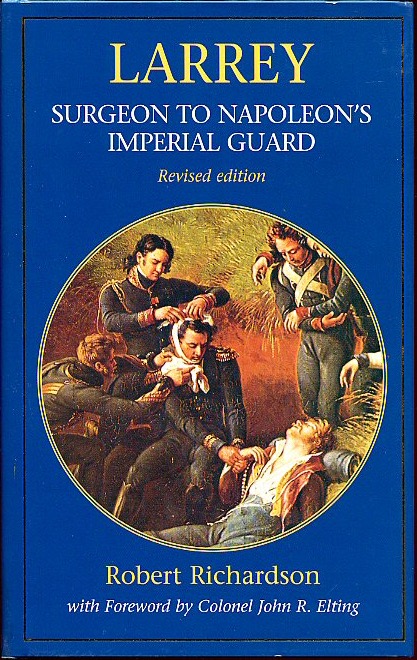
Book Review - Larrey, Surgeon to Napoleon's Imperial Guard: Robert Richardson


"The most virtuous man that I have known." Napoleon, in his bequest to Larrey.

Napoleonic warfare, for all the martial splendour of the peacock uniforms, was a sanguine business. As armies, battles, and wars became ever larger, so did the 'butcher's bill', particularly as the role of massed artillery grew, pitching flesh and bone against shot and shell.

It seems unsurprising now that at some point in the 19th Century the colloquial term sawbones came into use to describe surgeons. It's perhaps only surprising that the term seems to have originated after the Napoleonic wars, as it quite literally describes one of the most common  medical battlefield operations of that bloody era.

Larrey in action on the battlefield.


Larrey conducts operations in a 'casualty evacuation' station near the front.

The career and life story of Dominique Jean Larrey is backlit by these epic convulsions of 'military glory, that attractive rainbow, that rises in showers of blood' [1]. Indeed, Larrey was constantly up to his elbows in the gore of Napoleonic battlefields, frequently working, as in the upper of the two paintings above, on the field of battle itself, a fact also colourfully attested to in several passages in this excellent book. [2]


Larrey, as painted by Girodet.

The young lion, sporting his distinctive long, curly mane!

But the battles themselves were, in a manner of speaking, only half the battle. Not only did Larrey and his historic and innovative flying ambulance service daily brave death on the battlefield, seeking to restore life where others sought to take it. But they also had to contend with a military administration that treated them with barely credible contempt, rather as the casualties of war were themselves largely treated. A nuisance and inconvenience, an irritating distraction, or even obstruction, to the job in hand.

Larrey at work at Borodino, by LeJeune.

When a horse trod on a wounded man on the field of Borodino, one of Napoleon's entourage said words to the effect of, 'never mind, it's only a Russian', Napoleon famously replying 'on the field of victory there are no longer enemies, only men.' 

Whilst this, and Napoleon's interest in the medical services themselves (both generally and in his adoption of Larrey's initiatives) redound to his credit [3], sadly the norm was generally more in line with the original callous comment. Injured soldiers more often than not ceased to be treated humanely. They had, in fact, become less than men.

Richard Robertson, himself a doctor and medical man, has written a fascinating account of Larrey's life. The story is especially good because Larrey's career maps the whole period. Born just a few years before Bonaparte, his career in military medicine began some years before he first met his future emperor. That first meeting occurred at Toulon in 1794, prior to the young general's dizzying ascent to pre-eminence.

Although Larrey's memoirs include material on his pre-Bonaparte adventures, Richardson, having given a sketch of his background and early career, only really starts to get properly stuck in with the expedition to Egypt. From thereon in Larrey marches with the Guard, almost always near his emperors' side, through many campaigns, right up to Waterloo. 

From Egypt and the Holy Land, through the patchwork of German states and nations, to Poland and Russia, Larrey was there. And his main enemies throughout all this were not the enemies of France, per se, nor even the damage wrought by war, but disease and the administration. 


Larrey got the idea for flying ambulances from the impressive manoeuvrability of French horse artillery.


One criticism often levelled at Napoleon is that he didn't allow his subordinates enough independence. Well, I won't enter into that debate here as regards his military deputies. But it's clear that Larrey always stood by his principles, and would do so even if it brought him into conflict with vested interests. This was a big part of why his fascinating and inspiring passage through life was a rather stormy one. [4]

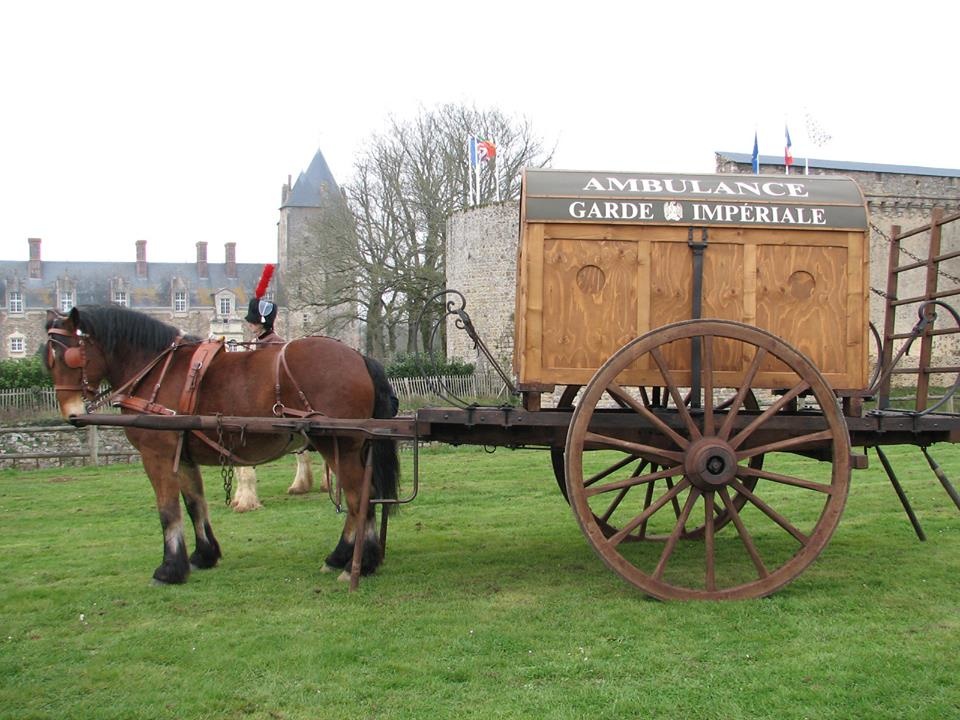
The Ambulance Volante predates Haynes manuals.


Surgery was his expertise, and both he and the French as a whole led the field in terms of successful battlefield surgery. The tales herein of the contrast between the old methods and the improvements of Larrey and others both chill and quicken the blood! In terms of the survival rate after amputations, the innovations of Frenchmen, Larrey amongst them, were demonstrably superior to older traditions. Nevertheless, adoption of new and better techniques proceeded with painful slowness, military medicine being a very conservative field. 


In addition to his famous flying ambulances, and his intense and principled dedication to seeing medical services better administered and provided for, another of Larrey's great contributions, once again related to his strict principles of always doing the right thing (and yet another that could potentially ruffle feathers), was his method of seeing patients in order not of rank or status, but the severity of their needs. 

A modern reproduction.

But if coping with appalling battlefield injuries was tough, dealing with disease was even tougher, as they fought an invisible and unknown enemy. Indeed, Larrey would himself come dangerously near death's door, contracting typhus at the tail end of the 1814 campaign. And whatever the practical medical issues were, there was always the administrative system to fight as well. Medical staff didn't hold military rank, and consequently were at the mercy of the often corrupt commissariat.

Napoleon was notably quicker to professionalise and militarise the army trains, which had formerly been a separate civilian adjunct. He did also eventually look to do something for the medical  corps, but it was too little, too late. French military medical services were not, in fact, to be properly organised until the closing stages of WWI! [5]


Larrey, immortalised on a stamp.


And a chocolate box! [6]

As well as having the grand sweep of the entire period, there's plenty of anecdotal detail: from the occasion on the campaign in Egypt and Syria, when Larrey operates on an Arab entertainer and his pet monkey, bringing tears of gratitude from the former and frequent scampering, leaping hugs from the latter; to the time he saves the life of Blücher's son, during the 1813 campaign, an act that found the inveterate enemy of France saving the surgeon's life in turn, when he was wounded and made prisoner after Waterloo.

Larrey did achieve fame and recognition in his lifetime, but it was a rough ride, and he was frequently sorely tried. Not just by the campaigning itself, but by rivalries, and fortunes that fluctuated between such highs as being made a Baron, given a home, and at several times being either honoured or  otherwise rewarded, to being passed over, intrigued against, not getting paid his dues, or - quite incredibly - being billed for the loss of equipment in Russia! [7]


Larrey's rather fetching artist wife, 'Laville'.


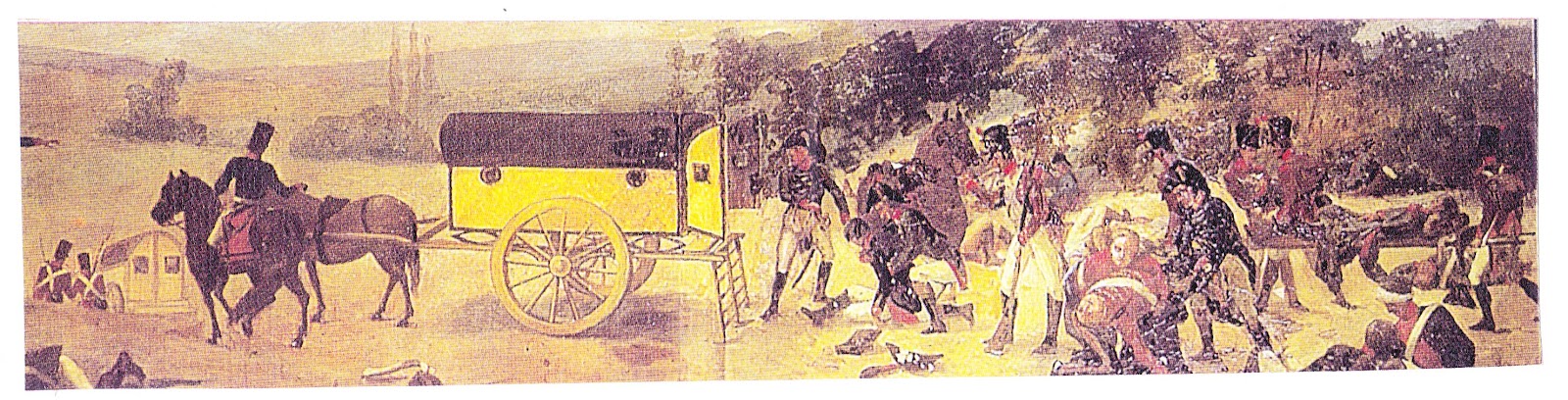
A rather poor image, but good in that it shows an ambulance and numerous medics in action.

Fortunately for all of us, like many in Napoleon's orbit, Larrey kept a journal, which he published, in part, during the Napoleonic era itself. His correspondence also survives, much of it having wound up in the Wellcome Institute archives. From these and other sources Richardson has assembled a vivid and moving account of a truly remarkable life, lead by a truly remarkable man.

Larrey was frequently called away from the wife (see above pic) and children he loved and treasured, to far-flung places where he carried out a very virtuous and very challenging occupation, often for precious little thanks, and frequently in great personal danger. But despite seeing so many others die on campaign, including such brave warriors and close personal friends as Desaix, Lannes and Duroc, Larrey himself was destined to outlive the adored imperial master whose friendship, respect and benevolence he earned.


Another view of the two wheeled ambulance.


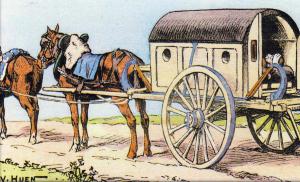
A larger four-wheeled ambulance. This an illustration, I believe, for a Historex model.

And unlike the unfortunate Marshal Ney, Larrey even managed to weather the two monarchical restorations, although after the second his prospects were, for a while, rather shaky. But his fortunes would rally several times in later years. 

After Waterloo he could easily have moved abroad - folk in high places, from the ruler of Brazil to the Czar of Russia, offered him prestigious posts - but he preferred to stay in France, where he lived long enough to see Napoleon return one final time, to the mausoleum of Les Invalides.


The way Larrey's story ends - I won't spoil it by giving it away - is typical of his life, embodying action, principle, duty, etc. And like his whole life story, it's also really quite moving. 

A really excellent and thoroughly enjoyable read. Highly recommended.

----------
An English translation of Larrey's memories can be read here

NOTES

[1] Abraham Lincoln.

[2] One of the best involves a shell going off directly overhead as Larrey is at work. He doesnt even look up! With miraculous good fortune, nobody is injured, but Larrey's hat is peppered with holes

[3] Some of these anecdotes very much run counter to the 'black legend' of his callousness, so assiduously cultivated by his enemies.

[4] There's an excellent story told here about how he saved 48 soldiers with hand wounds - who stand accused of inflicting them upon themselves and are sentenced to death - daring to stand up to all those, right up to the Emperor, who are keen to make an example of these unfortunates. 

[5] A British surgeon who tried to persuade Wellington of the benefits of Larrey's innovations, the flying ambalance in particular, found even shorter shrift than Larrey did in France!

[6] It's interesting that the Larrey on the stamp is the younger, fitter man, whilst the Larrey on the chocolate box, undoubted benefactor of mankind that he was, is the later more corpulent Larrey!


[7] The scenario was complex and tortured: Larrey's pay was significantly in arrears, and it appears that those with power in the administration decided that billing Larrey for the losses in military medical equipment that occurred in Russia, during the ill-fated 1812 campaign, would allow them not only to save on paying him, but to get money from him. Bloody typical pen-pushing, money-grubbing bureaucrats. Leeches!

Wednesday, 9 September 2015

WWII Media: HBO Pacific Tin Box


Powerful, compelling, moving. You thought Band of Brothers was good? This is even better.

Having acquired the Band Of Brothers 'tin box' some years ago, I finally got around to getting this. And boy am I glad I did. Band of Brothers is excellent, but this is - in my view - even better. I've now watched both series numerous times, and will doubtless watch them again in the future.

The series follows the 1st Marine Division into battle in several key actions in the Pacific theatre - Guadalcanal, Cape Gloucester, Peleliu, and Okinawa. Chiefly, we follow the action via the experiences of Robert Leckie and Eugene Sledge (whose memoirs formed the basis of the series, and which I have reviewed here on this blog). There’s also a smaller thread concerning the fate of gunnery sergeant John Basilone, whose actions at Guadalcanal lead to decoration and adulation, as he's cast as an all-American hero, sent home to raise war-bonds back in the U.S, before returning to combat at Iwo Jima. 

Decorated war hero John Basilone, wearing his Medal of Honor. Sent back to the U.S. to raise war bonds, Basilone starts to feel alienated and out of place, and yearns to return to his buddies, and ... combat.

Jon Seda as Basilone, rushing towards his destiny.

Pretty much all aspects of the campaign - leaving home, time en-route, combat, time behind the lines, home leave, injury and recuperation, etc, - are depicted, and the range of settings and scenarios is complemented by an equally diverse range of atmospheres, ranging from tender romance to brutal combat.

As is so well depicted here, the Pacific theatre could clearly be just as terrifying and intense as the European one: whilst Nazi racial policy in Europe was as extreme as such things can be, particularly on the Ostfront, it was being carried out predominantly against civilians, and with particular virulence in the East.

Obviously there was plenty of horrific brutality, even in the Western European combat theatre as well, but there was also a certain degree of fellow-feeling between some of the ordinary soldiery. I'm making these comments in relation to how both sides of this coin are portrayed in Band of Brothers.

Assault on Peleliu beach pinned down.

But, sadly, the Japanese had their own form of racial extremism, which appears to have run right the way through their military culture, such that not only was the 'death before dishonour' idea pursued  with ferovious intensity by all ranks, but also their contempt for both enemy soldiers and civilians was made frequently and appallingly manifest.

The Japanese fought rabidly, and were infamously brutal to their foes, frequently manifesting the same type of ferocious brutality that made the rape of Nanking so infamous. These traits were pretty common, it seems, amongst all levels of their soldiery, all over this theatre of combat.

The acting and direction, the scene-setting and special effects, the script and the overall arc of the narrative, all are superlatively well done. As well as obvious concern for historical accuracy, and, despite the brutality of the war, a clear intent to be even-handed, all make for a very, very good piece of long-form war-time storytelling. I was absolutely captivated, and riveted - albeit occasionally rather jumpily - to my seat. 

Leckie during the war.

Actor James Badge Dale as Leckie, in the series.

Sledge during the war.

Joseph Mazello, as Sledge.

This is compulsive viewing. I liked it so much I even watched some of the extras, which I don't normally bother with. I've also subsequently read a couple of the memoirs that formed the basis of the action: as with Band of Brothers, the series follows the fortunes of several key protagonists, chiefly Eugene Sledge and Robert Leckie.It's their memoirs I read, and they are well worth reading, but the reading experience doesn't convey the visceral impact that this series achieves so spectacularly well.*

Truly brilliant watching this. I just wish someone would approach the Napoleonic Wars with a similar budget and seriousness of intent! When I bought this, at Amazon UK, it cost just £15. At this point (having just checked back on Amazon at the time of posting this) it's just £15.99... bargain!

* I'll be posting my short reviews of both books here ASAP).

Tuesday, 7 April 2015

Book Review: Waterloo (Wordsworth Military Library) - Christopher Hibbert

Christopher Hibbert

With about 50 books to his name, mostly history or biography, Christopher Hibbert was a pretty prolific author, and highly regarded in his lifetime. But in this relatively small book on the battle of Waterloo, his own voice is a rather minor presence, because he acts more as a choreographer to the words of others than author in his own right.

Over approximately 250 pages Hibbert marshals a large selection of sources, most of which will be known to readers familiar with the era and his subject, to tell not just the story of the battle of Waterloo, but also give potted histories of Napoleon, Wellington, Blücher, the armies involved, the run up to and aftermath of the campaign, and the actions at Quatre Bras and Ligny, as well as the battle of 18th June 1815 itself. Pretty comprehensive for such a small book!

The Wordsworth edition. I got my copy for £2, from a book-seller at a wargames show (can't recall which/when). Amazon lists this as published 1998. I think mine might be 1993. Mind you, perhaps I saw 8 and read 3? Those numbers look similar-ish... at a glance!

The comprehensive sweep is impressive, taking in everything from the Congress of Vienna to the post-Waterloo evolution of the legend of Bonaparte, and ranges from material describing the intrigues of French and European politics to gory mud and blood spattered episodes on the battlefields. Although Hibbert's own writing skills aren't on display that much, he shows himself a dab hand at organising the accounts of others into a compelling and informative read.

The extracts from Houssaye's account of Waterloo are very exciting. Pictured above is a French imprint of his memoirs.

Houssaye's account is also available from numerous print-on-demand publishers at Amazon (and probably free, as an e-book, as well). Or it can be bought in either hard-back or soft-back from Leonaur (who also published the Jomini book I recently reviewed on this blog and at Amazon UK, the former here, and the latter here).

Originally published in 1967, Hibbert uses, by comparison with more contemporary methods, some really quite lengthy extracts from his sources. As with many such source-dependent books, the reader is often left desirous of reading these sources in full. Books such as this have lead me to acquire a steadily growing collection of contemporary memoirs and histories, from Napoleon's own writings on St Helena, to Capt. Siborne's two-volume history of the Waterloo campaign. Which is, I think, a good thing. However, one of the strengths of books like this is that they can cherry pick the sources, synthesising a full account from the best bits of a whole array of writers.

This is a very attractive map from Alison's History of Europe which you won't find in this book! 

There are, sadly, no maps at all, in my 1993 edition. So unless you either have maps to hand, or know the battle and terrain very well already, this is going to make the geographical detail, whether it be the larger movements of the campaign, or the the more detailed descriptions of the battle itself, tough to follow. I feel books of this sort really must have maps, so I have to dock a star for this omission. [1] Even though I know the battle quite well - plus I have numerous helpful maps I can lay my hands on if need be - nevertheless, I would've preferred to have had maps in the book. The absence of maps also makes this less than ideal as a starter book on Waterloo.

Textually, however, I found this to be a very compelling telling of the Waterloo campaign - I read the whole thing over the Easter weekend - and I liked that Hibbert contextualises it all with both background and after the event perspectives. Not an ideal intro to the subject, but good as a refresher, and (except that you may want some maps handy!) enjoyable as a standalone reading experience.

-----

[1] An interesting article, in the Telegraph, that underlines how the importance of maps - specifically in relation to Napoleon and the outcome at Waterloo - can be found here.

My much shorter review of this book for Amazon UK website is here.

Tuesday, 4 November 2014

Book review: With Napoleon in Russia - Caulaincourt


Caulaincourt's remarkable corrective to 'all the fables that have been told, and that will yet be told ...' 

Armand Augustin Louis de Caulaincourt (1773-1827) was a very interesting figure in the Napoleonic era, primarily serving France and Napoleon as a diplomat, and occasionally coming very close indeed to Bonaparte, in particular on the journey back to Paris during the retreat out of Russia, in the winter of 1812. His memoirs are interesting both because of this particular episode, with the unusual opportunity that circumstances afforded him, but also because they were not published during the lifetimes of either Caulaincourt or Napoleon, and, of course, numerous other reasons besides these.

The fact of the memoirs posthumous publication - in fact the manuscript, if the intro to this edition is to be believed, was nearly lost with the destruction of the Caulaincourt estate, only finally being published in 1933! - along with the tone of the writing itself, and the way that it dovetails well into many other contemporary accounts, has lead many authorities on the period to feel that it offers an almost unique insight into Napoleon the man (I'll return to this theme a bit later).

Napoleon in his winter togs, as painted by Russian artist Vasily Vereshchagin.

To my highly sceptical mind it's always debatable how far documents such as this, even those not meant for immediate publication, can be trusted, especially where the author make claims, as Caulaincourt repeatedly does, of speaking truth to power. Well, whatever the ultimate reality of that issue is, or was, one thing is certain, his memoirs - or at least this portion of them (this Dover edition only concerns itself with the 1812 related part; there's also material on the following period*) - are an excellent read!

Caulaincourt as sketched by J. L. David

When I read on p. 27 that 'like all curt and obstinate people, I remained on my own ground, maintaining only my own ideas', I immediately knew I really liked Caulaincourt! I loved his whole approach: his writing, like his mind, seems to have been lean and well-balanced, frank and open, and always interesting. Many writers of this era (at least as they've come down to us) wrote in very stodgily verbose styles, something that can be said of all kinds of people, from Siborne to Clausewitz, even Napoleon himself on occasion. 

The balance Caulaincourt strikes between criticism and admiration seems pitch-perfect: at points he is mesmerised by Napoleon's famed charisma - 'he seemed to me sublime'; whilst at others he isn't -  'the Emperor was carried away by his own illusion.' But he is always balanced and fair and, in the end, humble enough to conclude:  'Who could then foresee what has since happened?' 

Armand-Augustin-Louis de Caulaincourt

Caulaincourt also strikes a very successful balance between the big picture and the small details, such that we get character analysis of his boss, fabulous vignettes from the ever-fascinating story of the campaign itself ('for a few napoleons [I was able to buy], portraits of the entire Imperial family of Russia which the troops were using as screens in their bivouacs.'), through to many insights into Napoleon's thinking (extending in scope way beyond the 1812 campaign itself), noted down in far from ideal conditions whilst on a unique adventure in the company of one of recent history's true Titans.

In a recent debate for 'intelligence squared', chaired by by Jeremy Paxman, and featuring authors Andrew Roberts and Adam Zamoyski, the last named of these debaters cited Caulaincourt on at least one occasion, possibly more. Zamoyski, who has himself written one of the best short accounts of the 1812 campaign, was using Caulaincourt as ammunition for his anti-Napoleonic position. But, as I was reading these memoirs at the time, it struck me very forcibly that Roberts could equally well have quoted things from them to support his pro-Napoleon argument! I think this fact alone conveys quite well how candid and broad Caulaincourt's treatment of his subject is.

A British satirical print by Charles Williams: Boney returning
from Russia covered with glory.


A more sobre rendition of the same episode.

The same tableaux masterfully rendered in 28mm by Perry Miniatures.

The ultimate testimony is that Caulaincourt remained very loyal to Napoleon, and on balance one feels that he was, if you like, under the Great Man's spell. But this in itself is a very illuminating fact, because what it shows is that a man of great intelligence and independence of mind chose - as so many did - to follow Napoleon. In the end, therefore, I think Caulaincourt's memoirs serve better the argument for rather than against the idea that Napoleon was a Great Man.

Returning momentarily to the unusual insights this book gives into Napoleon the man (never mind the Great Man), I recall vividly a passage in which Napoleon and Caulaincourt discuss what might happen if they are intercepted en-route: after Napoleon checks that Caulaincourt has the pistols, and that they're loaded, they discuss the numerous grisly ends they might come to, all of which culminates in a near hysterical giggling fit.

Caulaincourt says of this episode: 'I never saw the Emperor in such good spirits, so human, so funny. His gaiety was so infectious that it was some time before we could speak a word without finding some fresh source of amusement ... I can't tell you what joy it gave me to see the great man laughing at this moment of supreme danger and nearly unbearable cold.'

died charging the Grand Redoubt at Borodino (L. Rousselot)

Another view of the same moment. This time the younger
Caulaincourt's death is in the background.

The life Caulaincourt and Napoleon lead was a very arduous one indeed - up all hours, always active, often in the saddle, sometimes even bivouacking, like the troops, en plein air, and frequently exposed to the very real dangers of battle - and this is something that these memoirs make abundantly clear. Indeed, Caulaincourt lost his younger brother (see above pics) at the Battle of Borodino, a passage in his memoirs that is treated with a very manly modesty and understatement, which only makes it the more powerfully moving.

This kind of Stoicism in the face of death and personal suffering is really quite incredible, and perhaps something that's hard for pampered civilians like myself to understand. Another interesting link here, is that whilst both Napoleon and Caulaincourt lost many dear to them in battle, they were both finally laid low by stomach cancer, Napoleon at the age of 51, and Caulaincourt at the age of 53.

Another portrait of Caulaincourt.

This Dover edition isn't the best served of books on 1812 in terms of maps or illustration, but then it is cheap, and these things can be found elsewhere. Unfortunately no credit is given to whoever did the translation, which is a pity, as it's excellently done. One very handy little feature that it does have, however, is a small biographical section in which many of the various Napoleonic Marshals, Dukes and suchlike are listed, along with brief potted histories. 

As any Napoleonic buff knows, this is an era blessed by a super-abundance of literature. For my money, Caulaincourt's memoirs rank with the very best in that extensive genre.

* Which, if it's as interesting and engaging as this, I'd love to read some day.

Yet another rendering of Caulaincourt's likeness,
from a French edition of his memoirs.