Showing posts with label erdpfahl. Show all posts

Thursday, 1 October 2020

Misc: Moulding & Casting, cont.


My erdpfahl. Far from perfect, but passable... I hope?

I'm kind of getting ahead of myself here, starting with the above image of numerous erdpfahl, or stakes, and other bits and bobs. But they are the item I first had a yen to scratch-built and cast in resin, thereby launching this whole moulding and casting saga.

I did a lot of mould-making and quite a bit of casting after the episodes I've blogged already. And I'm not showing all of them. One thing I did was cut the big mould which contained ammo boxes and shells down into two smaller moulds. And in turn I then further cut these moulds in two, adding more pouring and venting channels. The improved results, pictured below, show that this was a better idea than simply chucking the mould out.

Much better results from modified moulds.

The largest group, at the top, are best.

In the image above, I've cleaned up the castings from the modified moulds, and 75% or thereabouts are great. There's one iffy one, and one outright dodgy/unusable one per item: spent shell, live round, and ammo box.

Next up I decided to revisit copying some wheels. But this time in sets of four, and with properly laid out pouring and venting channels. Would this extra effort produce better results? Indeed, would it yield usable items?

Sets of better prepared wheels, ready to be moulded.

Wheel moulds in progress, plus another single erdpfahl mould.

Once all the new moulds were made I get the whole lot ready for a potential complete casting session (not, alas, of the Hollywood starlet variety). And here they all are. A good little set, quantity wise, even if not quality wise. One issue however, is that the resin I'm using cures so quickly I can't really cast a whole set as big as this lot. If I try to, the resin is already going off before I've done all the pouring.

Lots of luvverly blue moulds...

Before I move on to the final chapter in this saga, for the time being at least. Here are a couple of pics of some of the multiple little gubbins that I made for the 88s, this time cast in several sub-sets, as opposed to the over-filled single mould attempt I made earlier on. As can be seen in the upper of the two images below, I usually try and do a few other little moulds as well, to use up all the resin I've mixed.

Casting the 'multiple gubbins' moulds.

The results of splitting stuff up speak for themselves, I think

As the lower pic above shows, pretty clearly, breaking the over-filled mould grouping into smaller sub-sets paid off. Air flows far more freely through the admittedly still tiny passages, and the items are, as a result, far more likely to cast properly. The wheel on its own and a tiny erdpfahl, nigh on invisible below the wheel, were the only successes out of the several other smaller moulds in the upper of the two pics above.

After the steps shown just above, I moved on to a more mass production casting stage, and the results are shown immediately below. Including one set each of the new tyre casts. The latter aren't perfect. But I think they are usable. I'll be doing this with a few wheel sets. Primarily on account of Chester, our new cat/kitten, waging a pretty successful war on my mini-Wehrmacht forces. I have artillery, cars, trucks and even tanks needing various bits - mostly wheels - replacing. I had to move my whole modelling workspace upstairs out of the lounge on his account. The little devil! 

Once I got a stockpile going, I started to feel reasonably pleased.

Bagged up, sorted into groups for specific jobs.

And so it finally came time to add some of this stuff to a few of the models for which they've been produced. The moment of truth, I suppose! I started with the Hasegawa 88s, both of which needed erdpfahl, linkages, and handles. I've done one as if just deployed, before being staked, and the other with the stakes going through the arms/legs, whatever they are, ready to fire.

A Hasegawa 88with added stakes (stowed), linkages and handles.

Stakes deployed, and ammo and boxes added to the scene.

This is the Airfix 88, with stakes deployed, linkages, and (not visible) handles.

Another view of an Hasegawa 88, with stowed stakes, plus ammo stuff.

I've gone to great effort, considerable expense, and produced some not too great parts, that most folk probably won't even notice. Yay! That's the life for me. And, I think, quite typical model-making behavious, from what I see elsewhere. But I've had a lot of fun, and learned a fair bit. I think for my next attempts at mechanical reproduction, I'll try another and much cheaper technique. But before I get to that point, I think I need to paint these 88mm guns. And perhaps even base them?


Tuesday, 22 September 2020

Misc: the Saga Takes an Unfortunate Twist

Casualties of war... a load of busted micro-drills.

Oh dear... oh dear, oh dear, oh dear. 

My first moulding and casting experiment has been pretty disastrous. The casts were, with one iffy-ish exception - ironically the duff old erdpfahl (see two pics down from here) - appalling. I think this was caused by several factors. The chief one being crap mould design. I tried to pack too much into one mould, and I didnt go about the mould design and construction carefully or cleverly enough.

More casualties of war... first resin castings, a dizzzaster!

Sadly this means my two bigger moulds are most likely costly junk. Certainly the ammo mould doesn't work, as witness the above picture; contrast the part to be cast, bottom, with the casting itself, above/middle. I've yet to try casting the multi-part 88mm gubbins mould. But the second half of that cured in such a way that prising them apart was all but impossible, despite my use of the mould-release liquid that came in the casting set. So the mould is likely to be both damaged, as well as being crap to start with! I will cast with it, at some point. But I don't have high hopes for the results.

All the bits I cast: only the erdpfahl is tolerably ok.

One thing to come out of all this is a substantial re-design of the 88mm sundries, as can be seen in my next post. I've unpacked all the various bits, and wound up with four sub-groups. I've also taken more care with the forms, adding bigger and more plentiful pouring and venting openings. I'm hoping with better care and diligence this next time, I can get better results.

Sunday, 20 September 2020

Misc: Silicone Moulds & Resin Casting, the Saga Begins (Kind Of)

Ammo from the Hasegawa 88s I previously built.*

* The observant might notice I've drilled out the ends of the spent shells.

Things have gotten a bit asynchronous, if that's a word? What with techy issues plaguing me, from Apple iStuff that holds charge for 2 seconds to Blogger updates that pout the kibosh on the workflow, things aren't as smooth as they might be.

Anyway, the result is that this post ought to precede the last one, but I can't be arsed, faffing about any more than I already have. So here it is. These pics and the accompanying text document the run-up to the previous post, where I poured my first few silicone moulds...

My two main mould forms, ready for the first pour.

I used rice to calculate the approx' volume of silicone I'd need.

Not using the scales yet, but I've marked two lines...*

The thicker lower line is actual volume required; the thinner higher line allows for a little extra, just to be safe.

As can be seen, I built forms using foam-card and, for the two-part mould for all the scratch-built 88mm gubbins, embedded the parts in plasticene, with the added channels for vents/sprues. The ammo is purely for an experimental test moulding: can I reproduce stuff in a one-piece mould and get it all out on long single beam style 'sprues'? The 88mm bits, on the other hand, I'm intending to produce in small quantities, to detail my models.

I mixed the silicone in a disposable cup, and... gulp, poured it.

About two hours later, it looked like this... i.e. much the same!

I spent a fair bit of time after pouring the silicone tapping the forms, and popping air bubbles as they rose to the surface. This was kind of satisfying in the same way that dealing with blackhead can be (overshare?). I now had to wait, between 8 and 24 hours, to de-mould. I'd then be ready to pour a test batch of the ammo. But the 88mm bits and bats would need the second half of the mould pouring first.


Misc: Silicone Moulds & Resin Casting, the Saga Continues...

Two extra last-minute moulds...

The above photo shows my first two silicone moulds to be, er... de-moulded? Is that the right term? At left is my first attempt at an 88mm erdpfahl, or stake. That mould is one-piece, with a slit cut along it longitudinally, on top. In the centre is a repro of a German truck wheel. That is a two-piece mould, but made by cutting a one piece silicone mould in two laterally, around the circumference.

Both of these are purely experimental tests, not for 'production'. The erdpfahl, 'cause it's too crappy, and the wheel, because it's a copy of a commercially available model piece. Anything that I might plan to reproduce for actual use will have to be original, so as to not infringe on copyrights. But in terms of testing out the mould-making process, it's helpful to try out a complex shape with fine detail. In addition, both pieces, the erdpfahl and the wheel, have holes that pass though the whole piece. And I wanted to see how moulding and casting such things worked out in practice.

These two moulds were actually afterthoughts, made with leftover silicone - which had already been left an hour or more - from pouring the two larger moulds I'm making. I really wasnt sure if the silicone was too far gone already. But they appear to be usable, from a brief visual inspection. These moulds have been opened up after about 8-10 hours curing time. I'm going to leave the other larger moulds for the full 24 hours (the product recommends between 8-24 hours).

Tiny ill-formed moulds, made with leftover silicone.

I'm putting this post together without access to my iPhone - battery dead/charging, elsewhere! - on which I have most of the photos of all this process. So I might return to and amend this post, to show more of what I did. But here's a brief summary: The erdpfahl stake is scratch-built from styrene, the wheel comes from a kit, they're both 1/72. I used foam card and plastic (styrene) card to make forms, or enclosures, to hold the silicone. And on these two instances, I rather messily slopped the partially cured silicone into one side of a rectangular or near square form. I then placed this on a small foam card substrate, popped the piece I'm moulding into the silicone, and then plonked more of the blue goop on top. 

The silicone and resin moulding and casting set came with wooden spatulas, like oversized lollipop sticks. I used these to press the silicone and mummified parts into the form. These were then left overnight to cure, and freed from their forms this morning. The moulds needed tidying up a fair bit, as I'd made them in a very messy ad hoc way... the were after all afterthoughts/experiments. And finally I had to to cut into the silicone moulds in order to retrieve the cast objects. One cut along the top of the mould, from the pouring sprue/vent, for the stake, which I popped out by deforming the mould, and an all round lateral circular cut for the wheel (I'll also need to cut a pouring and possibly also an air-release vent for the latter). 

I also had to do some fiddly cutting inside the moulds to release both pieces, on account of the through-holes they both feature. After all this stretching and butchery, will these moulds produce usable castings? I'll have to have a try, and see. In the meantime, I'll try and add more pics from my phone, once that's back to life, and exercise patience re the larger pair of moulds.

Monday, 14 September 2020

Misc: Detailing my 88s...

My collection of scratch-built bits for resin casting nears completion....

Here's where I was at around midday today, having added a three shell wicker ammo-box (inc. lid), a single shell metal canister, and a spent round. These are in addition to the carriage mounts, erdpfahl (the trefoil perforated stakes), a winding handle, and a linkage for the folding legs, that I'd already made earlier.

Making the live shell - the only new element in the second pic, below - took ages. First I tried sculpting sprue using a Dremel style hobby tool. But this span too fast, even wound down to its slowest speed, causing the sprue to overheat and snap. I then tried working with brass. Not having any brass rod, I hacksawed a strip off a piece of brass sheet. I then span that in the drill to round it down. This also overheated and snapped off, long before it had gotten properly shell-shaped.

And bingo... all the sundry elements I'm intending to cast.

So, after numerous failed attempts, I reverted to searching out bits of sprue of roughly the right diameter, that might be viable for the different segments: base, propellant case and warhead. I wound up gluing three different diameter bits of sprue together, which, with some minimal profile shaping, finally gave me a shell I was happy-ish with. 

I think I'll make an initial mould and cast several sets, and then perhaps I'll make a second mould with a proper complement of items; two carriage mounts, four stakes, x ammo boxes and shells, etc. Or maybe the first mould will suffice? I guess I'll see which way the wind blows when the time comes...


Sunday, 13 September 2020

Misc: Scratch-Building Details for 88mm Guns

Making fins for the erdpfahl.

I'm really enjoying learning about the 88mm guns of Germany's WWII arsenal, and building a few models of them. I've decided to take my first steps into casting resin parts. Today I started making several small bits and bobs with a view to moulding them. First, my beloved erdpfahl, and then the carriage-hooks that support the gun between the two bogies. 

As can be seen, above, I tried two sets of erdpfahl, or stakes. The first, on the left, were pretty poor. The second, at right, were more satisfactory. I used the wire mesh to space a series of five pin-prick locator marks, made with my DIY pointy tool. I then drilled through these with a 0.5mm drill bit. Despite it being pretty poor, I put the first one together anyway, as pictured below. This revealed that the 'wings', or fins, needed trimming down, which I've started to do to the second set, as yet unassembled.

Refining the second set of stakes.

Below, the two erdpfahl, along with a wing or fin template. Upper is the less successful of the two. The lower is the better one. The central core is yet to be sized/shaped. I turned the cruciform base upside-down, so as to compare them with the ones integral to the Zvezda 88mm.

Erdpfahl #1 and #2, and the fin template, alongside the Zvezda example.

Next up, I started on a pair of the mounting hooks. The plan will be to make sets of four stakes, and two pairs of these hook mounts, a few other bits and pieces, such as a couple of crank-handles, linkages (for the folding arms or legs, or whatever they are), and numerous ammo boxes and shells, etc. Once I have a full complement of these oddments, I'll make a master mould, so I can cast complete sets in one pass.

Making a pair of scratch-built carriage mount hooks.

I'm keen to find or make some decent crews as well. I'm not too keen on any of the figure sets I've seen so far. I'm thinking crews in overalls/boiler suits, crews in shorts, crews with braces but no shirts, etc. The sort of stuff you see in many wartime photographs. I've wanted to sculpt some wargaming figures pretty much all my life. I've even tried a few times, albeit never very successfully. So this next step is something I'm both excited and anxious about...

Thursday, 10 September 2020

Kit Build/Review: Hasegawa 1/72 Flak 18


I do love my 88mm guns! Here's my second by Hasegawa, only this time the 18, not the 36, and my fourth 88mm Flak gun. Whereas the others all had their protective shields, this one is without that feature, as indeed many were. I've also modified one of the wire reels, to show it empty. I did want to have some wire on it, but was unable to stretch any sprues to the right length or thin-ness.

I'm getting into a habit of laying out all parts in groups, for clean up.

Ordered 100 Swann Morton 10A scapel blades. The best!

I noticed in this second build a mistake I'd made on the other Hasegawa gun. But it's only minor - to do with the cruciform gun mount legs/supports (feet?) - and can most probably be easily corrected. I also noted that whilst most of the design of this model is pretty good, one or two steps are s little unclear in the instructions. And some parts could be made to fit better. An example of the latter is the way too large holes for the two levelling wheels on the gun base, which kind of float in a void, until the glue sets.

Here are all my other 88s.

What... no progress? Well, actually this is over an hour later, after all the clean-up.

My obsession with the erdpfahl, or stakes, has made me realise that that's what the two sledgehammers on one of the bogeys are for. Strangely, the two folding limbs of the base have the 'female' holes into which the erdpfahl are driven, in very low relief. But they're not depicted on the fore/aft axis. Bizarre! When time allows I'll be casting some in resin, to further detail all but the Zvezda 88, which actually has them.

The real fun begins...

Bogey number one is done.

Bogey number two (titter...).

The gun itself; upside down to protect those still-gluing delicate little hand-wheels.

Thar' she blows... Note one empty cable reel.

I've another 1/76 Airfix 88 to build, plus bogeys. Think I'll probably do that afore I decide on painting and marking schemes. Plus there's the prospect of some resin casting for extra details, such as erdpfahl and ammo/ammo containers, etc. 

Build wise, it's good to be getting back into modelling. I must confess I'd prefer there to be less clean up time, a stage I find pretty tedious. Review wise, I rate these Hasegawa as both fun to build and decent models of the weapon. A lot of the detail one would hope for is present, such as the fuse setter, sextant, and even the bell (and wiring) on the left side of the gun mount. Zvezda's Flak 36 may have more and better detail. But it doesn't have the bogeys, which is a real shame. 

Tuesday, 8 September 2020

Misc: More 88mm Madness...

Resin casting kit from Sylmasta.com.

My resin casting set, ordered yesterday, arrived today. Woohoo! Great service from Sylmasta.com.

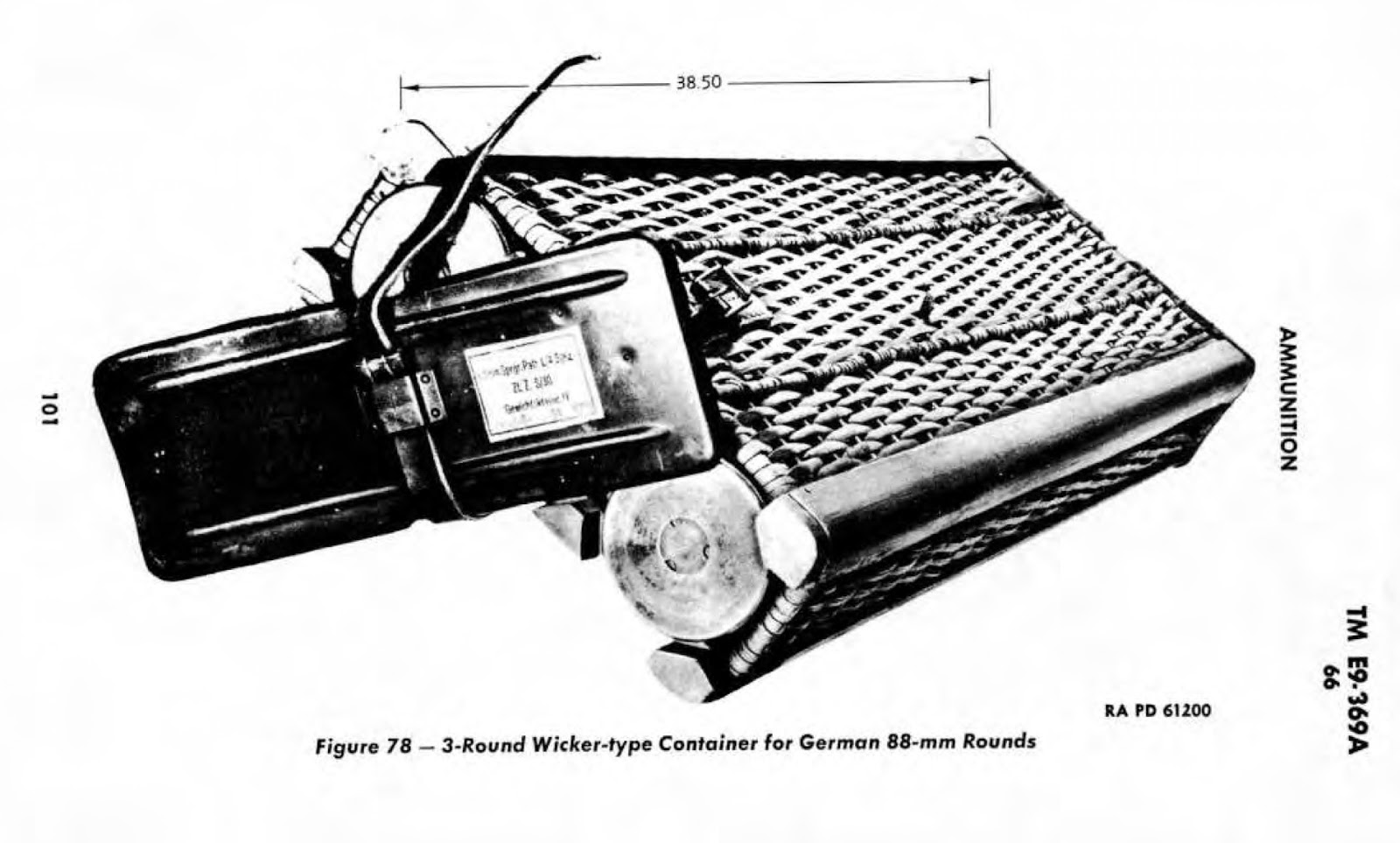
I found an excellent reference resource, here: TM E9-369A: German 88-mm Antiaircraft Gun Materiel (Technical Manual, War Department, June 29, 1943). Here are some screenshots from this online document that show the erdpfahl, and how/where they were located and used.

A kind of two in one picture.

The figure gives scale; the stakes are big!

I'm assuming that there are four stakes. But the imagery I've seen thus far is not clear re how they're stowed. Several images suggest that they're not stored one per leg, as you might expect. I'll consult my Haynes manual again, and the photos I took at Muckleborough, to see if I can clarify. Oh, and I can look at the Zvezda kit, as I believe there are some on that.

Anyroad, I think these erdpfahl doodads will be my inaugural resin-casting experiment. I might also do some ammo rounds, both spent shell cases and live rounds, and the containers they come in. The latter were either individual metal canisters or the three-round wicker boxes, as pictured below.


Sylmasta have a video on YouTube that shows how to use their kit:


Misc: 88mm Flak Madness

MORE FLAK 88 STUFF!

Since recently building a Hasegawa 1/72 Flak 36, and buying the Haynes 'manual' on this famed WWII workhorse (in its several types), I've kind of gone a bit nuts for the 88mm! I just bought another Hasegawa 1/72 kit, this time the Flak 18 variant, and a second 1/76 Airfix kit. The plan is to build these sans armoured shield.


Two new big guns...

One detail that emerged from studying the Haynes manual on the 88, was the absence on most 1/72 or 1/76 kits of any 'erdpfahl', or stakes, on the articulated side legs/arms of the cruciform gun mounts. I need to check, but I think the Zvezda 1/72 models might have them. Certainly the Airfix and Hasegawa don't. A desire to scratch-build these little doodads - used to help cope with gun recoil - perhaps even to batch-produce some in resin, is thus born! 

The erdpfahl, or stakes, are labelled in this German diagram.

Erdpfahl are 'trefoil', three-lobed/winged; part 8, the distinctive holed fins (AFV Club 1/35 PE).

Interest in other details, such as the presence or absence of the crew shield, and how that's mounted (the Zvezda is the best of the kits I've made so far by a long way, in this latter respect), or the rolls of cable on the bogies, and how these facilitate the communications wiring of the guns electronics, starts to rumble into life. Details like the sextant, dials and fuse-calibrator all start to seem more important.

And then there's the issues of deployment and transport: on or off the bogeys? And how about guns with recoil, or mid-firing? What about prime-movers, or guns mounted on vehicles, or even buildings? And how about the 128mm or even 150mm cousins of the 88mm? And I still haven't addressed my latent desire to sculpt my own crews*... This hobby certainly taps right into an obsessional part of the nervous sytem, no doubt about it!


The short video above, with a primitive but effective soundtrack added, uses archival WWII footage (much of which is also colourised) to show the 88mm in action. Fascinating! It leaves me wanting to convert at least one model so as to give it recoil, or depict it in the firing/recoil state.

* I ordered a resin casting kit from a company called Sylmasta.com, with a view to making various parts, like the erdpfahl, some ammo, and perhaps even some crew figures.