Showing posts with label TV. Show all posts

Tuesday, 17 March 2020

Media: Selling Hitler,


NB: This is another of my occasional archival posts, originally written ages ago and posted elsewhere. But it came to mind as I was reading and reviewing Tim Heath's recently published, Hitler's Housewives, as I wondered (or rather worried) about the author's unverifiable sources.

This short 5 episode series tells of the highly intriguing affair of 'the Hitler diaries'. Bought by a credulous and over zealous German reporter with a Nazi fixation, and sold to Stern magazine (and beyond), they were endorsed by handwriting analysts and even some historians, but forensics eventually proved them to be fakes.


It's a strange thing, in a way, knowing the outcome before you see the story unfold. But the drama is in the desire to believe, which grows exponentially the more money and faith is invested. The acting is good, with a strong cast filled with both the well and the lesser known of British acting at the time, headed up by Jonathan Pryce, who's excellent as Gerd Heidemann, the Stern reporter nicknamed 'the bloodhound', whose nose for a good story, whilst not quite failing him altogether, certainly leads him astray.

Some pretty big guns, like Tom Baker & Richard Wilson are great as other journalists, some supportive some sceptical. Alan Bennett is very enjoyable as historian Hugh Trevor-Roper, and Roger Lloyd-Pack makes a credible David Irving, whilst Alison Doody is suitably siren-like and enchanting as the rather air-headed air-stewardess wife of Heidemann. Barry 'Dame Edna' Humphries is convincing as hard nosed mogul Rupert Murdoch, and we even get to see a very young Peter Capaldi.

Alexei Sayle plays Konrad 'Connie' Kujau, a former petty criminal turned dealer in Nazi-memorabilia. Discovering he could turn his artistic skills into large sums of cash by forging pretty much anything his shifty but eager clients wanted, this ultimately leads him to fake a growing collection of 'Hitler diaries', which he feeds to Heidemann. Sayle is an aptly ironic and intriguing choice for this role, which he plays pretty close to the knuckle in terms of comedy (almost lapsing into farce), given the combo of his personal left-radical leanings and Jewish ancestry.

Selling Hitler aired in '91, but looks and feels very '80s (exhibit A: Peter Capaldi's hair!). On the whole this is fine, and quite interesting in itself. But there's one moment where the full horror of the worst of the '80s asserts itself, when Heidemann and his wife go on a shopping spree with his ill-gotten gains; thus brief episode is set to an appallingly awful slice of electro-pop. It was very difficult to watch that mercifully brief scene! Fortunately it was a one-off.

Much of the filming appears to have been done on location in Germany, which helps make it look authentic, and there are mocked up bits of newsreel footage (spliced with genuine stuff) that relate to the backstory of the plot. There are also some bizarre pseudo-Wagnerian moments, complete with near surreal '80s style 'video montage' effects. The titles also betray a slightly comic edge.

All in all, this is an odd package. Mostly played quite straight, it nonetheless has occasional undertones of comedy. This, and the surreal Wagnerian stuff, conspires to make it feel somewhat uneven. But it tells a very interesting story, and even has a strange period charm. Definitely well worth watching.

Tuesday, 20 August 2019

Media: The Pacific War in Colour


Just discovered this fantastic series on the Smithsonian Channel. It's already up to episode six of ten. And I can't seem to find a way, via my Virgin set-top box, to get back to episode one, and catch up. If anyone happens to read this and knows of a way, please let me know!

Tuesday, 5 March 2019

Kit Review: S-Models 1/72 Kettenkrad & Pak 36

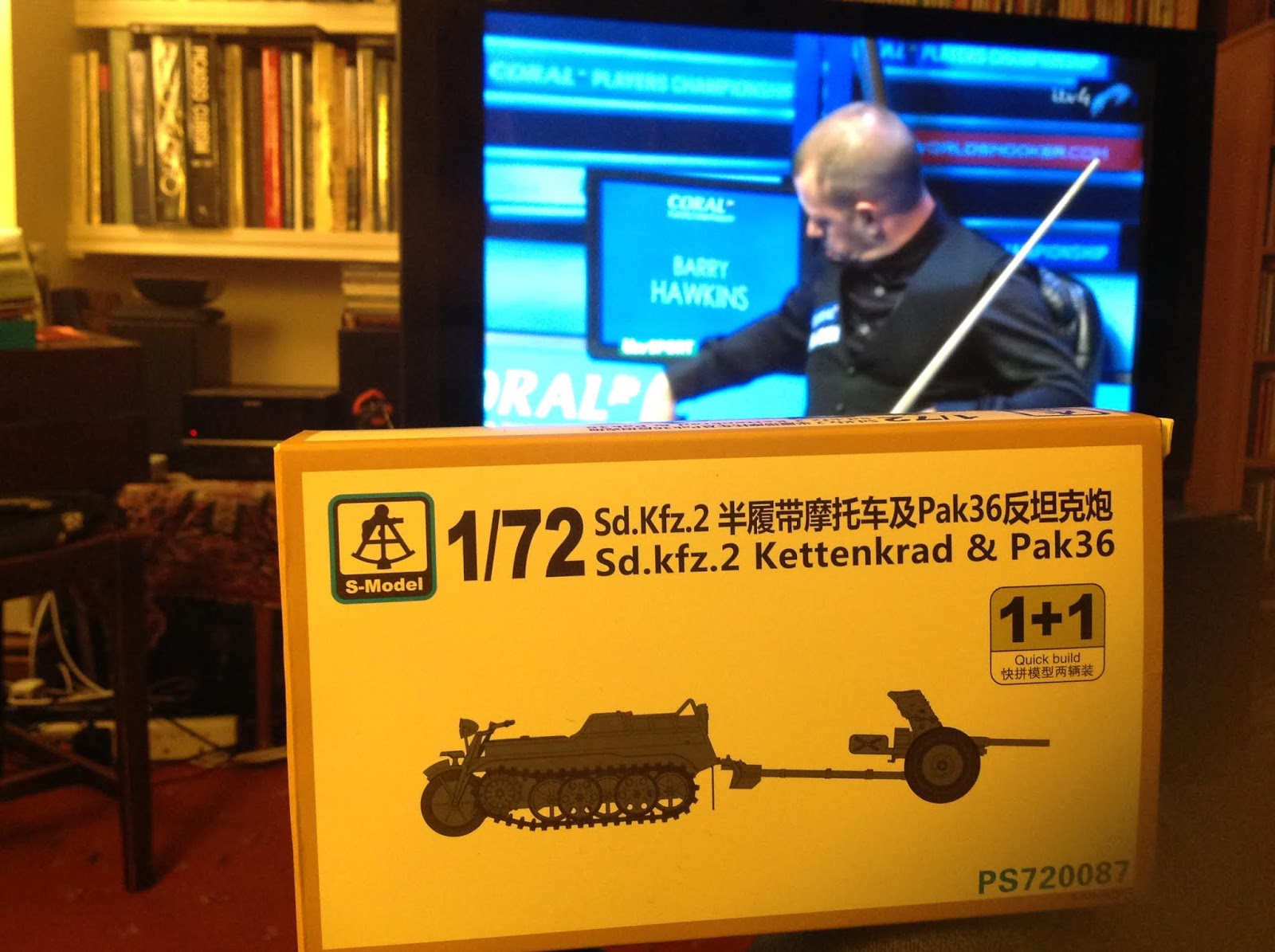
The box, and Hawkins, on the box.

Watching snooker on TV and building the two Pak 36 guns from my first ever S-Models kit this evening. Ronnie O'Sullivan made short work of Barry Hawkins. After the match O'Sullivan seemed a bit amped up, like he'd just done some coke, or something. 

Two gun sprues.

Partially assembled.

Well, I have to say I'm impressed with my first S-Model kits: cleanly moulded, decent fit. Good detail. Nice models! Shame there's no figures. Crew for the guns and a driver for the 'Krad would've been fab. 

Two rather cute little Pak 36.

I started this '1+1' kit - you get two models, and in this instance that's actually two of each, so four models - with the guns. Built those downstairs, watching TV on the sofa. Not ideal conditions for modelmaking. But fun! 

Building the Kettenkrad... in bed!

As midnight approached, bed beckoned. But I wanted to finish the kit. So I took the Kettenkrads up with me. Built them in bed... It's now 2.15am. Time to stop typing this and go to sleep!

And they're done.

Wednesday, 26 September 2018

Film Review: The Execution of Private Slovak, 1974


This 1974 made for TV movie* is critically lauded, and Martin Sheen won an Emmy for his performance. But, ugh... what a horrible story it tells! 

As the title starkly conveys, what we have here is the sad tale of the demise of private Eddie Slovik, the first man to be execeuted by the US for desertion since the ACW. And the only American soldier executed purely for desertion - plenty more were executed, but for crimes such as rape and murder - during WWII. Frankly, it's quite depressing viewing! It's well done though, and addresses something worth remembering.


An advert for the TV movie at the time it came out.

The book on which the film was based.

Martin Sheen plays the part very plausibly. One wonders how close he gets to the real Slovik, who was a former petty criminal. Whatever else he was, or had been, at this juncture Eddie Slovik is certainly one unlucky man! But then again, during wartime a lot of men (not to mention women and children) find themselves equally out of luck. And compared with the profligate brutality of Nazi Germany or Communist Russia... well, it doesn't even need any further comment.


Not light entertainment or easy viewing, but a good film about a grim subject.

Eddie and his wife, in happier times.

* Trivia fans might be interested to know that Levinson and Link, creators of Columbo (which I love!), worked on this film.

----------
NOTES:

According to Wikipedia, and I think it's also used in the film, Slovik said the following to his excecutioners: 'They're not shooting me for deserting the United States Army, thousands of guys have done that. They just need to make an example out of somebody and I'm it because I'm an ex-con. I used to steal things when I was a kid, and that's what they are shooting me for. They're shooting me for the bread and chewing gum I stole when I was 12 years old.'


Calka visits the Sloviks, united in death.

WWII veteran and fellow Pole Bernard Calka campaigned to have Slovik's remained repatriated, and interred alongside his widow's grave.

Monday, 11 June 2018

San Diego Model Railway Museum, on TV

Watching telly last night, I saw this... (apologies for the crappy pics of my TV screen)

Did you spot the oversized head, on the horizon?

Visitors give a sense of scale.

It was only a brief and passing segment, but it was nice to see some model railways on TV. I think what I like best about them, perhaps a bit perversely, are the landscapes. As a wargamer I want my landscapes, if/when I finally get that far with any of my various projects, to have the wow factor these set ups have.

Cool beans!

Portillo enthuses about the impressive layouts.

It was on Michael Portillo's final episode of Great American Railway Journeys, when he visits the San Diego Model Railroad Museum. The models and layouts are maintained by volunteers, and they've been continuously worked on for 35 years, and are valued, according to Mikey P, at $3,000,000!

One of the team of volunteers who maintain the exhibits.

It's on an impressive scale.

Watch it on iPlayer, when it's uploaded.

I emailed the museum, asking for some pictures, or permission to use some from their website. They kindly sent me the following images:


----------
Kind of unrelated, but also seen and enjoyed today:


Saturday, 9 June 2018

Film Review: Band of Brothers, 2001


NB - Another unfinished post from the vaults is dusted off and put online.

As I type this I'm watching 'Points', the tenth and final instalment of the Band of Brothers TV series. I'm starting to lose count of how many times I've seen it now. This - perhaps my fifth or sixth viewing - was possible thanks to being laid up with a cold; every cloud has a silver lining, eh?

Based on the book by Stephen Ambrose, Band of Brothers is ten episodes long, and follows Easy Co., 2nd Battalion of the 506 Paratroops, 101st Airborne Div., from training in the U.S. to wars end in the territories of the 'Third Reich', via England, France, Belgium and Holland. 

Soldiers of the real Easy Company.

Damian Lewis is excellent as Richard 'Dick' Winters.

The real Winters.

An ensemble piece, with different episodes following different characters, witn Damian Lewis' Richard Winters character at the centre of the story, it seeks - and very largely succeeds - to be both accurately historical, and compelling TV drama. There's some license with history, mostly compressing stuff to fit it into the narrative, with little that's plain wrong (although there are, as always in such human endeavours, errors and ommisions).

Costing $125 million, it was the most expensive TV-miniseries ever, until eclipsed by companion piece The Pacific. Largely filmed in England, with some 'Fatherland' segments filmed in Switzerland, it's a properly epic production, superbly staged. Fussy gear buffs will love the accurate materiel. My only gripe on this front is the fake snow in the winter scenes (Bastogne, Foy). How all this was done is shown in the DVD extras. It's incredibly impressive.


The production is spectacular. [1]

David Schwimmer as tight-ass disciplinarian Capt. Sobel, martinet of Currahee.

For Ron Livingston's Lewis Nixon, fond of a drop of Vat 69, Goering's private cellar is heaven.

The cast are, by and large, superb. And one really does become drawn into the stories of the protagonists. I'm certain I'm not alone in 'googling' various characters and events as I watched this each time, to correlate history with events as they're depicted here. It's obvious from info on the web that the series has spawned an immense amount of interest in this period of history, which has to be good. 

Of course there's an important difference between drama and history. And sometimes it seems people who've seen this take it as unadorned fact. Of course it isn't. Tom Hanks and co. have obviously aimed for accuracy, authenticity, and so on. But he and his team have also been candid about the process of turning history into TV drama.

A tense moment... the series doesn't shy away from the darker aspects of war. [2]

Atrocities by both sides are shown, and the ambiguities and the fog of war have their part to play. Both sides are also depicted with a clear even-handedness, sometimes even surprisingly so. The Holocaust is covered in the 'Why We Fight' episode, but we are not spared scenes of summary executions of Germans, or even 'collateral damage' in the Allied ranks. 

All facets of the war as these guys experienced are covered, from jump training at Taccoa, in the U.S, via England and D-Day, to France, with Bastogne, Foy and Hagenau, en-route to Bavaria and Austria, winding up at Berchtesgaden, and Hitler's 'Eagle's Nest'. From r'n'r, and training and supply behind the lines, to the mud and blood of conflict, there's stuff here for most tastes.


The real Easy Co. at The Eagle's Nest.

And a similar yet different view of the HBO scene.

One notable absence is any concession to a romantic subplot. I don't miss this, as such threads in this kind of drama are all too often incongruous distractions. It's interesting that in The Pacific there's a clear choice include this usual staple of even war dramas. The Pacific is a bloodier and more intense series, combat wise. Judging the two series against each other is tricky. For a whole I thought I preferred The Pacific, after first seeing it. Now I think both series are brilliant, and probably about equal in merit.


Some might think Hanks and co., and indeed America as a whole - the term 'The Greatest Generation' became a popular description of the generation that fought WWII - continue to be over-reverential in their attitudes to the war. Michael Kamen's magisterial and mournful signature theme (influencing war movie theme-music worldwide that came after!) captures this feeling. That may well be true. Whatever the case, Band of Brothers is a superb achievement, and a terrifically compelling and enjoyable TV-series.

Ze vorr is over, ja? Ve all kamerdan now!

To their great credit, BOB gives due respect to the German army, perhaps best of all in a moving speech delivered by Wolf Kahler.

Winters accepts the surrender of a German officer, played by Philip Rahm: note similar set of German jaws!

----------
NOTES:

[1] I think I heard, or read somewhere, that quite a lot of the filming was done in Hertfordshire. Or if not Herts, then certainly somewhere in England.

[2] This particular scene, from the final epsode Points, is perhaps one of the most harrowing. Another is the summar execution of a former (presumed) German soldier, in an idyllic bucolic pastoral setting.

Thursday, 7 June 2018

Book Review: Redcoat, Richard Holmes


The full title of Richard Holmes' fantastic book is Redcoat: The British Soldier in the Age of Horse and MusketIt's wide-ranging, detailed, well-written, exciting, and packed with material that educates and entertains.


The format of the book is, I think, a great success; eschewing the straightjacket of strict chronology, Holmes subdivides his very broad subject according to his own schema, dealing in broad strokes with different areas, and yet maintaining focus and interest with myriad details, and plenty of contemporary first-hand material.


An early Redcoat: 29th Foot, 1742.

The classic Napoleonic era Redcoat.

First situating the whole project in it's times, he then brings the political and practical structures into focus, before zooming in on the respective arms, and then panning out across the landscapes of home service and foreign campaigns, all the while stuffing his erudite narrative with pithy and frequently entertaining quotes, from original sources (it leaves me wanting to read more of Holmes' sources: e.g. the memoirs of individuals like rifleman Harris), that are really very engaging.

There was a time when Holmes frequently graced our TV screens.*

And he was himself a former soldier.

The book is also pretty well stocked with evocative illustrative imagery, as well as several rather basic maps of the main theatres covered during Holmes' chosen period. One omission I'd like to see made good in future editions would be a glossary. It's also worth being aware that whilst Holmes doesn't shy away from the more macabre aspects of his subject, from brutal and duplicitous enforced conscription, through corporal and capital punishment, to the horrors of war itself, it's clear that this is the work of someone in love with his subject (an ex-military man himself). I.e. don't expect this to be a clinically impartial look at war and warriors, it's clearly both passionate and partisan.

All told, this is a hugely compelling and enjoyable read, and I'd recommend it unhesitatingly.

* Having passed away aged just 65, in 2011, he'll not be fronting any new shows, alas. It'd be good to see his work back on screen.