Showing posts with label David Chandler. Show all posts

Saturday, 22 September 2018

Book Review, The Campaigns of Napoleon, David Chandler


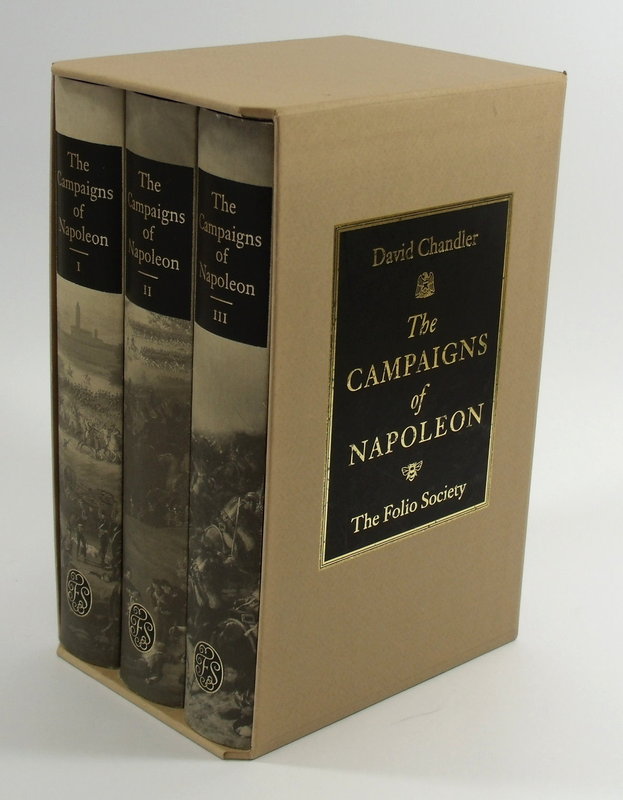
Well, this one really is an essential classic. And I'm lucky enough to own the very handsome Folio Editions trilogy, in hardback, in a nice slipcase (as pictured above). Lovely!

Vol I

In the first volume one of this superb trilogy, Chandler sets the scene, telling us about Napoleon's rise, from the petit noblesse of Corsica, thought the turbulent waters of the French Revolution, to military fame in Italy. We see Bonaparte adventuring in the near 'Orient' of Egypt and Syria, before returning and assuming power in the coup of Brumaire. 
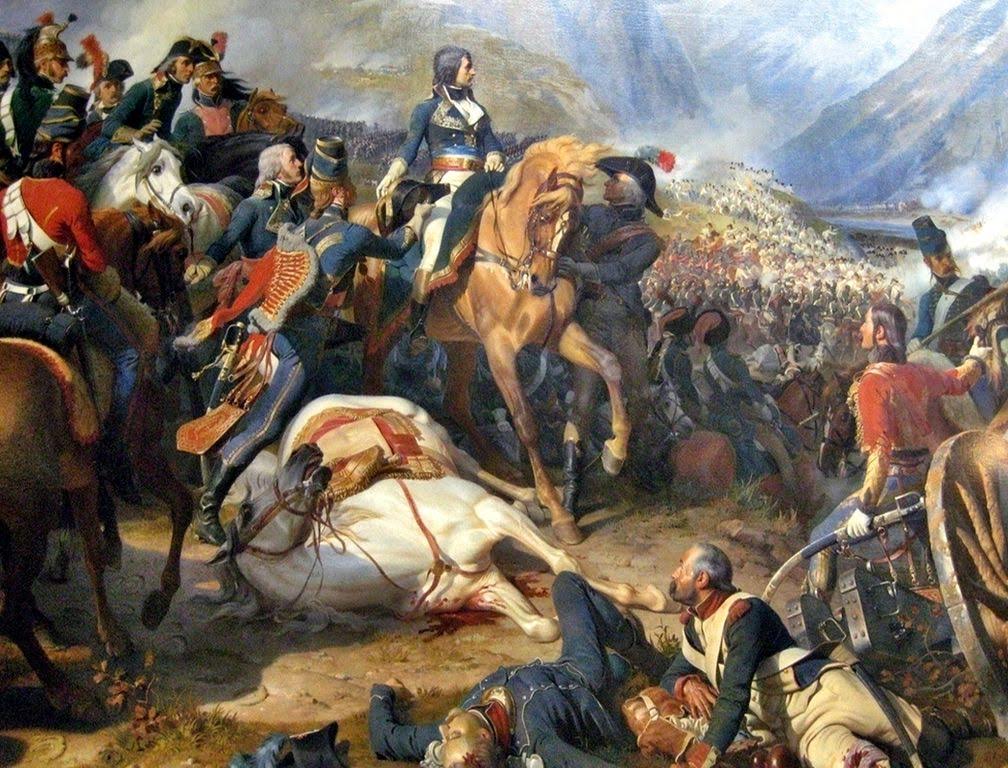
Rivoli, Napoleon's star rises.

Chandler's narrative conveys his enthusiasm for his exciting and colourful subject admirably, balancing a clear passion with lucid objectivity and judicious critical insights. A good deal of space is given over to an analysis of Napoleon's early ideas, and how they evolved; where they came from, and how he put them into practice and developed them. 

And this all happens surprisingly early, both before, during and following on from his Italian campaigns, showing, as Chandler notes, a precociousness and audacity that would see Napoleon's star rapidly ascend. This first part of the story/trilogy is tremendously exciting, charting the improbable but seemingly inexorable rise of the young Napoleon. It has the colour and grandeur of Greco-Roman myth, which Napoleon would've liked and appreciated.

Vol II

In broad brushstroke terms this second volume starts with Ulm/Asterlitz, and ends at Borodino, thus running from late 1805 to late 1812. Here Chandler covers the 1805 campaign against Austria and Russia, culminating in Austerlitz, the 1806 war with Prussia (Jena-Auerstadt), on into the 1807 campaign in Poland against Russia (Eylau and Friedland). 

He then takes a Peninsular diversion, focussing mostly, in keeping with his title, on Napoleon's part in this theatre; from his 'ill considered decision to intervene in Spanish affairs', deputising to oft-incompetent subordinates, to his brief but effective personal intervention in the war itself, before returning to more central-European affairs, with the campaign against Austria in 1809.

Napoleon visiting the bivouacs, in the eve of Austerlitz.

One thing that struck me in all this was, well... no, two things really, were: firstly how minor the Spanish business seems in the larger picture, even though it would ultimately prove, as the suppurating 'Spanish Ulcer', a decisive contributory factor in Napoleon's downfall (a fact not so easily appreciated from the British perspective, with our tendency to obsess over our part in these wars).  And secondly, that for all the talk of continual or 'total' war [1], there are large periods of relative peace within the bulk of the territories under the Imperial jurisdiction. 

For example, between the end of volume one, and the start of volume two, or roughly 1802-1805 [2]. And, excepting the ongoing rumblings of the Peninsular, between 1809 and 1812 [3], when the narrative jumps from Wagram and the treaty Pressburg to the invasion of Russia. The latter debacle ends part two, and marks a foreboding and decisive end to the period of Napoleon's almost unassailable ascendency, and, in consequence, makes for a narrative that continues to be both gripping and dramatic.

Vol III

Napoleon's regrouping and rebuilding of the French and Allied armies, and his waging of the defensive campaigns of 1813, clearly excite Chandler. And he communicates his enthusiasm for this period both ably and contagiously. And then of course there's the audacious return from exile and the Hundred Days. 

This is factual history with excitement levels to eclipse all but the very best fiction. Indeed, history like this is better than practically all fiction, in my opinion. If someone made up a story like this, who would believe it? Napoleon returns from Elba with barely 1,000 men. And within days he's back in Paris - this whole story is the subject of the excellent 1815, The Return of Napoleon, by Paul Britten Austin - a whirlwind of activity, as he seeks peace whilst preparing for war. Encroyable!

Leipzig.

As you'd expect, Chandler's coverage of this whole exiting episode, set within the equally exciting larger epoch, strikes a perfect balance between the big picture and the smaller interesting details. Who needs or wants to read fiction, with history as exciting as this? And in how many stories -  especially 'real life' stories - is the final act a rather disappointing damp squib? Not so here. Commensurate with Napoleons own rather grandiose estimate of himself, this is a story that remains hugely exciting right to the end. And what a tragic yet epic ending it is!

Conclusion

Although Chandler is hardly a rank radical of the Jacobin variety, being in sober fact - as a professional military academic - far more likely to be on the conservative side of the spectrum, nevertheless, like Andrew Roberts in his turn (a more blatantly politically Conservative historian), one clearly senses the admiration, perhaps even the affection, Chandler has for his subject. And yet, again like Roberts, his excitement and awe don't cloud his judgement. We still get a balanced and critical view that gives both credit and finds fault where they are due.

All told, as I previously said in a post about a few of my favourite troilogies - of which this is most certainly one - this an epic account in every way. Being both hugely informative and great fun to read. For my money, this has to be amongst the very best and most essential writing on Napoleon's military career, a career which defined the story of Europe in the days that bear his name.


----------
NOTES:

[1] I've lost track of the number of times I've read authors describing the Napoleonic Wars as a foretaste of the World Wars of the 20th Century.

[2] Interestingly, Chandler gets around a commonly glossed over aspect of historical nomenclature here by calling his work 'The Campaigns of Napoleon'. The issue arises, I guess, because - strictly speaking, and despite Napoleon's involvement - the Wars of the 1st and 2nd Coalitions come under the heading of The Revolutionary Wars, whereas those of the following [x] coalitions are the Napoleonic Wars 'proper'. 

[3] These volumes are concerned, as the title makes clear, with military history. But these large eras of peace throughout the areas of French dominance deserve more study, in my view. Not just to counter the persistent image of Boney as nowt more than a bloody warmonger, but simply because they're interesting in themselves. There has certainly been study made of the general unrest that bubbled away in and across Napoleonic Europe, such as Broer's excellent Napoleon's Oher War.

Thursday, 20 September 2018

Book Review: Military Maxims of Napoleon, ed. Chandler


This small hardback collects together 78 (I think?) maxims, of the man so often described, as indeed he is on the dust jacket blurb of this book, as 'history's greatest military commander'. 

But, as noted by W. E. Cairnes in his introduction to the 1901 edition of this collection 'Napoleon ... frequently violated his own maxims, sometimes with success, sometimes with disastrous results.' Maxim XVI, for example, finds him pointing out that one shouldn't do what he did at Waterloo or Borodino: 'A field of battle ... which he [the enemy] has previously studied and reconnoitred, should be avoided', and 'never attack a position in front which you can gain by turning'.

Borodino, as pictured by Lejeune.

But as Cairnes points out at another point in his intro, Napoleon's military genius was such he could as often achieve victory by burning the rule book as by following it. But it is perhaps sobering to note that where he went wrong he was usually contravening one or more of his own states principles. Napoleon himself also once said, and his own martial career proved him right, that great military leaders usually have a limited shelf-life, in terms of unmitigated success. 

The older Napoleon. Past his use-by date?

The maxims the themself are pithy and intriguing, and nicely presented in this edition (as pictured at the top of this post). Cairnes' turn of the century reflections - he looks at the then recent history of the Boer War through the lense of Boney's ideas - are also very intriguing. Chandler's intro is, one might say (a tad cynically, perhaps?), rather cursory, and possibly just an excuse to get his name on yet another interesting Napoleonic dust-jacket.

Although this is a lot less in-depth, nevertheless, I found it a lot easier to read and generally more satisfying than Jay Luvaas' ostensibly or potentially similar Napoleon On The Art Of War.

Book Review: Napoleon, David Chandler


Although this is far from the first book I've ever read on Napoleon or his era, I think it'd make a good starting point, and perhaps especially so for younger readers. Certainly I thoroughly enjoyed Chandler's history of Napoleon's life and military achievements. A quick, straightforward read, the book is short - a heavily illustrated 200 pages - and divided into just six chapters. These are:

Preparation and Promise - Napoleon's Corsican roots, and the beginnings of his youthful rise to prominence in pre-revolutionary and then revolutionary France. 

Italy, Egypt & Brumaire - Napoleon 's meteoric rise continues, as he makes his mark in Italy before embarking on and then abandoning an Egyptian adventure, eventually returning to France and intriguing his way to ascendency.

Brumaire, Napoleon seizes power, Bouchot.

The Years of Achievement - Napoleon's 'glory days', the founding of the myth of invincibility, and the seemingly unstoppable ascent of his 'star'. This section covers his most successful campaigns - Marengo, Ulm/Austerlitz, Jena, Eylau, Friedland, etc. - in the period 1800-7.

The Path to Failure - Napoleon opens the Spanish 'ulcer', and then disastrously overreaches himself, irrevocably leading to his own ultimate undoing, by opening up a second (and massive front), taking on the Russian 'Bear'. Whilst this period sees Boney sow the seeds of his own destruction, it also covers the successful 1809 campaign against Austria. 

Defeat and Abdication - The campaigns of 1813-14, and, of course the 'Hundred Days'. Europe finally pools resources successfully, defeating Boney at Leipzig, and hounding him back into France. By now his enemies have adopted the best of French military measures, and have strategies for getting around Napoleon's wiles. Returning from Elban exile he tries one last gamble, which very nearly succeeds (it'd only have given a brief respite though, as war-weary France, short of men, horses or any further appetite for war, couldn't indefinitely face off a united Europe), but of course doesn't.

Napoleon fleeing the battlefield of Waterloo, Jazet after Steuben.

It all ends, militarily speaking, with Wellington and BlĂĽcher at Waterloo, which for many British readers will also be where their interest began. It certainly was for me, in the shape of an Airfix 'La Haye Sainte' toy soldier set!

Nap & His Art of War - The final chapter looks at Napoleon's character, and briefly sketches out his tactics and the tools of his trade, i.e. la Grande Armée, it's formation, history & structure, etc.

Given the small size of the book, everything is covered only very briefly. And yet a heck of lot is covered, and there's a lot of very interesting detail. Perhaps this is not so surprising an accomplishment as it might at first appear, given that Chandler's greatest and perhaps best known work is his magnificent three-volume Campaigns of Napoleon, which he'd completed before writing this shorter work for the general reader.

If Napoleon were a starter, this would be banquet.

Unlike Esdaile, in Napoleon's Wars, Chandler, whilst acknowledging political (and other) dimensions, concentrates firmly, and in typical old-school military buff fashion, on Napoleon's military story. I believe I once read somewhere (alas, I can't recall where) that Chandler didn't like Napoleon, and made that clear in his writing. Well, in my reading experience so far he seems at least as admiring as he is critical, although undoubtedly he is both. To my mind Chandler gives a pretty well balanced view, if also one that's starting to look a little old-fashioned. 

Many readers, myself included, will seek to find out more about Napoleon's achievements outside of his military career. One needs to look elsewhere for that. But as a short, comprehensive and easy-to-read military history of Napoleon's career, this seems to me a good pretty good place to start.

David Chandler

Wednesday, 19 September 2018

Book Review: Napoleon's Marshals, Ed. David Chandler


I don't know what you folks are like, in this respect, but, when it comes to reading books (or watching DVD series, for that matter), I like to systematically plod through; start at the beginning, and work to the end. Sometimes, however, a book lends itself to episodic study. And this is such a book.

The coveted marshal's baton. [1]

Nonetheless, even under such circumstances, I'd usually start at A and work stolidly to Z, just so as to be sure to cover all points and not miss anything. I'm pretty much the same with collections of music or film. If in this respect I'm a methodical plodder, my wife, by contrast, is a whimsical dipper. As a consequence, there are episodes of Sherlock Holmes or Poirot she's done to death (so to speak!), and others she still may never have seen.


Napoleon awards MacDonald his Marshal's baton at Wagram.

So, even when presented with the opportunity to dip in randomly, I rarely do it, and so strong is my aversion to such random reading that certain other other books that encourage this approach (I can think of two by philosopher A. C. Grayling, for example: Ideas That Matter, and The Good Book) remain on my shelves, practically unread.

However, my 'Jones' for things Napoleonic is sufficiently overpowering as to overcome this aversion. The handsome weighty hardback under review here, that has seduced me against my own principles is Napoleon's Marshals, by a collection (a who's who, in fact) of authors known for their interest in the period, under the editorial eye of Napoleonic ĂĽber-buff, David Chandler.


Davou[s]t. [2]


Murat, beau sabreur, etc.

One of many things that helps me cross the threshold in this instance is the fact that one may be reading about a certain episode or period within the Napoleonic Wars - say for example Davout's incredible feat at Auerstadt, or the heroics of Ney in the retreat from Russia, the many nigh comical caperings of Murat, or Poniatowski's tragically short spell as a baton-wielder - and feel the urge to know more about that particular character.


Poniatowski.

Or, alternatively, a cumulative interest may build, as it has with me in regard to particular figures, such as Davout, for his staunch dependability, or Bernadotte for his far more volatile and Mercurial relationship with Napoleon. And in some instances, it's my general ignorance of a character, such as the oft-lauded Lannes, or Massena, of both of whom - despite noting the reverence frequently accorded their names - I have next to no knowledge at all.

At the time of posting this review I've only read the chapters on four or five of the Marshals (Murat, Ney, Bernadotte, Davout and - I think? - Berthier), and I've found them to be of quite a variable flavour, according to who wrote about who, ranging from gruffly factual to almost homely and anecdotal. Interestingly, thinking of an author like Delderfield, it struck me that even some pro historians and ex-miliatry types are as much or maybe even more given to romantic reveries as the seriously interested and knowledgeable amateur.

Bernadotte.

Massena.

A little patchy, in terms of prose quality, and quite varied in terms of levels of detail and interest - for some there's not a great deal to say, whilst for others, this format (according all 26 Marshals a roughly equal weighting of a chapter each) doesn't give enough room to go into sufficient detail - and with as much trad old-soldier's anecdote as scholarly meat... well? Having not read the entire book as yet, my current judgement is that this is, whilst not an out and out classic, still an essential addition to the Nappy Buff's library. 

----------
NOTES:

[1] This particular example might once have belonged to Marshal Jourdan.

[2] Why his name is sometimes rendered as Davoust, as on this print, has always confused me.

Thursday, 13 September 2018

Book Review: Dictionary of the Napoleonic Wars - David Chandler


A handy reference work on one of my favourite eras in military history, by one of the periods major experts/ĂĽber buffs. Not the sort of book you'd typically expect to read cover to cover, unlike most of Chandler's other voluminous output on the period, but something to dip into, as the moment requires.


One of the reasons I only give this four stars, however, concerns one of the chief reasons I originally acquired it: Napoleon bestowed titles on his henchmen/cronies/family with liberal abandon, and many of the contemporary works of history - and even some later ones - use these honorifics, e.g. Duc d'Vicenza (Caulaincourt), or Viceroy of Italy (Eugene d'Beauharnais), etc.

Eugène de Beauharnais, aka Viceroy of Italy.

I had hoped this book would allow me to quickly find/work out (and over a longer period perhaps even learn) who was who in the potentially confusing world of Napoleonic nomenclature. And the info required is in here, by and large. But it would've been nice, at best, as a table all gathered in one place, or, at worst, with both proper names and titles listed and cross-referenced. Instead you have to laboriously search under proper names until you hit on the right person. Or, as I do, use Google/Wikipedia instead!

So this is a good/useful book. But it could've been even better. And it disappointed me in respect of one of the chief reasons I acquired it. Nonetheless, another pretty essential work on this colourful era from David Chandler.

David Chandler, avec Boney's Bicorne!

Thursday, 2 June 2016

A Trinity Of Trilogies - Sometimes Good Things Come In Threes

An attractive edition of an essential Napoleonic work.

At the time of starting this post I'm currently retreating westwards across Europe with EugĂ©ne, as Napoleon rebuilds his armies after the debacle of 1812, and prepares to take on his growing list of enemies, in volume three of David Chandler's superb Campaigns Of Napoleon. 


And with my recently acquired (Salute, 2016) tripartite version of Paul Britten Austin's monumental and superlatively wonderful 1812 narrative - which I've already read in a single volume edition (bought at another Salute some years back) - winking suggestively at me from the bookshelves, as pictured above, I find myself ruminating on the joys of the well-written trilogy.


The third of my three-parters in this 'holy trinity' of trilogies is John Gill's series on the 1809 Austrian campaign. I've already reviewed two of these series elsewhere - excepting only Chandler's, which at this point I haven't quite finished. This post is simply a place to explore and share some thoughts on these excellent epics.

I couldn't face unearthing my own Gill volumes from the mountain of boxed up books at ours. Nor could I find the whole set in one pic on't web. So it had to be all three covers individually!


One of my first experiences with the joys of the triple-decker literary sandwich banquet was Tolkien's fabulous Lord Of The Rings. He hadn't wanted it to be a trilogy, but was persuaded to partition it by his publishers. I first read that monster masterpiece (as with the PBA work) in a single volume budget edition - as pictured below - albeit that it was still subdivided into the three 'books': The Fellowship Of The Ring, The Two Towers, and The Return Of The King.

I first read Tolkien's fantastic meister-work in an Allen & Unwin paperback edition, sporting this rather attractive cover.
Although this isn't the best looking Folio Society edition of LOTR, it's the one I own, thanks to the generosity of my illustrator buddy, Tim Oliver. Cheers Tim!

And then, over the course of later years, I acquired various three-part editions of the LOTR, including a still as yet unread Folio Editions imprint, shown above. Coincidentally it's a gorgeous Folio Editions version of the Chandler trilogy I'm currently working my way through, as pictured at the top of this post. I think there's a strong argument to be made for investing in beautiful editions of favourite works, as it invests them (literally and metaphorically, I guess) with added value and appeal.

David Chandler 

This post isn't about in-depth reviews or analyses of these works or their authors, but is simply a celebration of a particularly enjoyable literary form. I also have Everyman Library editions - thanks mum! - of Gibbons' mammoth Decline And Fall Of The Roman Empire, which, with a nod to such works as these, they decided to format as two sets, each of three volumes. A kind of double-decker trilogy!

There's a fabulous quote from Gibbons himself about his gigantic undertaking: 'Unprovided with original learning, unformed in the habits of thinking, unskilled in the arts of composition, I resolved to write a book.' I just love that! And I'm eternally grateful to all those who pick up their pens, literal or metaphorical, to tell us these epic stories.

John H. Gill

Chandler and Gill both appear to fit the typical military buff profile, whereas Paul Britten Austin is intriguing to me because his other interests, in terms of published works, were pretty diverse (Swedish rococo poetry figures, I believe!). One thing they clearly all share, however - and who can blame them? - is an ardent interest in Napoleonic history.

Chandler was very prolific on both military topics generally, and Napoleonic era material in particular. I don't know much about Gill other than that he's written this trilogy, plus a companion volume, With Eagles To Glory, all focussing on the 1809 campaign against Austria. I was so blown away by PBA's 1812 trilogy, a masterful 'word film' [1] collage of authentic original accounts, that I desperately wanted to find more of the same by him. Alas, I've only been able to find one other Napoleonic book by him, entitled 1815, The Return of Napoleon, which relates the fascinating tale of Bonaparte's return to France from Elban exile, and the build up to Waterloo.

Paul Britten Austin

This last bit may seem like a very random digression, but, er... bear with me! Rather like the character Zelig, in the bizarre but excellent Woody Allen film of the same name, I often find myself imaginatively 'doing a Gibbons' when I watch a film, read a book, or listen to a song, inasmuch as, like Zelig becomes like the people he's around, I start to form imaginary plans of making my own book, film, song, or whatever. I'd love to think I have a trilogy of my own in me somewhere!

Some of the many faces of Leonard Zelig: as a 'red Indian', a Scot, boxer, fat man, Oriental, and, ummm... 

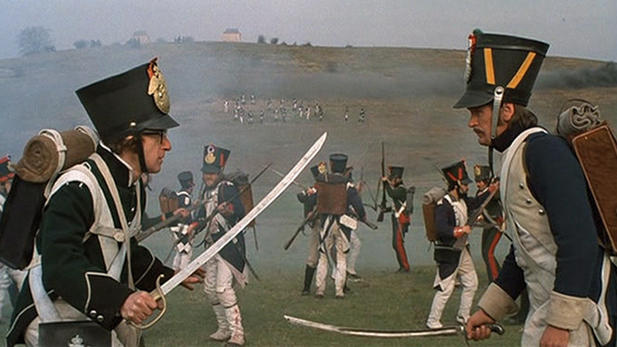
To really appreciate the excellence of Woody Allen's 'human chameleon' idea, as presented in this movie, you need to see the film itself, in which he also temporarily turns black, and appears alongside everyone from Charlie Chaplin and Al Capone to Hitler and the Pope! Oh, and to get back us on track; of course Woody Allen also did a Napoleonic era film, the highly enjoyable and entertaining Love & Death.

Allen as Boris Grushenko, in Love & Death (1975).

And finally, to really get back on topic: although when I started draughting this post I was retreating back towards France with EugĂ©ne, by the time I actually posted it - the very day, in fact - I finally finished reading Chandler's superb tripartite epic. Having at last got around to reading this essential classic, I can now fully appreciate why the work merits both those adjectives. Merci beaucoup, Mr Chandler,  and Vive l'Empereur! I raise a glass of hearty French vin rouge to your memory, and thus do I salute you!

----------
NOTES:

[1] The phrase 'word film' was Paul Britten Austin's own way of describing his textual synthesis of firsthand accounts. It's a good phrase, accurately conveying the vivid quality of the material.