Showing posts with label Peter Hofschröer. Show all posts

Sunday, 3 September 2017

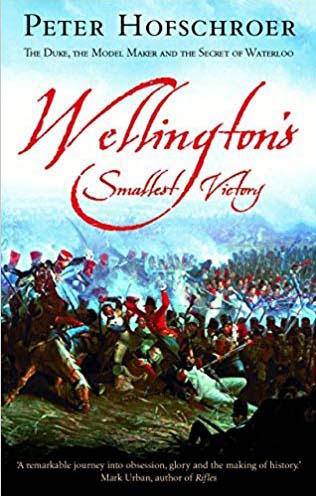
Book Review: Wellington's Smallest Victory, Peter Hofschröer


As a child fascinated by Napoleonic history I was bought an Airfix Waterloo set. Between then and now I've more than once fantasised about building a big Waterloo diorama. It came as something of a shock and surprise to learn, many years later - having consigned such dreams, along with my interest in the period (the latter only temporarily, as it turned out), to the dusty attic room of memory, a kind of childhood-in-storage - that someone had in fact done this [1]. This someone being William Siborne, the subject of this fascinating, informative, and highly enjoyable book.

Despite returning to my childhood interest in things Napoleonic, particularly in terms of reading quite widely on it, Siborne's model was unknown to me until I discovered this book: the very idea that someone had realised this childhood ambition of mine seemed like the stuff of dreams come true. But, as the saying has it: be careful what you wish for! Poor old Siborne's travails were such that ultimately his health suffered, the building of his epic model creations perhaps contributing to the shortening of his life. 

I picked this book up on a Sunday morning, and barely put it down, finishing it off the following day. Without interruption it could quite plausibly be read in one sitting. I guess this means I found it pretty compelling!

A view of Plancenoit, on the Siborne Waterloo model. [2]

Having read and thoroughly enjoyed Hofschröer's excellent little book, I made a promise to myself that I would go and see both of Siborne's Waterloo dioramas. And, if poss, also read Siborne's two-volume work, published under the title History of the War in France and Belgium in 1815. The literary-historical content of this work (actually there was a third volume, of maps; but they were made using a weird near 3-D effect which can't be cheaply reproduced, more's the pity!) is available in a pair of well produced print-on-demand editions from the Cambridge Universtiy Press: History of the War in France and Belgium, 1815 (Vol. 1), and History of the War in France and Belgium, 1815 (Vol. 2).


I've revisited this review, originally written some years back for posting on amazon.co.uk, since I have now seen both the 'large' Waterloo model, at London's National Army Museum in Chelsea, and his second, or 'new' model, depicting the charge of Uxbridge's cavalry, at the Leeds Armoury. Both are amazing works. The NAM's model, the core subject of Hofschröer's book, showing the entirety of Waterloo is very large. And when I went it was rather difficult to see or admire properly, being in a sealed room behind glass, only viewable from two sides. 


Thousands and thousands of tiny figures were cast for Siborne's Waterloo.

It's also on a scale where the figures are really tiny, being only about 5mm tall. The 'new' model has a figure scale where they end up closer to an inch in height, and is, consequently - though it shows only a much smaller portion of the battlefield - far easier to see and admire. Hofschröer, to his great credit, even addresses such arcane but interesting matters as the different scales and ratios used, in terms of models to actual participants, and vertical and horizontal ground scales.

One of the major points that this book makes, however, and the theme gives the book it's title as well, is the contention that arose between Wellington and Siborne regarding historical truth: as has often been pointed out in regards to generals on the day of a battle, what they say on the field frequently prioritises the need to motivate subordinates as opposed to a desire to be factually correct. And even after the battle, there are myriad reasons why exact truth might be, and often is, the first casualty of war. 


Capt. Siborne.

Hofschröer contends that Siborne is the truth-teller regarding Waterloo, having the Prussians arrive earlier and in larger numbers than Wellington wanted to admit to. Wellington was, Hoschröer argues, playing politics. 

This fabulous scene is a view of  Siborne's other Waterloo diorama.

Such wrangling didn't affect the Uxbridge cavalry charge model (as far as I recall) a portion of which appears in the image above - but it severely affected the work on the Waterloo model, which was both delayed and revised, and was almost never completed because of this business. But as this is precisely what the book's about, I'll leave it there and let you read and decide for yourselves.

PS - I have vague recollections of a villain in one of the older 007 movies having various dioramas in their lair, possibly including one of Waterloo: is this right? And if so, can anyone tell me which Bond film it was?

----------
NOTES:

I originally wrote this review some years ago, and have only now got around to posting it here. It is very sad to have to record that Peter Hofschröer has been convicted of some pretty sordid offences. What does this mean for his work as a Napoleonic historian?

Hofschroer's publicity mugshot for Wellington's Smallest Victory. [3]

[1] Of course many have now done so. But, as far as I know, Siborne was the first. Certainly he was the first to build such a painstakingly researched model of the entire battlefield.

[2] Now at the National Army Museum. Plancenoit was one of the key points at which the Prussians arrived, and made the difference between probable defeat for the allies, and certain victory.

[3] I believe Hofschröer has fallen spectacularly, and is now in prison! How the circumstances of that entirely separate and different imbroglio might affect a readers' views of his often deliberately contentious Napoleonic work, well... I don't know? 

Friday, 1 April 2016

Book Review: The Napoleon Options - Ed. Jonathan North


The Napoleon Options is a terrifically enjoyable collection of pseudo-historical 'what-ifs'.


Written by a who's who of Napoleonic history boffins - several well known as wargamers, and almost all of whom will be names very familiar to any true Napoleonic buff - in much the same style as they would write about actual historical events, I found these 'what if?' scenarios, all very plausibly constructed, made for fascinating and highly entertaining reading. [1]

The authors and scenarios are as follows:
1) Paddy Griffith - A successful French invasion of Ireland by Hoche, 1796-7.
2) Charles Grant - Napoleon conquers Egypt & Syria, 1798-9.
3) Philip Haythornthwaite - Junot is victorious at Vimeiro, 1808
4) John Gill - The Austrians attack early, but are still defeated by a decisive Napoleon, 1809
5) Digby Smith - An alternative but equally bloody stalemate at Borodino, 1812, but with a very different outcome.
6) Jonathan North (Ed.) - The Grand Armée kicks Chichagov's butt at Minsk & Borisov, 1812.
7) John Gallagher - France wins the 1813 campaign, leading to a 2nd treaty of Tilsit!
8) Peter Hofschröer - Napoleon takes Brussels after Constant Rebeque follows Wellington's order to move on Nivelles, abandoning Quatre Bras, 1815.
9) Andrew Uffindell - A longer more complex and bloody two-day Waterloo, with a similar -yet radically different - outcome, 1815.
10) John Elting - Napoleon, regrouping at Quatre Bras, goes on to win the 1815 campaign.

Some of these alternate histories totally reverse events, as when Junot wins at Vimeiro, or Napoleon beats Wellington and Blücher in 1815. Others simply reach the same outcome via different routes, as when Napoleon defeats the Austrians in 1809, or is defeated after a two-day Waterloo. 


Lejeune's beautiful painting The Battle of Moscow, 7 Sept 1812 (1822). Known to us as Borodino, of course.

The Russian 1812 period has, for some time now, been my primary area of Napoleonic interest, so I found Digby Smith's alternate Borodino fascinating. Starting, as do all the accounts, from things as they really were, Smith begins changing things by allowing the Russians more forces and greater success in their northern flank attack, in which Platov's Cossacks harassed the French baggage train.

Whilst Smith has Napoleon stave off the worst of disaster that might've resulted in the areas of the field under his stepson Eugene, nevertheless the ultimate stalemate is worse for the French than it was on the actual day.

His account further diverges from real events in that, with heavier French losses, Napoleon chooses to overwinter in Smolensk. And from that point onwards Smith's alternate history takes a very radically different course.

One very intriguing point worthy of note, an aside by Smith described as a 'discordant footnote' to his imaginary history, is his reference to 'The slightly-unbalanced Bonapartist, Pierre d'Offshruere'. 

Pierre is the French form of Peter. Smith appears to be having a dig at 'revisionist' historian (as some call him) Peter Hofschröer. Hofschröer is, as it happens, a fellow contributor to this volume, and no stranger to intrigue. The world of Napoleonic literature is, like its subject, a scene of conflict! 

Editor Jonathan North contributes a second Russia 1812 piece, telling how Napoleon might've fared had he preserved the base and magazines at Minsk, and soundly thrashed Chichagov's army. This is another of those alternate realities that has very profoundly different outcomes for Europe and the world at large as a result. Very intriguing and entertaining indeed!

John Gallagher, the only contributor whose name I wasn't already acquainted with, offers us an 1813 campaign that, instead of ending with Allied victory at Leipzig, instead finds Napoleonic France re-ascendent, culminating in a second treaty at Tilsit. This was fascinating for me, as the 1813-14 campaigns are one of the areas of this era I'm least familiar with. Discerning fact from fiction was, for me, much harder!


William Sadler's depiction of Waterloo.

The book ends with three Waterloo related scenarios. Yes, three! Given the epoch-making and epoch-breaking significance of this particular battle that's not altogether surprising, perhaps.

Those who know the other Waterloo related works of Pierre d'Offshruere, um... sorry, Peter Hofschröer, might not be surprised by his 'what if' Waterloo finding Wellington worsted. Like all the scenarios in this book, it's both plausible and fun. Sensitive admirers of Wellington be warned, noses may be put out of joint!

Having struggled with (and thus far failed to finish) his Fields Of Glory, I was somewhat surprised that I found Andrew Uffindell's two-day Waterloo both one of the most convincing and most exciting of these accounts. 

On day one Napoleon pushes Wellington back on Waterloo village & the forest of Soignes, momentarily succeeding in his aim of separating the allies. 

But, despite Wellington dying on the second day, the Prussians, under the indefatigable Blücher, seal the gap and attack the spent French in ever-increasing force, also bolstered by elements arriving from Wellington's detached force at Hal, to the west. 

Not content with killing Wellington, Uffindell also has Napoleon slain, whilst sheltering in a square of the Old Guard, as the Armée du Nord is pulverised. With a welcome touch of humour he refers to revisionist controversies that question the 'Blücher myth'.

Hugely plausible, and hugely enjoyable. Well done Mr Uffindell, I doff my imaginary bicorne to your imaginary sanguinary scenario!

The Napoleon Options ends with a chapter by John Elting, the most novel-like, in terms of prose style, of the treatments of these 'captivating scenarios' [2]. 

Elting imagines that Napoleon not only successfully rallies his shattered forces at Quatre Bras, but then turns the tide on Wellington and Blücher, finally succeeding in his original aim of dividing and defeating them in detail. 

One senses a cheeky grin, and perhaps a gleam in Colonel Elting's eye, as his account ends thus: 'Military historians generally agree that Napoleon's post-Waterloo 1815 campaign was possibly the most brilliant of his entire career.' What fun!

I'd thoroughly and unhesitatingly recommend this book to wargamers and any other form of Napoleonic history buffs. 

----------
NOTES:

[1] Jonathan North's forward mentions Louis Geoffroy's pioneering work Histoire de la Monarchie universelle: Napoléon et la conquête du monde (1812–1832), which I first heard about in Zamoyski's excellent 1812. This has been translated and published in English, but is a rare expensive book. French versions can be found free online.

[2] Quoted from the dust jacket blurb.

Tuesday, 24 June 2014

Waterloo: Captain Siborne's 'Large Model' - The National Army Museum, Chelsea, London


Captain William Siborne


With around 75,000 tiny lead figures (the closest modern scale equivalent would be about 6mm), on a landscape model covering approximately 400 square feet, Captain william Siborne's 'large model', depicting the decisive moment of the decisive battle of Waterloo, is a stunning achievement.

Sadly for Siborne his obsessive information gathering brought him into conflict with the military establishment, who'd originally set him the enormous task of building the diorama, as part of the ongoing efforts top commemorate the defeat of Napoleon Bonaparte.

Sadly the calumnies perpetrated on Siborne, both during his lifetime and afterwards, are still in effect, with the National Army Museum official page on the exhibit - at least they have given it a decent home - scandalously misrepresenting Siborne's near superhuman efforts (I'll address this touchy subject later on in the post). I sincerely hope that come 2015, the 200th anniversary of this decisive fight, they might have the decency to amend their misrepresentative picture of his work.

One of the first points of interest is that most maps or other depictions of Waterloo show the dispositions or actions of much earlier in the day: Siborne chose to depict the field as it was around 7pm-ish. Here's a map of the field as it's more normally shown, with troops in their 11am 'kick-off' positions.


Siborne's unusual approach to his subject is compounded by the way National Army Museum displays his mammoth work. Maps are almost universally shown with north at the top. The model in Chelsea can only be viewed from either the north looking south (where the British and Allies are) or the east looking west (the eastern edge of the battlefield being from whence came many a pesky Prussian... more on this later!).

Here are a few of my pictures, taken on a visit in December, 2013.


An overview of as much of the model as I could reasonably fit into the lens of my crappy little camera, looking south.


The view here is pretty central to the diorama, looking from the north more or less due south, with the Brussels to Charleroi road bisecting the battlefield vertically, and heading off into the distance


Unlike generals back in the day, we can 'see behind the the hill' here: on the right of the picture are the squares that had repeatedly seen the French cavalry off. At the extreme right top corner one can just see the exposed forward position of Hougoumont.


I include this final composite picture because it helps highlight one of the problems of both viewing and photographing the model, as it's currently displayed: first off it's in a sealed room behind glass, and then there are these pesky lights, illuminating the model, which keep changing. The above pics overlap a little in content, and yet are lit in opposite halves!

Siborne spent months surveying the battlefield, and years compiling correspondence. His correspondence took in all the parties involved, including the British and the allies, Prussian and french sources. Naturally it was easiest to get british accounts, but Siborne did his best to get as complete a picture as possible. 

But you wouldn't think as much if you were to go by the brief info on this amazing exhibit that's still being peddled by the National Army Museum, whose audio presentation and online page (Model of the field of Waterloo made by Captain William Siborne, 1838) both misrepresent Siborne's efforts somewhat. 


Peter Hofschröer and Malcolm Balen have both written interesting books about this fascinating man and his travails in building this epic model (and also, of course, the 'small model', now housed in the Leeds Armoury). Balen's book combines a fairy full account of the battle itself with a parallel telling of Siborne's sad tale. Hofschröer's account is much more about Siborne and his achievements, and the wrangling with the 'powers that be' that ensued. 

Hofschröer makes a strong case for Wellington and the British establishment deliberately downplaying the impact of the Prussians, to the extent of, in Hofschröer's telling, deliberately misrepresenting the historical facts, and forcing Siborne to comply with their version into the bargain. Hofschröer certainly has something of an axe to grind on this subject, having also published a book called 1815, The Waterloo Campaign: The German Victory!

In terms of the theme of my blog, Siborne's work is fascinating not just in itself, but because of how he chose to represent the two scenes, both in terms of the landscapes and the numbers and sizes of figures. His 'small model', actually using the larger scale of the two, which gives figures sizes closer to what we'd call 25/28mm, depicting the cavalry charge in which Sergeant Ewart captured a French Eagle, as the divisions of Marcognet and Donzelot advanced. I believe there are about 6,500 models, including infantry, cavalry and artillery.

Whilst the 'small model' depicts an early afternoon action in the area around the Brussels-Wavre crossroads - including the famous farm of La Haye Sainte - his 'large model' encompasses the entire Waterloo battlefield, including Plancenoit, where large numbers of those contentious Prussians were fighting in Boney's rear. I'll need to return to the various books on the subject to fill in more info about the ground scales used, and the exact number of figures Siborne eventually 'deployed'. This latter point is interesting, as he was ultimately browbeaten, very much against his will and better judgement, into removing substantial numbers (many thousands) of Prussians!


For die-hard Waterloo nuts, it's pleasing to know that Siborne's exhaustive researches are available to buy, either secondhand, as in the Napoleonic Library edition, or new (as print on demand) from several sources. I bought my two volumes from the Cambridge University bookshop, via their Cambridge Library Collection imprint. The Napoleonic Library have also printed his correspondence, on which his History was based.

Waterloo: Captain Siborne's 'Small Model' - A Waterloo Diorama at The Leeds Armoury

It turns out that with this post I discovered my original chronology (see previous post) is probably all wrong. I thought I got back into wargaming aged 40, during 2012. But it appears I went to Sheffield Triples and The Leeds Armoury in May 2011. Hmmm!? Perhaps at that stage I was still in the 'limbering up' phase?

Anyway, I though I'd share a few of my better pics from that visit. Unfortunately the model is under glass, my camera isn't very good, and flash photography isn't allowed. I've had to adjust the brightness and contrast on most of these, and I've only picked some of the better images (in term of focus, etc.). Actually the slightly out of focus nature of some of them adds a bit to the look of the 'fog of war', I reckon.

So, here they are:


A British square, hunkered down amidst the corn. I can't recall what Siborne's figure ratios were, but the square looks pretty well stocked and cool.


A view from the British side of the field, looking south towards a ragged French infantry unit, falling under fire from the 'thin red line'.


Even Siborne's 'small model' has huge numbers of figure deployed. Here we can see the massed French battalions, at left and centre, cresting the rise and coming into contact with the British, who are on the right of the picture. The masses of figures look terrific, and the effect of the few stragglers and dead/wounded, in the foreground space, is great too, making an effective contrast.


A slightly different angle on what may be the same masses pictured above. When I get a chance I'll find out exactly which units are depicted.


I love this picture! I like it so much it's currently the background picture for the title of this blog. Okay, it's not crystal clear, but doesn't that just capture the 'fog of war' feel? with a little Photoshop tinkering to the background this could be made to look like a pretty convincing 'contemporary photograph' of the battle... taken before photography had even arrived!


A slightly more aerial view of the same rather ragged French advance.


Again, admittedly not the crispest photograph ever taken, but I do like the effect of the out of focus foreground cavalry (I think they may be French Carabiniers), set against the slightly more in-focus cavalry descending the sloped cornfield in the background. I really must find out who's who in these pics. Are the approaching cavalry retreating French Cuirassiers, or are they part of the British Household & Union Cavalry Brigades?


And finally, a close-up view of some melee action: this could well be where Sergeant Charles Ewart captured a French eagle, as there's a French infantry unit, with it's flag in the centre, and some cavalry that look like the Scots Greys wading in amongst them from the right.

I haven't the time now to do this, but I will return and edit this post once I get the info on exact units and positions depicted, and I may add some other pics as well.

I'll also update this post with more on Captain Siborne, and the sad tale of his efforts to build what should rightly be considered national treasures, but have in fact - although now both have found decent homes - suffered much neglect. He also made a Borodino diorama: being a bigger Russia 1812 nut than a Waterloo one... oh how I wish that had come down to us!

Recommended reading on the subject:

Napoleon's Smallest Victory - Peter Hofschröer
A Model Victory - Malcom Balen