Thursday, 1 September 2016

WWII Miscellanea: Foreign Troops In German Service

Yang Kyoungjong, who's life story in WWII is tantalisingly bizarre.

Numerous things prompt this post. Having just read (and thoroughly enjoyed and been educated by) Ben Shepherd's Hitler's Soldiers, and also recently having watched, entranced and appalled, the amazing Russian film Come And See, one thing that has struck me as particularly odd and intriguing was the role of foreign troops in German service. [1]

That the Germans made cynical use of POW's and others, from Jews of all nations to intellectuals or Communists from occupied territories (and even Germany herself) as slave labour is well-known, and accords with the brutal tenets of Nazism. In this short post I just want to very briefly look at a few of the many people who did fight, willingly or unwillingly, alongside the Germans.

Looking every bit like the prototypical SS officer, with a firm self-belief in his belonging to the 'master race', Christian Frederik von Schalburg was a Dane who served in SS Wiking, before founding the Frikorps Danmark. [2]

Spanish troops of the Blue Division.

French soldiers of the Légion des Volontaires Français.

As well as such political/military allies as Italy, Hungary, Bulgaria and Romania, Germany's Axis partners, whose troops all fought alongside the Germans at various times, there were also numerous units made up of foreign troops, such as the Spanish Blue Division, the Frikorps Danmark, and so on.

Kenneth Berry and Alfred Minchin, two of the very few Britons who responded to calls for a British Free Corps.

British fascist John Amery even suggested to the German leadership that there should be a British outfit, which was eventually called the British Free Corps. Primarily recruited from British POWs, and sold as a crusade against communism, apparently only about 50 or so men ever joined, and the unit never exceeded 27 men at any one time! Amery, son of the very prominent politician Leo Amery, was hanged for treason in 1945.

Gen. Vlasov addressing troops of the ROA, or Russian Liberation Army. [3]

If alliances with Communist Russia, and even Japan - given that these were considered 'Asiatic' peoples, and that that term was a byword for backward and barbaric in the German/Nazi lexicon of this era - seem odd enough, there were still stranger bedfellows, such as the Bosnian Muslims who became SS troops in the Balkans campaign.

The Grand Mufti of Jerusalem at a parade of the 1st Croatian or 13th Waffen SS Mountain Division, aka Handschar.

Men of the Handschar [4] Reading propaganda material (one assumes?).

As Ben Shepherd discusses in Hitler's Soldiers, whislt the German army wasn't inherently Nazi, it colluded with the regime in order to see itself grow and prosper. And as the war went on it grew every more enmeshed and compromised in the crimes the Nazi regime was perpetrating. Therefore, to arm such people as they did, and have them fight for their cause? It does seem rather odd, to my mind. [5] 

The Nazis were very reluctant to employ women in their war effort, especially German women, who they saw as wives and mothers, not warriors. And given the deeply racist nature of Nazism, the actual fact of these many native auxiliaries (as opposed to the volunteers from places like France, Spain and Denmark, etc.) seems a strange mix of hypocritical utilitarianism on the one hand, and an acceptance, on the other, that one can't simply wipe whole people's out, but need their co-operation, if only to wage a war the eventual aim of which is to wipe those same people out. 

Well, war is madness, I guess!

The Indian Legion, originally a Wehrmacht unit, was transferred to the SS eventually. 

Despite the messy complexity of the subject, there are numerous examples of this happening in the German Army, ranging from Sikhs of the Indian Legion fighting the Allies in Normandy, to Russian 'volunteer' units, containing troops of numerous ethnicities, and even Croatian Muslims in the SS, and Cossacks acting as police type auxiliaries. [6]

Cossacks in German service, on parade.

Moustachioed Cossacks on parade, under the stern eye of a German commander.

At the top of this post is a picture of Yang Kyoungjong, a Korean who, aged only 18, was press-ganged into Japanese service, having been conscripted in Manchuria, the Japanese puppet state on Chinese territory, to fight the Russians. Captured by the Russians, after a spell of forced labour he was sent to fight the Germans, who, in their turn, pressed him into service. The picture shows him, in german uniform, being registered as a POW by the Americans (he settled in America, where he had a family, dying in 1992). 

A South Korean documentary has concluded that the evidence for his existence is not conclusive. I hope the story is true. It'd make for an amazing film ... Indeed, there is such a film, called My Way, made for the Asian market). I've got to check it out!


----------
NOTES:

[1] Other things I've seen that stimulate this thread include uniform illustrations in Blandford's old Uniforms of WWII book (a German cossack auxiliary, in particular), Anthony Quayle pretending to be a German pretending to be South African in Ice Cold In Alex (not strictly in line with this topic, perhaps, but a reminder about the multinationalism of WWII and the shifting and varied allegiances people might have), and ... well, see note 6 below.

[2] Schalburg was killed during fighting in the Demyansk Pocket, attempting to lead from the front, in true hung-ho SS style.

[3] There's an interesting scene in the five-film Russian epic Liberation, in which a character who looks very like Vlasov tries to recruit some Russian POWs. He also talks briefly to Stalin's son, Yakov Dzhugashvili, suggesting a prisoner swap with (I think?) Gen. Paulus.

[4] I wondered what the units name meant. Apparently, according to some 'talk' on the wiki page: 'The name "handschar" is the German spelling of a Balkan word for a sword or knife, ultimately from Arabic khanjar (خنجر).'

[5] It's a bit like Afro-Americans fighting for the South. And indeed, some did. But that's a whole other story! 

[6] There are some chillingly repellent characters in Come And See who are clearly Russians in German service, aiding in the burning of a village and its inhabitants. As Alan Clark says in his study of Barbarossa, Russia was the theatre 'where the septic violence of Nazism festered openly', in 'scenes of not so much medieval as of pre-Roman barbarism'.

Book Review: Hitler's Soldier's - Ben Shepherd


In Brief


This is an excellent book. At something over 500 pages it might appear daunting at first glance. But considering how much is covered - from the blitzkrieg in Poland and France, to the heat of North Africa or the cold of Russian winters; from heady victories to abject defeats, on the frontline and in the occupied rear areas - it's actually remarkably concise.

Over twenty-four chapters, subdivided into five parts whose headings pithily map the narrative trajectory - Military Ascent, Moral Decline; Triumph & Hubris; Losing The Initiative; Beleaguered; Defeat, Destruction & Self-Destruction - Ben Shepherd both tells the story and analyses the actions of the German Army between 1933-45. 

Victories came easily in the early days.

I don't want to give too much away for readers coming to this fresh, a great deal of whom will probably know much of the history beforehand anyway. But, in brief, Hitler's brinkmanship and the army's own 'auftragstaktik' doctrine (something Shepherd makes much of) initially appear to serve the German cause well. 

But, ultimately, the huge gulf between ends and means, and the toxic racism central to Nazi ideology, ensure that the rot sets in very quickly. Once the regime's brutal belligerence - the army being a chief tool in this respect - has angered and alienated a large enough coalition, the 'thousand year Reich' and the army used to create it, are doomed to an early demise.

Bogged down in Russia.

This comprehensive and compelling account is, above all else, a very nuanced and balanced reading of this dark and messy chapter of recent history. And as the books subtitle, The German Army in the Third Reich, suggests, as well as simply telling us what happened, Shepherd examines the context, asking such questions as how complicit was the German army in Nazi atrocities? and why did it continue to fight so ardently when it was clear the war was lost?

A woman weeps as Jews are rounded up in Greece.

This pic is from Albania. The war in the Balkans was, as in Russia, very brutal.

Journeying throughout the varied theatres of this monumental conflict with the German armed forces, as Shepherd seeks the answers to these questions, was fascinating and enlightening. A sure-fire sign that a book is worth reading is when it's hard to put down, and stokes the fires of interest in further, deeper reading. This book assuredly does both.

Up next: I wanted to get this when it first came out in hardback, but managed to wait till the cheaper paperback (as pictured) arrived.

In Depth (well, a bit more depth, anyway...)


As alluded to at the end of the brief review above, there were aspects of the content of this book that intrigued me, regarding further future reading. As it happened, at one of the recent '40s events we attended, I picked up the memoirs of Panzer General von Mellenthin, a German commander I'd not heard of before, but who Shepherd quotes a number of times.

I'm reading this now.

But as well as getting better knowledge of the source material, there are whole other areas, such as the conflict between the various commands (e.g. the OKH and the OKW), and the growing encroachment of the SS upon the army's roles, or the individual campaigns, all of which excite interest in further exploration.

Some of the other things that I found interesting here include the following: the concept of auftragstaktik; the different faces of occupation, from the relatively civilised [1] west to the openly and deeply barbaric east; individual campaigns (pretty much all of them, but perhaps especially the blitzkrieg in France, Barbarossa, and the campaign in Italy); and the roles of other arms, e.g. the Luftwaffe and Kriegsmarine.

Brauhitsch, an old-school German commander, of aristocratic origin. He had a chequered career, in and out of favour. Despite his high rank (field marshal, and even C-in-C in the early part of the war), he was often sidelined. Whilst conspiring with Halder to try and get rid of Hitler somehow, as early as 1939-40, he ultimately backed out. Surviving the war he died in captivity, before he could be brought to trial.

Jodl was one of the new breed at the top of the german army. A frontkampfer in WWI (and therefore more like both Hitler and his ideal of the new Nazi soldier), who rose through the ranks, ultimately signing both the infamous 'commissar order' (1941), and the unconditional surrender (1945). He was hanged in 1946 for war crimes

Some of this involves reflecting on the content of what this book covers (the german army's doctrine of auftragstaktik would be a case in point, as would their complicity in Nazism's ideological crimes), and other aspects involve delving deeper into stuff Shepherd only has time/space to briefly allude to. 

One good example of the latter case would be the way that, at the outset of the war, the germans combine arms very successfully. Whereas, by the middle of the war, and ever more so as it goes on, they are reduced to a one-dimensional force: once they lose air and sea supremacy they only have  the edge (if they ever have any advantage at all), or just a fighting chance, on land.

Combined arms: look very carefully and you'll see a diving Stuka in this pic.

The bulk of german armour early in the war was light, such as the Pz I, Pz II, Pz38s (Czech chassis!), with only a few Pz III and IV.

An iconic image of Blitzkrieg in France.

Planes such as these Stukas played a vital role in early german victories, psychologically as well as tactically.

So, when the German Army invades France the Luftwaffe's dominance in the air is crucial to the success on the ground. And likewise, at the other end of the war, as they retreat from France, it's lack of air support (never mind supremacy!) that is decisive in sealing their doom, as manoeuvres can only be carrie out at night, and the transport infrastructure is constantly hammered by the Allies.

Auftragstaktik is a term that creates difficulties in explanation, even for the experts (check this link, to see what I mean), including, to some degree, Shepherd himself. Interestingly, it is very different from the Napoleonic style of command - something Hitler would aim to emulate ever more as the war progressed - whereby the central commander knows and directs all, and only tells subordinates the minimum they need to know to execute his will. Auftragstaktik, by contrast, very much depends on knowledge, flexibility, and independence, all the way down the chain of command, but especially at the 'sharp end'.

Rommel, in North Africa.

Guderian gets lambasted.

Some commanders emerge from this account relatively okay, although very few (if any) could claim to be to be free from the taint of implanting Nazi policy. Rommel is taken down a peg or too from his most exalted myth, but not trashed as some have seen fit to do. Guderian is portrayed more hardly still, as a self-serving careerist, who overstates his own importance, happily sacrificing others, from rank and file to high level colleagues, in furthering his own ambitions.

Shepherd certainly focusses a lot on how the officer corps composition evolves, away from the old-school Prussian aristocratic model (ready enough to embrace Nazi militarism as it was) to the broader volksgemeinschaft of Hitler's Nazi vision, a classless meritocracy (of sorts!), in which bravery and fanaticism were key components. Schörner emerges from Shepherd's account as the exemplary of this latter type. A leader who could be as brutally terrifying to his own troops as the enemy!

To combat escalating desertion rate ardent Nazi commander Ferdinand Schörner implemented an infamous order requiring on the spot court-martials and hangings for troops found separated from their units.

Shepherd makes good use of material from the lower ranks as well, often quoting from letters home. So, to finish off this review, here are some pictures of the more rank and file type elements. 

Landser... trudging through the vast Steppe.

Panzergrenadiers of the GrossDeutschland regt.

A nice colour image from the german magazine Signal.

War whatever the weather.

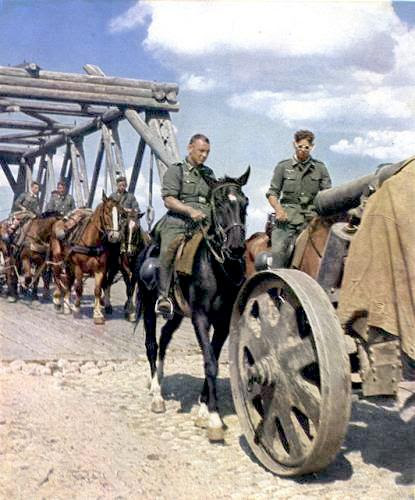
Despite her much vaunted mechanisation, and those feared Blitzkrieg weapons the Panzers, Germany remained heavily reliant on old-fashioned horsepower.

Still trudging through the Steppe.

I forget the exact figures Shepherd gives for German wartime casualties, but I thinks it's something like 700,000 on the Western Front and 1,700,000 on the Eastern Front. [2] Many more were missing and never accounted for, and of course many more were wounded. Again, my memory for the figures is hazy. But I think Germany mobilised about 9,000,000 of their armed forces, during the war as a whole.

These kids are actually SS (Totenkopf). By the end of the war Hitler and Germany were scraping the barrel, rather like the Marie-Louises of the Napoleonic era.


----------
NOTES:

Shepherd's book is illustrated, chiefly with a section of pics in the middle. The pics I've used here are not from his book, but Wikipedia and the web in general.

[1] I say relatively advisedly. Whilst the Germans might have enjoyed civilised relations, especially initially, with the social/racial groups they considered their equals, such as the French, or the Germanic/Nordic peoples, the army was heavily complicit in enacting Nazi racist policy as regards the 'out groups', with the Jews being the primary target.

[2] I thought I'd check on Wikipedia, but it's clearly a messy and complex subject, as this link demonstrates.


Film & Kit Reviews: Ice Cold In Alex & Airfix 1/76 K2 Ambulance (Pt.1)


Having been out of the loop for a while I thought I'd wade back in with a double-whammy: a film review and a kit build (only partial at the time of posting, I'm afraid) in one post.

I've been watching loads of war films lately, mostly set in WWII. And most of them have been pretty good. There's only been the occasional below par offering, and only one outright turkey. But I'll be posting on many of these soon, so I'll save further info for later posts.

Ice Cold In Alex is both an unusual war film, since most of the drama relates to four people in an ambulance crossing an otherwise mostly empty desert, and an  excellent one. After watching the film a few weeks back, I decided I'd like to make a K2 'Katy' Ambulance. And, perhaps, maybe even make an Ice Cold In Alex diorama.


The Film:

Ice Cold In Alex is a bona fide classic WWII movie. That said, it's also pretty unusual for the genre, broadly speaking, in that it's more a character study, and for the most part concerns just four individual battling their demons and the harsh environment, the desert, as much as the Germans. 

I don't wish to offend any readers of this 'across the pond', but it shows a fundamental misunderstanding of the film that the version released Stateside was cut by about 50% and remained Desert Attack! The uncut version is 130 minutes long, whereas the U.S. edit is only 76!

An American poster for the butchered shorter version. Note different title!


The film is based on a book of the same name by Christopher Landon, and purports to be a true story.[1] We meet Captain Anson (John Mills), already the worse for wear, slurring his words and drinking spirits, in a Tobruk HQ. Anson's commander, a Brigadier played by Liam redmond, who we first see bathing in a tub, briefing Anson during a bombardment!

Anson is ordered to set about evacuating a column of ambulances from Tobruk, bound for Alexandria. But the Brigadier requests he stay behind and accompany him, along with his MSM, Tom Pugh (the ever dependable Harry Andrews, affecting a strange west-country-cum-Norfolk accent!). Two nurses are added to the ambulance crew by accident, when they're left behind.


The delay in setting out means we never see the main column of ambulances. And, indeed, after an attack results in the death of the Brigadier (and his driver, another war movie stalwart, Allan Cuthbertson), Anson an co. find their retreat route cut off when a bridge is blown just as they reach it. Shortly after this they pick up Captain van der Poel (Anthony Quayle). And thus the adventure begins.

As ever, I don't want to give too much away for those who haven't seen the film. But it's a corker. Military buffs such as our crowd will inevitable be disappointed that the few Germans Anson and friends meet are usually in American half-tracks. But the story is great, with the main enemies being Anson's personal demons, and the desert.

Mills, Sims, Andrews and Quayle, all looking overheated on a cool German poster for the film.

All the four major leads, Mills' Capt. Anson, Andrews' MSM Pugh, Quayle's van der Poel, and Sylvia Sims as the very foxy Sister Diana Murdoch, are superb. They are all characters you grow to really love and admire, as they fight their way over minefields, through enemy held territory, battling booze, quicksand and even tackling an excellent espionage subplot.

The famous theme, that both gives the movie its title and its iconic end sequence in the Alendrian bar, has even been used in two beer adverts. One's a spoof - from a series called 'Holsten-Pils Productions' - in which Griff Rhys Jones is interpolated into vintage footage from this and several other old films. The other's a riposte to the Holsten Pils ad by Carlsberg, and simply shows Anson downing the pint, which clearly shows the Carlsberg logo.

A nice pic of the cast and crew during filming. [2]

The whole film is excellent, filled with not just action - and even then not the kind of action modern films rely on (explosions, fast cuts, etc.) - but, and far more importantly in my view, with character and feeling. I'd seen it before, many moons ago, but was blown away seeing it again. So much so I watched it again with friends!


It also inspired me to search around for model of the 'Katy' K2 Austin ambulance, a vehicle that is almost a character deserving of a credit of her own in this wonderful film
----------


The Kit:

So, from the film to the model.

I'd have liked to find a 1/72 version of this vehicle. But the only thing I could find that was close, was this RAF Emergency Set, by Airfix, which also includes an Austin fire engine and some RAF ground crew.

One thing that happened, mirroring something that happens in the film, is that, on opening the box, I discovered my kit was missing a suspension spring for the ambulance. In the film they break one, and replace it, in a very memorable scene in which van der Poel literally shoulders the heaviest share of the work.


I had to scratch-build a new spring, which I made from thin plastic card and stretched sprue. My photos of this process are woeful. But perhaps thats for the best? As my spring, whilst fit for purpose (and probably unlikely to ever be seen anyway!), was not a perfect copy!


The model is a fun build, although it's an old Airfix moulding, with a lot of tidying required (much flash to trim off, and ejector pin marks to remove or fill). I intend to model mine on the vehicle in the film. And I might even attempt either converting some figures, or even sculpting them, so as to provide the four key characters.

Looks like I'm not the only one to be recently inspired by Ice Cold In Alex! [3]

Not sure whether I'll have any door or windows open. And the build has currently stalled momentarily anyway, as I prepare for the new school-term's teaching, and decide about the interior detail.

I might go for this, as a diorama option.

Some interesting details can be seen here: a tow cable; rolled mats on the front mudguards; painted 'frames' on the windows; the rooftop red cross logo in a different place to that suggested by the Airfix kit.
----------

Now, I'm not usually one for any royal nonsense, but I did find the following pictures interesting:


Princess Lizzie, as she was then, learning to drive a K2 Austin ambulance; 'doing her bit', I guess. I don't know that this was anything more than a publicity exercise - I doubt she was an active ambulance driver (correct me if I'm wrong!) - but the pics are great nevertheless.

----------
NOTES:

[1] I haven't looked into the truth (or otherwise) of this claim. Anyone else know anything about it?

[2] StudioCanal have some nice galleries of still from this film, which can be viewed here.

[3] I can't recall where I saw this pic. But apparently it's a set from the Perry's workbench. So I suspect they're 28mm?