Showing posts with label T-34. Show all posts

Thursday, 22 October 2020

Misc: Current Armour, on the go...

Oldies and newbies.

With a nice kind of symmetry, here's a bunch of older models, and my current crop. Amongst the older ones, the first WWII mini-military model I made on returning to these ol' hobbies, the 1/76 Airfix Panther, in late-war 'ambush' type camo'. This remains one of very few completed models, thus far. The vast bulk of my kits require varying degrees of painting/finishing.

The latest bits of building, today and yesterday, were the rear bins on the newer Airfix Panther, and a second go at the mortar crane/winch, on the B&P Sturmtiger. Whilst I was at it, I also changed the Sturmtiger's upper casemate access hatch handles to wire ones. Looks nicer, methinks.

Rear stowage bins on ye olde Panther, one open.

I really took my time and had a look at a load of ref for the second attempt at the winch. And I think it's come out okay. Nicer, indeed, than the one on the ACM Sturmtiger. I also roughed up the 'fenders' a little, and added some dings and hits to give the ol' beast a more worn in look. I'm looking forward to painting the Sturmtigers. I think I'll go for one of those late war funky three colour disc camo' patterns.

Winch deployed inboard this time.

Suitably chunky for this rather oversize model.

From behind...


Wednesday, 8 May 2019

T-34 (+ others) Tank Factory, Update


Yesterday I managed to spray basecoats of green on to my T-34s, and a bunch of Allied materiel. Can't recall offhand what green I chose for the Russian armour. But I know I used Olive Drab for the Shermans, Jeeps, etc. Sadly the aerosol I was using for the T-34s - brand new, and therefore supposedly full - drained in one go. On bringing them all indoors, after spraying them in the garden, I discovered I'd missed one. Took it out and tried, but there just wasn't enough paint in the can. Think I'll do it with my airbrush, as I don't want to fork out for another full (hah!) can for just one vehicle.


I didn't want all the T-34s a uniform green. So when I airbrushed the unpainted tank, I also resprayed a couple, and with one - front and centre above - tried to get a blend of the two, to give a third shade of green. I also checked th colour of the lighter tanks, and found I'd used Humbrol Light Olive (86). Next up, I'll need to paint all the stowage, and other bits and bobs, before I seal it all under a glosscoat prior to adding decals and weathering, etc.

Tuesday, 16 April 2019

Kit Builds/Reviews: Various 1/72 T-34

After enjoying the T-34 Tank Craft book, I decided to try and build a few more, and work towards finishing a batch of Russian armour. The models in question are all T-34s, some are the earlier 76 variants, others the later 85 type. The makes are Trumpeter (one T-34/85), Armourfast (two T-34/76 and two T-34/85), Italeri (two T-34/76), and Zvezda (two T-34/85). I also got a SU-100 tank destroyer, by Zvezda. The Zvezdas are the snap-fit variety, but I'll be gluing them up anyway. 

My tank factory, inc. several T-34s.

So far I've been detailing the kits I've already got in hand. Although I did also build the two Italeri 'fast assembly' kits, which are very well designed, and, as they proclaim themselves, perfect for wargamers. They're better detailed and nicer than the Armourfast models which, whilst robust and easy to assemble, are just too clunky and lacking in detail.

These are great, far superior to Armourfast.

So, first thing for this post, a quick look at building the fast assembly Italeri kits. The colour of the styrene is gorgeous, a near perfect Russian WWII green. If you wanted to go super basic, you could simply apply decals, paint the parts that aren't green and there you have it. But that wouldn't satisfy me, nor, I suspect, most of us modellers/wargamers. In fact I want to use these tanks as practice at weathering and making monochromatic colour schemes look good.

Got to dig that green styrene!

Laying out the kits for cleaning up.

Tank number one cleaned and ready for assembly.

The turret mounting clip is a really great bit of design.

First tank assembled. I'll attach the turret after basic painting.

Adding stowage and little bits of detailing.

As well as detailing the models a little, e.g. with wire handles, lamps, boxes, blankets, and so on, I had to reattach an idler wheel on the Trumpeter T-34, which snapped off when I was supergluing the tracks in position. I'm also drilling out the barrels on a pair of Italeri (old Esci) Nebelwerfers, as they were ludicrously thick. You can see before and after above.

Not a great photo, but I'm pleased with my scratch-built saw and headlamps.

In the photo above you can see, albeit not very well, my scratch-built saw and headlamp, on the left. At right you can see how basic the rear engine-deck of the Armourfast kits are; no grill detail. I've also made a boo-boo with the towing cable, tying it off as if it's just strong, as opposed to steel cable. That's it for tonight. I'll do further detailing tomorrow, and then get them all undercoated and base coated, ready for detailed painting, decals, and weathering, etc.

---------------
And now it's tomorrow... today! Decided I'd try a bit of silk purse from a sow's ear, and replace the Armourfast rear deck grill panels, with some mesh and plastic card. Got the mesh from Ely City Cycle Centre's model department, along with some more Vallejo acrylics and some (new to me) Tamiya liquid cement.

Rear deck grill panel removed.

New wire-mesh replacement fabricated, with added storage.

Is this overkill on an Armourfast kit? Hmmm!? It certainly improves the tank, in my view. But it also makes me feel the need to do similarly for hand rails, lifting eye-hooks and tracks. Can I be bothered? It remains to be seen. I've already cut out mesh for the other three Armourfast T-34s. But one of them is going to be very difficult to do on account of stowage I've already added. Unless I remove it...

Adding more detailing to the various T-34s...


Sunday, 14 April 2019

Book Review: T-34, Robert Jackson (Tank Craft series)


This is my second Tank Craft book. And I have to say that, so far, I really love them. Although I mostly make 1/72 German WWII models, I do have several T-34s, and a few other Russian vehicles. This book provides inspiration and information, in turn giving motivation, to finish those kits. 

As Tank Museum curator David Willey notes in his excellent 'Tank Chat' on the T-34, this vehicle has become an icon of Russia's Patriotic War, as a result becoming - as with many German Panzers - wrapped in layers of myth (check out the bizarre Russian film White Tiger, if you're in any doubt about this!). 

Author Robert Jackson gives what I believe is a balanced account of the facts as we know them: like many of the fabled German Panzers, Russia's T-34 had a bumpy genesis, and was beset by problems throughout its evolution. But, as this book's subtitle - 'Russia's Armoured Spearhed' - suggests, it was undoubtedly essential, as was the Sherman for the Western Allies, to eventual victory.

My current clutch of Russian WWII armour, all T-34s.

The first two chapters, Development and Design and The T-34 in Detail, address this historical situation with admirable concision and brevity, before chapters on Camouflage and Markings, Model Showcases, and Modelling Products address the modelmaking aspects. Into Service and Into Action and Enter the T-34/85 flesh out the campaigns of WWII on the Eastern Front, examining the performance of the t-34 and its variants in context, before the book concludes with a brief look at the postwar use of the T-34, in theatres from the Middle East to Asia and the Balkans. 

I thoroughly enjoyed this slim but info-rich and superbly illustrated book. I'm no expert on the T-34. But I feel I know it much better now. And this book has prompted me to order several more kits of both the 76 and 85 variants, which I look forward to making. The models in the showcase are all very well done. Most are 1/35. My only real gripe re this book (and the series as a whole, insofar as I'm getting to know it) is that I'd like to have seen at least one 1/72 build.

Richardson's exquisitely realised 1/16 T-34/76.

The most impressive model is Brian Richardson's 1/16 Trumpeter T-34/76, which has been completed to a stunning level of realism, with an amazing paint job topped off with terrific weathering. 

At £15 a pop (RRP being £14.99 at the time I'm posting my review) these slim Tank Craft titles are reasonably dear. But I think they nonetheless represent decent VFM (value for moolah), as they combine a lot of useful info with copiously rich visual reference. The colour profiles section is terrific, with nine pages of well executed illustrations to inform and inspire. 

I look forward to more titles from this series, which admirably meets its stated brief of providing modellers with 'a new standard of primarily visual reference of both full-size tanks and their scale models'.

Tuesday, 5 June 2018

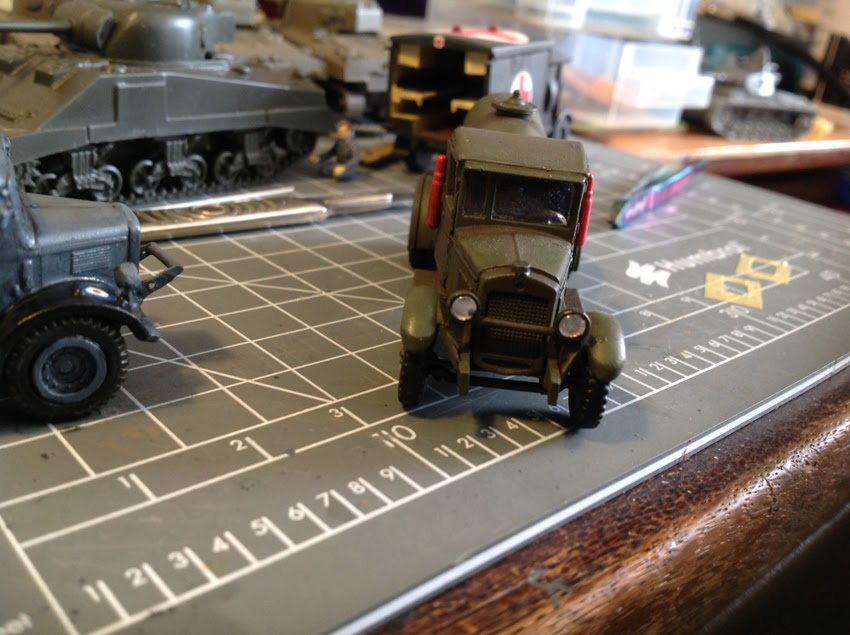
Kit Review: 1/72 AER/PST ZIS-5-BS fuel truck


NB This post was originally drafted in February! So it appears out of chronological sequence.

A recent trip to The Muckleburgh Collection in Norfolk resulted in the purchase of a T-34/85, in 1/72, by Trumpeter. Both that and the Muckleburgh trip will be blogged in dew coarse, so to speak. In the meantime, having just built some US matériel, I figured why not some Russian stuff also? Apart from the aforementioned T-34, the only Soviet stuff in my stash is the ZIS-5-BS, under consideration here.

I bought this at a show, poss at Bovington, for a knocked down price - £6, so not all that knocked down - due to it being simply bagged up, i.e. not in its proper box (instead a home-printed version of the box aw - pictured above - had been inserted inside the bag. It was only when I got it home that I realised it also lacked instructions, nor were there any decals. So I kind of felt that I'd overpaid, even tho' 'twas cheaper than the RRP for a pristine kit.

Making headlamps...

... in situ.

Anyways, this was all some time ago. Digging it out of my stash today, I decided to get stuck in. To do so required finding instructions for assembly, which I duly unearthed at the very helpful Henk of Holland website. These downloads are particularly useful in cases such as this, when not only are the instructions missing, but the parts on the sprues - shown numbered in the instructions - are not actually numbered! So, a bit of rigmarole required before I could even start.

The quality of moulding suggests a small short-run Eastern-European type operation. The kit and instructions were listed under PST on Henk's site. But one of the sprues has AER on it. Whoever made it, it's certainly not of the super-crisp variety, such as the Academy models I've recently been making, and requires quite a lot of clean up.

I don't seem to have build pics. Nearing completion.

It's not just removing flash and ejector pin stuff, either. Some of the tires needed sanding, on both external and internal facets, so as to get them properly shaped and onto the wheel hubs. And some parts - most notably the front axle - were just plain wrong. Also there appears to be a single unused/redundant part (not so unusual, perhaps), and another part - the drive-shaft - is simply not included. Instead of supplying a styrene part, mention is made in the instructions of making your own with metal rod.

The two front wheel arches need large appendages removing. And it's not entirely clear what the final shape ought to be. So I just winged it with them, using web ref. Using the suggested piece of styrene for the front axle meant the front wheels couldn't be fitted, as they were obstructed by the front wheel arches. Experimentation finally established a suitable length, and I butchered a surplus part of one of the Academy models to make the necessary longer axle.

Production line: Shermans, RAF Water tank, K2 ambulance, and Russian fuel-truck.

The rear axle was also too short. For this I used some of the same wire I used for the drive-shaft. Once again experimentation and judging by eye were required. All this mucking around with the kit, and improvising solutions to little issues, is, I find, part of the fun of model making. So I don't judge the kit too harshly. As I've doubtless said elsewhere/before, I love all this rear-echelon stuff (oo-er, missus!). So, starting my Soviet war machine with a fuel truck is fine by me. Next, though, I'll do the Trumpeter T-34. I strongly suspect that'll be a rather different kettle of fish!

As usual with my builds, this remains unfinished: the fire extinguishers need some shading, and I need to mask/paint the lettering - as the kit came without any decals (so, number plates are lacking as well!) - on the side of the fuel tank. But, as basic and simple as it looks, I'm actually fairly happy with how this kits turned out.

Friday, 27 October 2017

Book Review: Army of Steel - Nigel Cawthorne


NB: The pictures used to illustrate this post are not from the book under review.

I got this at The Works, for just £2, brand new. RRP was £7.99. At that low a price I thought I might as well take a punt on this. Army of Steel is a small paperback, running to just over 230 pages, and it's a light, easy read. There are a few black and white maps and photos sprinkled throughout, but it's not lavishly illustrated. Subtitled 'Tank Warfare 1939-1945', the focus is primarily on the 'panzers' of the German armed in forces in WWII.

How it started: Pz I, Poland, 1939. 

The book starts with a brief and fairly vivid account of the rapid conquest of Poland, before backtracking to look at the rise of tanks as weapons (their role in WWI, Britain/Churchill's championing of them [1], etc.), and their subsequent ascent to a position of central importance in the new 'Blitzkrieg' approach to war, that initially served the Germans so well. The chapter titles convey the arc of the narrative:


1) The Plains of Poland
2) Tanks and Tank Tactics
3) The Making of the Corps
4) Blitzkrieg
5) Into the Desert (This is one of the biggest chapters! Slightly over-represented, perhaps?)
6) Operation Barbarossa
7) Soviet Superiority
8) Tigers in Normandy
9) Last Gasp in the Ardennes
10) Panzer Kaput

Guderian en route to the Ostfront.

Army of Steel is liberally sprinkled with quotes from a wide variety of sources, ranging from inter-war British theorists (Liddel-Hart, Fuller, Churchill), to Panzer commanders like Rommel and Guderian, right down to crews in the thick of the action (characters like Schmidt and Von Konrad), which definitely make for a more lively engaging account. I've heard it said that Rommel's and Guderian's reputations are over-inflated, the former mostly by admirers (inc. many amongst the Allies), the latter mostly by himself. Certainly this book leans heavily on Guderian, and seems to prortray him quite sympathetically. [2]


This book reminds me of Delderfield's Napoleonic history books, in that it was easy, quick and great fun to read, and not a stodgy academic book attempting to cover all the bases, or trying to come up with some new or unique angle or source (such books are often very good, but often also very long, and frequently quite hard work). I would suggest Army of Steel would make a good intro to the subject of tank warfare, especially as it was in WWII, and in particular from the German perspective.


How it ended: a Tiger II, or King Tiger, amidst the ruins of the 1000 year Reich.


What emerges is that, despite Germany's undoubted verve in tank design, the mass-produced standardised tanks of Russia and the U.S. eventually won out by, if nothing else, sheer weight of numbers. Germany's industry, including her access to raw materials, and her tendency to proliferate and over-engineer, all spelled doom in the long term.

As an avid reader of certain aspects of military history, and a model maker cum wargamer, I found this very enjoyable indeed. It covers a lot of territory, in every sense, but remains basic, and easy to digest. I read it over two days, and I'd definitely recommend this as a light entrée to a big and potentially very heavy subject.


----------
NOTES:

T-34s on the Eastern Front.


Initially outclassing German panzers when they first met, and continuing to outproduce them throughout the whole war, the T-34, as pictured above, typified the Russian war effort. And as if the 'Red hordes' weren't enough, the Germans had to face U.S. Shermans; another front, another superpower enemy, and another standardised tank in seemingly unlimited numbers.


Shermans on the Western Front.


[1] Cawthorne gives the same basic outline as can be found here, at this IWM link, from which I'll quote the following:

 "The name 'tank' came from British attempts to ensure the secrecy of the new weapons under the guise of water tanks. During the First World War, Britain began the serious development of the tank. Ironically, the Royal Navy led the way with the First Lord of the Admiralty, Winston Churchill, establishing the Landships Committee in early 1915."

[2] Most of books I've read on the Ostfront quote Guderian, and usually apparently taking him at his own word. I've ordered both his books: Achtung Panzer and Panzer Leader. The former, published before WWII, is cited by Cawthorne as explicitly counselling against war with Russia, a position Guderian maintained he adhered to, right up until Barbarossa began, after which he stoically did his duty, albeit... well, he paints himself as something of a maverick, in his disobedience and openly critical relations with both the high command and Hitler. He was certainly put out to grass on occasion, even if usually called back in. An interesting subject for further reading?


Pictured above and below, unfinished King Tigers. Had Germany been able to build enough of its end of war weaponry, such tanks as these, along with their jets and intercontinental missiles, might well have significantly prolonged the war. The biggest issues, aside from the proliferation of competing designs, were raw materials and production capacity.