Showing posts with label North Africa. Show all posts

Thursday, 9 May 2019

Book Review: Tiger I, Southern Front, 1942-45, Dennis Oliver (Tank Craft)


It's interesting that whereas there's currently just the one book in the current Tank Craft series on the T-34 or Sherman, covering these vehicles over the entire war, some German armour is getting much more detailed treatment, as exemplified by the title under review in this post.

Dennis Oliver seems to have his own slightly different m.o. when it comes to his contributions to this very useful series from Pen & Sword. Most of the Tank Craft titles I've read by other authors follow a fairly standard format, whereas Oliver instead uses a series of his own devices, such as timelines, unit histories, and organisational schematics, etc.

A Tiger I in Tunisia.

If you are, as I am, a Panzer nut, then this is both a blessing and a curse: it's a blessing because more detail is great. It's a curse because it entails greater expenditure. There's also the matter of what kind of info you're after, and which approaches most chime with ones own tastes. Oliver's idiosyncratic approach is fine with me. Indeed, by and large I really like it. This said, the degree or depth of detail is pretty hardcore. And, whilst they're useful references, the timelines he frequently employs are, for me, quite hard going.

Certain key parts - the colour profiles, under the heading Camouflage & Markings - and the Model Showcase and Modelling Products segments are pretty much as per all the Tank Craft titles. Most of the models showcased in these titles, are 1/35, with just the occasional 1/48, 1/16 or - my preferred scale - 1/72. On this occasion, whilst the Products section mentions numerous 1/72 and 1/76 kits from several manufacturers, none are featured in the Showcase chapter.

A Tiger crew engaged in repairs in the field, Italy.

Of the theatres covered here, which are North Africa, Sicily and Italy, it's the last two that interest me most, and Italy in particular. The terrain which was being fought over, and the camouflage and markings of the materiel are all, for my money, more interesting than the dusty/sandy monochromes of the North African desert war.

All in all another solid chunk of highly useful/enjoyable stuff for us Panzer freaks. Love it!

Saturday, 2 March 2019

Book Review: Greece 1941, Jeffrey Plowman


I've wanted to know more about the Greek Campaign of '41 since seeing the very brief but tantalising bits of footage on it in The World At War. The look of the buildings and terrain in those brief clips, I think, drew me towards this theatre.

Operation Lustre, as the campaign was known, is but a passing footnote in that epic TV series and, as the dust jacket blurb for this book says, remains 'a neglected theatre of the Second World War'. The campaigns of North Africa have taken the lions share of attention in relation to the Mediterranean. Even the subsequent battle for Crete eclipses Greece in terms of coverage in much WWII history.


Aussie troops posed, like any tourists, at sites of interest.*

Australian and Greek troops in a very staged looking pic.*

Anzac forces played a large part in this campaign, and Plowman, a Kiwi himself, judging from his special interest in NZ forces and info in his Acknowledgments section, covers everything from the larger strategic picture, to the nitty-gritty firsthand of battle. The writing is very good, let down occasionally by a few editorial oversights. 

Where the book is weaker is, despite a too brief glossary, the lack of explanation of certain acronyms or military terms, and the maps. The last is a common issue in military history literature, I find. I like to have sufficient and detailed enough maps to try and follow the action visually, as well as textually. But there are not enough nor detailed enough maps here. 


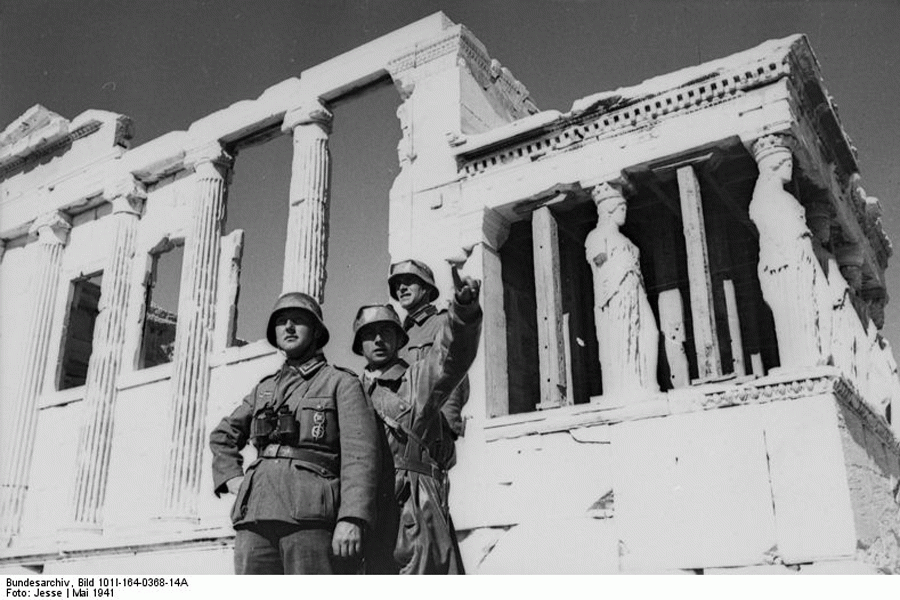
German flak against a fabulous backdrop of classical columns.*

Despite the Blitzkrieg myth a lot of Landser slogged along on foot.*

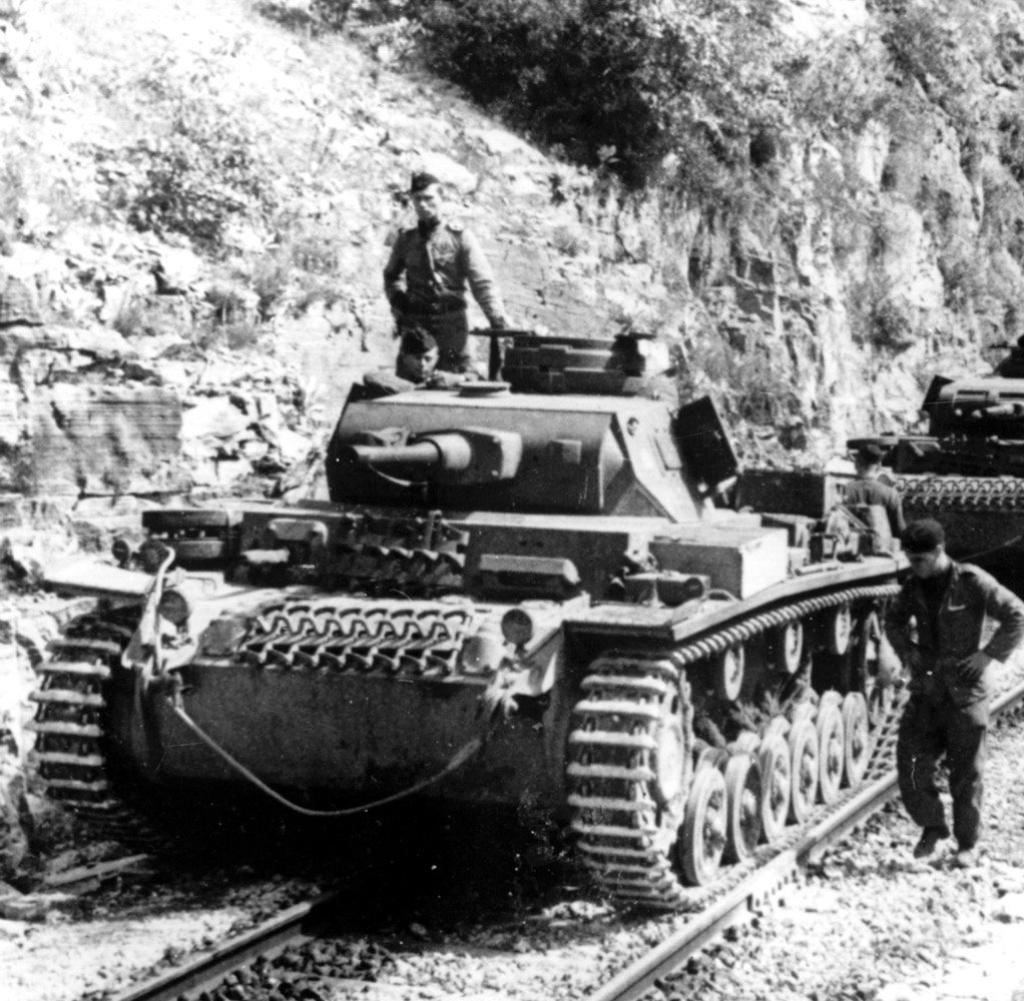
Mountainous terrain and poor roads meant rail lines sometimes doubled as highways.*

German artillery in a beautiful landscape.*

Most Greek roads were dirt tracks like these; ok in good weather, but appalling when it rained.*

However, overall Greece 1941 is well enough written to keep the reader - or this one at by rate - excited and interested. The bigger picture is sketched out at either end of the narrative, with the bulk of the book given over to the blow by blow ground level action, with excellent use of firsthand accounts keeping it very lively. This said, there are times when the barrage of unit numbers and names gets a bit tough to keep a handle on. But that's war, complex, ever-changing, confusing!

The Commonwealth forces for the Greek campaign were always under strength, and poorly equipped compared with the German invaders. [1] And to some degree the whole operation was doomed from the outset. Plowman maintains, however, that the Allied forces, even the Greek element, gave a good account of themselves. 


Amongst the NZ forces in Greece was this Maori unit.*

One of the mainstays of the Allied contingent, the Universal Carrier.

 Blitzkrieg blunted; German pioneers work to reopen supply lines.*

Soon it was the Germans turn to play tourist.*

Germans pass by and examine wrecked and abondoned Allied materiel.

I think the provocative subtitle of the book, The Death Throes of Blitzkrieg, overstates things somewhat. But Plowman's contention that this may be the first time the vaunted Blitzkrieg began to falter is a lesser and far more plausible claim. His focus is definitely more on the Commonwealth forces, but he does include Axis testimony. 

As well as regular Wehrmacht troops and materiel, there are SS, paratroopers and, of particular interest to me (I'm not sure why?), Gebirgsjager. And the campaign is doubly or triply fascinating because, due to the interesting topography, all elements/arms are involved, for all belligerents, from the ground forces to the naval and airborne contingents.


Gebirgsjager at rest in Greece.*

Gebirgsjager at work in the mountains, Greece.*

Mountainous terrain isn't ideal Blitzkrieg territory.*

The fate of much Allied materiel, abandoned and destroyed.*

This is one of those books that poses a real danger to me, in terms of a desire to build wargaming forces with which to refight elements of it. If I were to go down this avenue, I think I'd choose 1/300 scale, or 6mm, so as to be able to involve air and sea elements, as well as land warfare, and also so as to include as much topography (mountains, coast, islands, etc) as possible. Uh oh...

A thoroughly enjoyable read. I'd definitely highly recommend this.


Most Allied A10 tanks threw their tracks, or broke down one way or another.*

Retreat for the Allies and advance for the Germans was often hampered by poor roads laden with heavy traffic.*

ANZAC troops take shelter whilst waiting to be evacuated.*

Amongst those rescued by sea, these NZ nurses.*

----------
NOTES:

* I've tried as far as possible to use pictures in the public domain found online, that are not used in Plowman's book.

I suppose the image chosen for the cover (see top of this post) fits with the subtitle of the book. But as I say in my review, above, I think that's an attention grabbing overstatement. A much more representative cover image would've been an A10 that had been abandoned due to track failure! Indeed, I've a mind to make me a diorama of a scene depicting German soldiers gathered around the wreck of an A10 somewhere in Greece. That's a definite one for the the 'to do' project list!

[1] It was the actions of Mussolini's Italians that forced Hitler's hand in this theatre, at least as he saw it. But the theatre as a whole included Yugoslavia, Bulgaria and Hungary, and ramifications further afield meant that Crete, Turkey and all around the eastern and northern Mediterranean were affected by events on the Hellenic peninsula, as was Hitler's planned invasion of Russia. These other nations and their actions are often mentioned, as they relate to unfolding events in Greece itself, but don't come within the scope of this book.

Tuesday, 12 February 2019

Book Review - Images of War: M7 Priest, David Doyle


I'm beginning to gather a reasonable collection of these Images of War titles. When I bought Sherman Tank, by Gavin Birch, to support my concurrent 1/72 kit builds, I was a bit disappointed , as it was mostly Shermans in British service (which the title didn't make clear), and whilst the images were okay, the text was less so.

This time around I got the book first and, loving it, then went out and bought a couple of kits. First off, this is a better put together book anyway, being better written, very clearly, simply and well structured, and appropriately (not to mention copiously/richly!) illustrated. As befits a title from a series called Images of War, the pictures are fabulous.

M7 firing on German positions near Ribeauville, on the Rhine, France, Dec' '44.

Carentan, France, 1944.

The text and images start with a written introduction to the subject, followed by pictures and history of the first trial type (a model of which I intend to build, based on the superb visual ref contained herein). Words and imagery then move through the various production models/variants, based around the various orders placed by the US military with several contractors, before moving to descriptions, written and photographic, of the M7 in the field.

The M7 saw service in North Africa, Italy, the Invasion of Europe and the Pacific, and there is excellent material here from all theatres. There's one rear-view pic of a British mortar carrying variant, and mention of the Kangaroo personnel-carrier type, but no. pics of the latter. The Priest's development and deployment by the US continued into the Korean War, in the early '50s, which Doyle covers. 

An M7 in Luzon, The Phillipines, June, '45.

A nice colour pic from '43, showing a Priest firing during training.

As well as a few WWII colour pics there are a generous selection of crisp full colour photos of surviving examples, adding to the already rich arsenal of visual reference. The evolution of this vehicle is superbly and compellingly communicated. This has, quite unexpectedly (as I generally favour German WWII stuff) become my favourite title, thus far, in the Images of War series.

I liked it so much I immediately went out and bought a couple of Revell 1/76 kits of the M7 Priest, from a friendly local model seller. 

Okinawa, May, 1945. Note the spare track used as armour.

M7 Priest dug in, to achieve higher gun elevation, Kleinblittersdorf, Germany, Dec. '44.

---------------
 More Pics!

This is not David Doyle's first book on this subject. Pictured below is the cover of a Squadron Signal publication he did on the same subject.

A previous publication by Doyle on the same topic.

As mentioned above, I enjoyed this so much I went out and bought some models, and during research for my model and this review, I came upon a load more pics not used in the books, some of which come from the same series of pics used here.


Preparing artillery rounds for firing.

Inside the fighting compartment.

Disembarking a Priest from a landing craft.


Hosing down the vehicle.

Nice view of the manned machine gun.

Bogged down in mud.


What are these doodads?

This appears to be a still from a colour film of an M7 Priest.

A nice view of a Priest's driver.

The Priest featured in Life magazine.

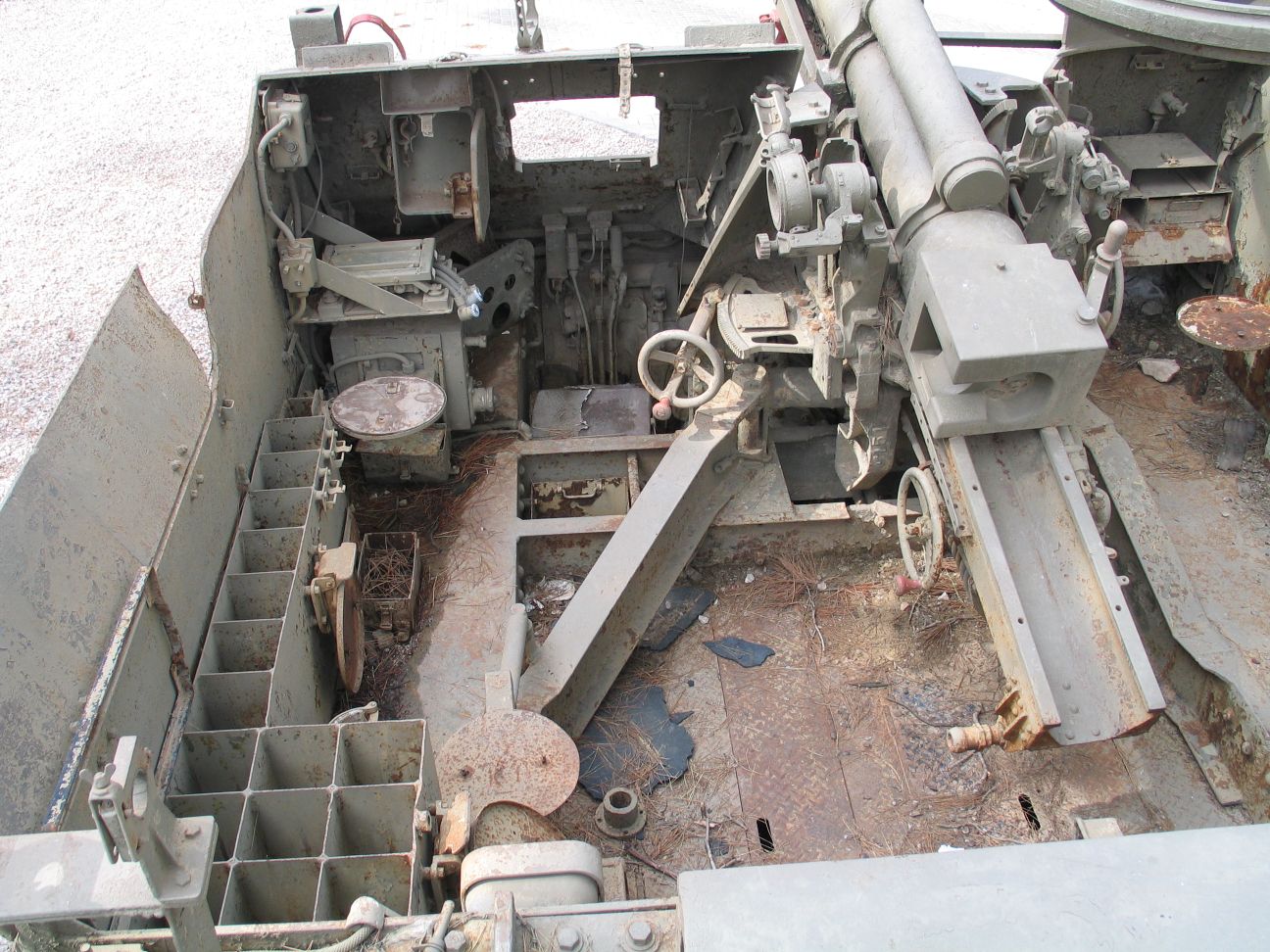
Contemporary photo of a surviving M7 Priest's interior.


Amphibious training in California.

An M7 Priest alongside a recovery vehicle.

A Priest being serviced during firing.

In Action in Italy.