Showing posts with label photographic. Show all posts

Tuesday, 12 January 2021

Book Review: Strabokran, Volker Ruff


Got myself this for Xmas, 2020. I have a yen to scratch-build one or two of these cranes, in 1/72. The few kits of the Strabokran I found in 1/72 seem to be about £30-40+. I managed to get my copy of this book for a little over £20. That seemed, to me, better use of my limited funds; this way I can build my own models, for the cost of a few bits of plastic profile, plus I get this plush reference work, for about the same cost, or poss’ even less, as buying an off the shelf kit.

Of the several similar format books I've bought in the last few years, this isn't the best, or my favourite. The minimal bi-lingual text (in English and German) isn't terrific, and the quality of the images is quite patchy. But, nevertheless, overall it's still excellent reference, gathering together plentiful contemporary photographic imagery - albeit of very mixed quality - and supplemented by numerous line diagrams. 

The latter include 1/35 scale plans, which will be very useful for me, once all the dimensions are halved. Another of my minor gripes, however, relates to the overall clarity of all the info', both textual and graphic. I'm well past my third, fourth and now even fifth perusal of the book, and I still find it all very confusing, what with all the differing variants, and issues around the quality of the translation from German, and clarity of images, etc.


---------


Still, despite these several caveats, I'd like to add my 'amen' to the 'hallelujah chorus' of approval that this book has received elsewhere online. 


Momentarily returning to the translation from the author's German into English, it almost feels like it’s been arrived at by simply running the German text through Google Translate, or something of that ilk. The resulting combo of strangely Germanic lumpen prose and editorial slips make the text heavier going than I'd like.  


And, despite the huge number of illustrations, which are - unusually for books in this line on similar subjects - split between mostly WWII archival photographs, and more recent line diagrams, I don't feel that there's as great a degree of visual clarity here as one might wish for. 


I bought this book partly simply because I'm a WWII/Panzer nut, and partly because, following on from the former, I wish to build models of these cranes. Repeated intensive perusal of the masses of material presented here still leaves me uncertain on several details of these fascinating machines.


However, having returned throughout this review to certain critical points, I'll end by conceding that it'd be pretty churlish to score this much less than five kreuz stars. As, after all, it does indeed gather together an immense amount of reference on its subject. 


The following short recitation of certain section headings (and contents) gives an idea of the level of detail:


After a brief intro, there's a potted history of the company that made the cranes.


Then we have info on the 15t, 16t, 20t variants, plus other stuff (inc. postwar production).


Parts of an Allied report, Operation Backfire, are reproduced, which includes illustrated descriptions of deployment.


'Strabokran in Action' shows them in use with Tigers, Panthers, Elefant and V2 rockets.


Further sections on rarities (other cranes used when Strabokran weren't available), survivors, patent applications (!), and unit formations/allocations add detail.


But best of all, for the modeller like me, there’s both a detailed photographic 'walk around’, and lots of 1/35 scale drawings.


And, whilst not perfectly rendered, nearly all the textual content is presented in both English and German. 


All in all, then, whilst admittedly not perfect, this certainly is a fascinatingly interesting and very useful resource, if - like me - you're a dedicated 'beyond hope' Panzer nut.


----------

Volker Ruff's strabokran website

https://www.strabokran.de/index.php?seite=strabokran

Thursday, 19 November 2020

Book Review: The Ghettos of Nazi-Occupied Poland, Ian Baxter (Images of War)


As someone who literally loves the uniforms, equipment, materiel, and quite often even the combatants and their stories, the whole racist/fascist aspects of the Nazi regime are anathema to me. It would be beyond churlish, in my view, to even attempt to downplay, ignore or worse still deny or support those aspects of what was an appalling ideology.

Having said that, for the most part I do separate the two aspects: the fascinating military machine/history, and the contemptible visions it was employed in furthering. In the same way I could happily assemble both sides of American Civil War forces, or, for that matter, English Civil War armies, without declaring allegiance to any of the views espoused (or not) by the combatants.*

With those thoughts in mind, what of this book? Well, thus far I haven't read much of the textual content. Instead I've just studied the many interesting images and read the captions for them, and occasional parts of the text, like the short intro/aftermath segments. In some ways, whilst the underlying segregationist concept is, to me, awful - if not as unusual historically as some might suggest - what strikes one most, at first glance, is the ordinary everyday banality of much of it, street scenes and people milling about, even markets, policemen, firemen, postal workers, people working in factories, etc.


Ghetto residents working in a shoe-factory, Lodz.

But this disguises, now as it did for the Germans back then, including perhaps those who took most of these photos, who might've look at some of these images and fooled themselves they weren't being all that bad, several key things: first and foremost these weren't ghettos 'naturally' formed, so to speak, by ethnic groups choosing to congregate, as many around the world to this day remain. They were government enforced relocations, and part of the more sinister so called 'cleansing', i.e. institutionalised genocide. Aka the infamous 'final solution' to 'the Jewish problem'. 

And whilst the Germans, lovers of bureaucracy and form filling, list-making and so on, did create the semblance of normal institutions within ghettos, these were token gestures, beneath which racist contempt saw them utilise the Jewish population as a disposable low-maintenance workforce. Those who weren't dying of starvation, or diseases like cholera, typhus, and so on, would be working in German industries, mostly towards the war effort

This photographic study concentrates mainly on the ghettos as photographed, on the whole, by a number of German servicemen. Some of these collections of photos only surfaced in fairly recent years.  And, unusually for a WWII Images of war title they include a segment of colour photographs. 

One of a number of colour images. Biebow visits Lodz.

The main chapter headings convey the content:

Ghettoisation - Jews** are removed from their homes and relocated, mostly by train, but also on foot. This section also has numerous pictures of german 'brass' and functionaries, like Hans Biebow, a businessman turned Ghetto administrator.

Life in the Ghettos - This is, at first glance, the most apparently humdrum chapter. But the banality belies the underlying brutality, as the casual littering of corpses occasionally reminds the viewer

Liquidation of the Ghettos - as ominous as it sounds; this is the segment that, inevitably, depicts - even if only in a few shocking images - the most brutal part of the Nazi war crimes process, the wholesale butchery of unarmed non-combatants.

The Warsaw Uprising - Another brutally bleak chapter in this sad story sees the largest of the ghettos rise up, only to be mercilessly crushed.

The book ends with The Aftermath and two appendices. The first lists major Polish ghettos (but by no means all of them), many illustrated by single photos, and the second and last says a brief word on the infamous Reserve Police Battalion 101, who were instrumental in facilitating Nazi policy in these tragic times.

Personally I think it's very salutory to remind oneself of the reality and the enormity of these crimes against humanity. Their scale beggars belief, and their proximity in time should be a warning against complacency. On a European tour with a band I was once in, our Dutch tour bus driver took us to a transit camp in, I think, Belgium. To stand in a place of that type - not even an extermination camp - and think how whole categories of humans were treated as disposable trash, was a very powerful experience.


Note on photos: the two colour photos I've used here - so washed out they almost look black and white - are, like a number in the book, from the USHMM, or United States Holocaust Memorial Museum.


* It's worth remembering that many soldiers are not primarily fighting for the causes their leaders say they stand for. Many just fight for their nation, homes and families, each other, or simply to stay alive.

** And, let's not forget, other so called 'undesirables', such as leftists, gypsys, homosexuals, and so on. But obviously, as per the title, this book concentrates on the Jewish aspect of Nazi persecution, it being the largest and primary 'out group'.


Monday, 16 November 2020

Book Review: Artillery Warfare, '39-'45, Simon & Jonathan Forty


This excellent single volume packs an awful lot into a pretty small space. 

Over 400 black and white photos illustrate the massive range of materiel covered, taking in all the main (and many minor) combatant nations and theatres*. As well as the plentiful imagery, extracts from wartime records are used to show how the various artillery branches of the armed forces operated. 

A remarkable range of artillery is covered, even if - give the enormity of the subject - only in relatively quick or short form; from the brief mention of hand-held anti-tank weapons, to individual entries on such weaponry as the Long Tom, or those crazily huge Nazi rail-super-guns, including towed artillery, SP guns, rockets, AA and fixed batteries (like the Maginot and Westwall), and so on. 

From pocket-sized pea shooters, like the Pak 37...

The roots of modern artillery developments in WWI, their rapid evolution during WWII, and even hints of the postwar legacy - many guns of WWII remained in use long after '45, and many technologies evolved by quantum leaps during the Second World War, to create a new era (guided missiles/rocketry) - are all here. 

Appendices add info on observation and gun siting, etc. All in all a very impressive work, covering exactly what the title suggests. I'd say this is a pretty essential reference work for the seriously interested WWII history buff. But obviously being a brief and wide ranging picture based survey, more in depth detail is to be sought/found in more specialist publications.

... to huge monsters like this, there's a lot here.

Further to this last point, this book might also, as it has for me, stimulate a desire to delve further into certain sub-categories; for example, I recently got into the famed German 88mm gun, and I'm prompted now, having read this, to pick up a book from my pending pile about Germany's West Wall...

* The only notable omission theatre/combatant wise that struck me being China.

Tuesday, 12 February 2019

Book Review - Images of War: M7 Priest, David Doyle


I'm beginning to gather a reasonable collection of these Images of War titles. When I bought Sherman Tank, by Gavin Birch, to support my concurrent 1/72 kit builds, I was a bit disappointed , as it was mostly Shermans in British service (which the title didn't make clear), and whilst the images were okay, the text was less so.

This time around I got the book first and, loving it, then went out and bought a couple of kits. First off, this is a better put together book anyway, being better written, very clearly, simply and well structured, and appropriately (not to mention copiously/richly!) illustrated. As befits a title from a series called Images of War, the pictures are fabulous.

M7 firing on German positions near Ribeauville, on the Rhine, France, Dec' '44.

Carentan, France, 1944.

The text and images start with a written introduction to the subject, followed by pictures and history of the first trial type (a model of which I intend to build, based on the superb visual ref contained herein). Words and imagery then move through the various production models/variants, based around the various orders placed by the US military with several contractors, before moving to descriptions, written and photographic, of the M7 in the field.

The M7 saw service in North Africa, Italy, the Invasion of Europe and the Pacific, and there is excellent material here from all theatres. There's one rear-view pic of a British mortar carrying variant, and mention of the Kangaroo personnel-carrier type, but no. pics of the latter. The Priest's development and deployment by the US continued into the Korean War, in the early '50s, which Doyle covers. 

An M7 in Luzon, The Phillipines, June, '45.

A nice colour pic from '43, showing a Priest firing during training.

As well as a few WWII colour pics there are a generous selection of crisp full colour photos of surviving examples, adding to the already rich arsenal of visual reference. The evolution of this vehicle is superbly and compellingly communicated. This has, quite unexpectedly (as I generally favour German WWII stuff) become my favourite title, thus far, in the Images of War series.

I liked it so much I immediately went out and bought a couple of Revell 1/76 kits of the M7 Priest, from a friendly local model seller. 

Okinawa, May, 1945. Note the spare track used as armour.

M7 Priest dug in, to achieve higher gun elevation, Kleinblittersdorf, Germany, Dec. '44.

---------------
 More Pics!

This is not David Doyle's first book on this subject. Pictured below is the cover of a Squadron Signal publication he did on the same subject.

A previous publication by Doyle on the same topic.

As mentioned above, I enjoyed this so much I went out and bought some models, and during research for my model and this review, I came upon a load more pics not used in the books, some of which come from the same series of pics used here.


Preparing artillery rounds for firing.

Inside the fighting compartment.

Disembarking a Priest from a landing craft.


Hosing down the vehicle.

Nice view of the manned machine gun.

Bogged down in mud.


What are these doodads?

This appears to be a still from a colour film of an M7 Priest.

A nice view of a Priest's driver.

The Priest featured in Life magazine.

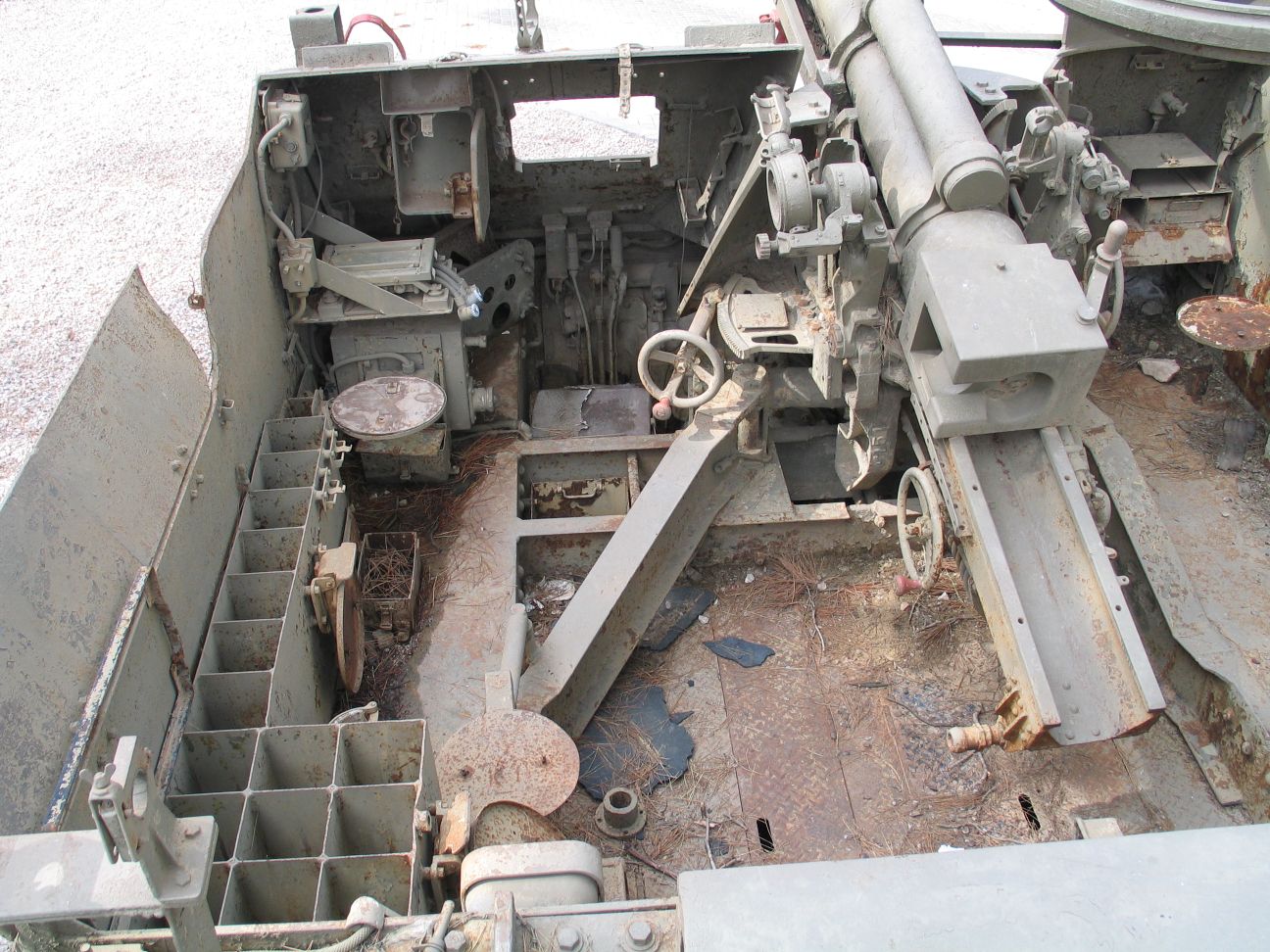
Contemporary photo of a surviving M7 Priest's interior.


Amphibious training in California.

An M7 Priest alongside a recovery vehicle.

A Priest being serviced during firing.

In Action in Italy.