Showing posts with label illustration. Show all posts

Saturday, 25 May 2019

Misc: La Bête est Morte, WWII bande-dessinée.

This morning I got an email from Bovington Tank Museum, under their 'Tank Times' banner, which had an interesting link regarding a recent book donation (read more here). This is something I'd definitely like to know more about; a bit of 'googling' lead me to unearth the following images:

Cover of the first in the two-part edition.

A scene depicting French liberation.

The German war machine invades France.

Here we see the two editions.


The artist who's supplied the illustrations, Calvo, is obviously superb. He's clearly influenced in these artworks by Disney's contemporary style. But despite this obvious indebtedness, the artworks remain fabulous in their own right. 

The British Bulldog bites Hitler's arse!

Some spreads are a series of frames...

... whilst others are fantastic double-page spreads.


At the time of posting these are in a random order, as I found them online. I'll probably return to edit this into a more sequential order at some future juncture. I've captioned the most obvious content. But there are numerous images I need to study more. I've seen originals online for crazy prices. I'm hoping that there are affordable English editions!? Perhaps it's even still in print? Does anyone know?

Churchill's Bulldog vs. Hitler the crazed Wolf!


It looks like all theatres are addressed; here we see North Africa.

Hitler, Goering and Goebbels.


As this shows, the comic doesn't pull any punches.


A small detail from a larger and superb pastiche of Delacroix.


Nazi training.


The global view.

I'll definitely be looking to acquire this. Probably in an English language version, to be honest. It looks utterly fantastic.

Sunday, 14 October 2018

Misc: Started A New Blog!

The latest post at my new blog.

For years now I've been meaning to start a blog attached to my sebpalmer.com domain. That has been my illustration 'business' website for a long time now. But as I'm currently not doing much illustration, it's been laying dormant.

My illustration website, currently dormant.

I've long wanted to make that a more general website, with different pages for my various different interests and activities, such as my drum teaching and art, as well as the illustration. I also had a yen for making the blog attached to the website a WordPress one. Not exactly sure why? But I suppose learning to publish in both Google Blogger and WordPress just seemed sensible/attractive.

This blog's most recent post.

Actually it turned out that choosing to do it using WordPress contributed to the long delays getting set up and started. But I've finally made a start. Whereas I've blogged quite extensively in the Google platform, and have arrived at a style I'm currently happy enough with, the same foes not hold for WordPress. It'll doubtless be a while before I learn how to present that as I really want to.

The most recent post on my inactive music blog.

So, I now have three blogs: this one for my wargaming and mini-military hobbies, sebpalmer.com/blog for my all round personal and professional stuff, and sounds from the funky goat, another Google blog, dedicated to music, and currently inactive.

Saturday, 29 September 2018

Book Review: Uniformes Napoléoniens, Carle Vernet

1er Regt. Carabiniers.


Whilst doing some picture research for my post on Paul Britten Austin's superb 1812 writings, I was looking for images of Swiss Voltigeur Jean-Marc Bussy, and failing to find any. So I settled for a couple of uniform plates, one by Knötel, and another by Carle Vernet, showing Swiss troop types that might've looked similar in appearance.

1er Regt. de Hussards.

Chevau-légers lancers Polonais.

Infantrrie lègére.

Having browsed numerous Vernet plates from this particular series online, I became aware that a complete Folio of around 245 plates had been produced. Covering the entire Grand Armée, it illustrates the new 1812 Bardin regulation uniform update, ordered by Napoleon as he campaigned in Russia. I looked longingly at originals for sale online, knowing that unless my fiscal fortunes change massively at some point, I'll not be owning such treasures any time soon.

But I did discover that there'd been a book published by the Musée de l'Armèe/Bibliothèque de l'Image, reproducing 77 of these fabulous images. I promptly found and bought a copy, via the Abe Book website, from a bookseller who turned out to be just a few miles away, in Ely. The book arrived promptly, very well packaged and in pristine condition. So I'm really chuffed.

1er Regt. de chasseurs à cheval.

1er Regt. de Dragons.

Artillerie, Col. et chef de Bataillon.

The uniforms are splendid, and the images illustrating them are gorgeous. The figures and their faces and anatomies are rendered in a style bearing the hallmarks of the Academic training of the day, with Neo-Classical profiles, and poses/gestures. Not enormously realistic, but very stylised and graceful, and totally in keeping with the peacock finery of the apparel.

Carle Vernet collaborated with Bardin in the massive project, with Bardin taking care of the technical details and Vernet supplying the artistic eye/hand. The text of this book is entirely French, and quite brief. There are no plate by plate entries elucidating the content of the individual images.*

Infanterie légère, chasseurs. Preparing a meal.

21eme Regt. de chasseurs a cheval, ice-skating!

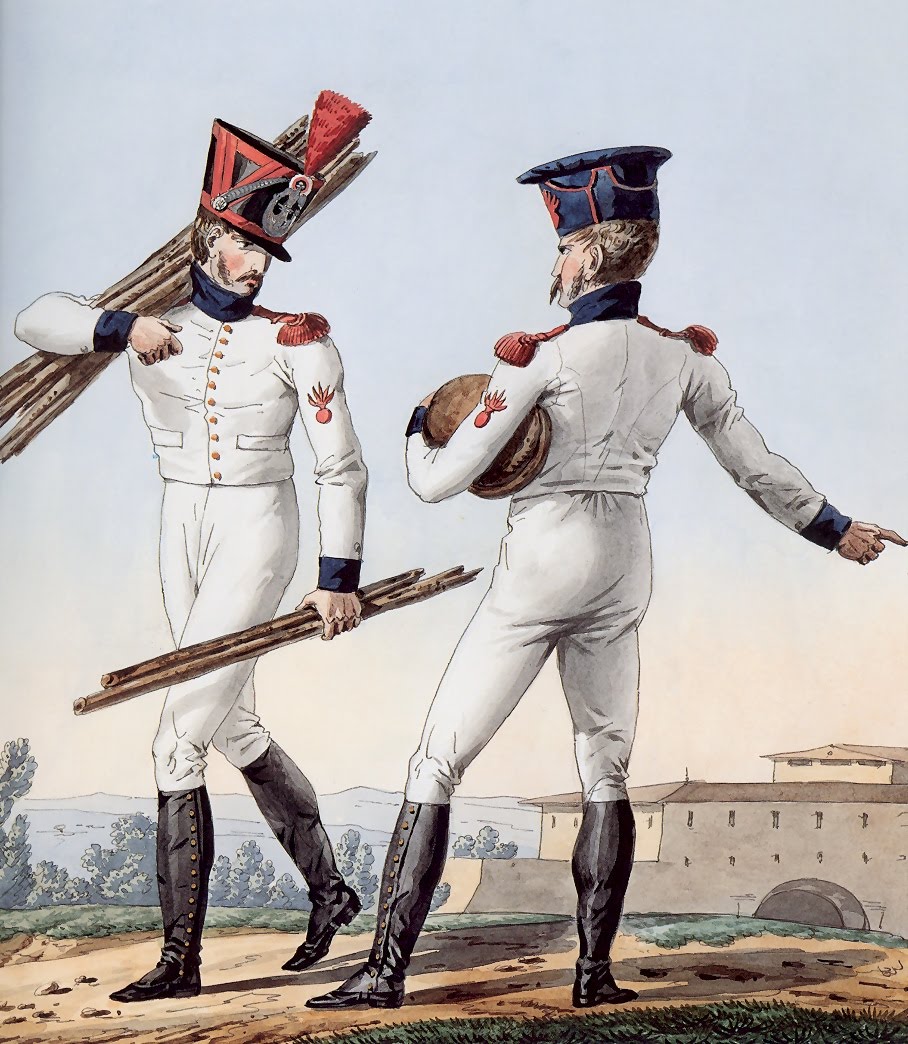
One of the many things I like about this book and the art it depicts, are the numerous little scenarios, such as the skaters, or the guys preparing a meal, above, or the Dragoons practising with wooden/whicker swords, or the line grenadiers en veste, at their bivouac, with firewood and loaves of bread, below.

26eme Regt. Dragoons.

Infanterie de Ligne, grenadiers en veste.

I've read in numerous places that the introduction of changes such as are commissioned and illustrated in a project like this take years to come into effect, and they often don't reach all the areas they're intended to at all. Sometimes being ignored, or sometimes being superseded by other changes. So to what degree these images reflect how Napoleon's troops actually looked over the next few years is something I'd be hesitant to pronounce on.

But as a resource for the Napoleonic buff, and even just as an object to be admired in itself, this is unquestionably a wonderful little publication.

The original Folio volumes.

How the original plates were presented,
with info below, in a kind of 'inscription'.

* I've half a mind to try my hand at translating the text, as there's not that much of it. But whilst preparing this post I found out that Greenhill books have published an English edition of this book. Hmm? Should I get that?

Carle Vernet.

Saturday, 16 June 2018

Book Review: Vingt Batailles, Theodore Yung


You know how it is, one click leads to another, and before know it, the interweb has lead you a merry dance to who knows where.


Siege de Saragossa

This morning I had just such an experience, and it lead me to discover this, a digitised edition of Theodore Yung's Vingt Batailles de la Revolution et de l'Empire. I first became aware of Theodore Yung's beautiful artwork through the use of his image of Ligny on several book covers (the front of The Emperor's Last Victory, and the back of Grouchy's Waterloo, for example).

Bataille de Montereau

Rummaging around online I found original editions of this handsome looking book either for sale or having sold, ranging from about £350 to around £1,500. I realise my combined Napoleonic Wars fetish and general bibliophilia is getting pretty serious, 'cause I find myself desperately wanting to find some means, any means, of acquiring this beautiful book.

Bataille de Waterloo

But for now I'll have to make do with the above-linked online version, from Gallica, or something similar. I make that last remark having also found several other online versions here, which looks better quality (but the images are smaller), and here. Sadly the image quality in the latter is rather poor. But it was from that source that I was able to harvest this full listing of the plates:

Siège de Toulon (1793), Sainte-Euphémie (1806), Prise de Gaëte (1806), Combat de Somo-Sierra (1808), La Corogne (1809), Prise d'Oporto (1809), Siège de Saragosse (1809), Talavera (1809), Ocaña (1809), Passage de la Sierra-Morena (1810), Fuentes d'Oroño (1811), Affaire de Brienne (1814), Combat de Champaubert (1814), Montmirail (1814), Montereau (1814), Craonne (1814), Arcis-sur-Aube (1814), bataille de Paris (1814), bataille de Ligny (1815), bataille de Waterloo (1815).


Thursday, 7 June 2018

Nostalgia/book reviews: L & F Funcken's Napoleonic Uniform Books


As a kid I'd take these wonderful books out on loan from the Cambridge Central Library, then in the Lion Yard (now the Cathedral of Capitalism known as The Grand Arcade), frequently running up fines, as I held onto them overly long, delighting in the artwork of Liliane et Fred Funcken.

Nice double page spreads as endpapers.

The fact the authors/illustrators were French added to the charm and romance. I'm not sure why, but right from the outset I was more interested in the French, first and foremost, and their allies - especially the crazy patchwork of tiny states that was to become the Confederation of the Rhine - and then the Russians, Austrians, Prussians.

The Russians.

I don't know quite how or why, but from very early on I sensed that the English and their minions were something of a sideshow. And - despite Wellington's role/achievements, or Nelson and the Navy, or even our primary contribution to the Napoleonic Wars, as bankers to the several European coalitions - I still feel this way.

It wasn't until many, many years had passed, including my near enough two-decade break from military miniatures and history, etc, that I bought these fab books for myself, at one of the wargaming shows I now ocassionally attend. I can't recall which show it was - I have a feeling it was Salute - or exactly which seller I got them from. Most likely it was either Lanchester or Meekins.

An attractively done vignette of Baron Larrey's 'flying ambulance'.

As in days of yore, it's the pics I'm primarily drawn to. Although, unlike when I was a nipper, I do now also read the text. The peacock finery of military uniformology reached a kind of apogee at this point. The Napoleonic era was and remains my favourite for martial attire. And as splendid as these books are - and what a pleasure it is to no longer rack up fines as I endlessly pore over these - I now need to supplement and extend my knowledge, so I have numerous other similar titles, including series like Osprey or Blandford, or collections of particular artists, like Rousselot.
A handy black and white 'glossary' spread. [1]

I've also learned that the Funckens worked with Hergé, producer of the fabulous Tintin series, and also a man with an avowed mission to educate youth. In the latter capacity he had the Funckens, through studio Hergé and its numerous projects, frequently producing all sorts of historical material. On one of my visits to the Waterloo battlefields I bought a rather attractive hardback that compiles a number of these works on the theme of Waterloo. It's fantastic. The only drawback is it's in French, and my French isn't exactly tres bon!

However, this post concerns their two Arms and Uniforms titles [2] on the Napoleonic Wars: Volume one covers the French army, including Napoleon and his staff, and everything else except the various formations of the Imperial Guard. Then it goes on to cover the British, Prussian and Spanish armies. Volume two starts with the Imperial Guard, and then moves on to 'Allies of the French' (from Confederation of the Rhine to Italy and Naples, etc.), and the Swedish, Austrian and Russian armies. Unsurprisingly, it's the French army that gets the fullest treatment. [3]

I absolutely love these two books, as they were a powerful part of my early interest in the period. Consequently the Funckens also have a special place on the nostalgia map of my soul!

In the foreground, a personal favourite: Eclaireur, 2nd Regt.

----------
NOTES:

[1] There are numerous illustrations of equipment, badges, flags, etc. Mostly in colour.

[2] The Arms and Uniforms series covered everything from the ancients, through medieval, right up to the two World Wars.

[3] As a result of this fuller coverage I've always had a soft spot for certain more obscure branches of the French military machine, from the artillery train, or the medics, to the Eclaireurs. Often based purely on the aesthetics/colour schemes of their uniforms!