Showing posts with label Kriegsmarine. Show all posts

Thursday, 19 September 2019

Book Reviews: The U-Boat Commanders, Jeremy Dixon & Knights of the Battle of Britain, Chris Goss

Two quite similar books under review in this post, one on the avionics plane and the other on a maritime tack. The books most obvious similarities are that they focus on German medal-winners of WWII. The former gaining their laurels fighting in the Luftwaffe, the latter proving hardy in the Kriegsmarine. [1] I'll look at them t'other way round, seas then skies.


In just over 300 pages, with about 200 illustrations, Jeremy Dixon gives us 123 short biog's of German Kriegsmarine personnel who won the various grades of Knight's Cross serving in the U-Boat arm. He starts with the highest grades and works downwards, each class getting bigger as we get lower down the grades. This is quite good, as it front-loads the book with the high-scorers, amongst whom are some of the more familiar names, like Kretschmer, Prien and Topp.

The nature of this book, and others like it (see below!) is great in that it lends itself to dipping into, as opposed to the more normal front to back and all of the way through of normal narrative history. I love the latter as well, don't get me wrong. But when you read as much as I do, then a change in format and feel can be quite refreshing!

You could, of course, read this cover to cover. And if this is your foremost area of interest, you might well choose to do so. I'm only recently getting more into the maritime stuff, having traditionally favoured land-based warfare over either aerial or naval combat. But books like this are helping feed a growing interest in the perilous combats on the briny seas. Possibly a bit specialist for the general WWII reader. Nevertheless, a solid, readable and informative resource.


This book has a more concentrated focus, in that it only covers Ritterkreuz awards made during the Battle of Britain. 121 airmen are profiled, over roughly 200 pages, 118 of them appearing once, for being awarded the Ritterkreuz, with three - Werner Molders, Adolf Galland and Helmut Wick - being featured a second time [2], for achieving the next grade, mit Eichenlaub (with Oak-leaves).

In most respects this is very like the similarly themed U-Boat book, differing only in how it's organised - chronologically, as opposed to in descending order of grade - and the shorter time-span it covers, April to December, 1940, as opposed to the whole war. Each entry succinctly synopsises the life and career of the recipient, whilst also giving a brief account of their part in the Battle of Britain.

Copiously illustrated in black and white throughout, with a short additional photo section towards the end, this is ideal for dipping into. Again, if this is your primary area of interest a cover to cover read might be in order. But for me it's a case of occasionally having a glance through, and cherry picking a few entries. This makes it eminently suited to workplace reading, if one's job allows occasional time-outs, as mine occasionally does.

A fascinating and informative resource.


NOTES:

[1] Sorry, couldn't resist the pun!

[2] In these cases the first entry is the fuller account, the second being very cursory.

Sunday, 14 July 2019

Book Review: Battleship Bismarck, Garzke, Dulin, Jurens


When this weighty tome arrived I was tremendously excited. Around about A4 portrait size - as tall, roughly, but slightly wider - this handsome hardback, just shy of 500 pages, looks terrific. I'm gradually growing ever more fascinated with war at sea, with a special focus on WWII and the Napoleonic era, i.e. in conjunction with my other main areas of mini-military modelmaking and figure collecting.

My very small WWII naval collection is slowly growing: I have models of Bismarck and a U-Boat, several films, such as Sink The Bismarck, Battle of theAriver Plate, Das Boot, etc, and a number of books, ranging from general histories such as Jonathan Dimbleby's War in the Atlantic, through to more specific titles, such as this handsome new one from Seaforth.


It's interesting to note the involvement of film-maker James Cameron, of Titanic and Avatar fame [1]. His interest in nautical and naval subjects is longstanding: he filmed Bellard's discivery of the Bismarck wreck for National Geographic, and then some years later explored the wreck himself. His research, drawing and many images from this latter expedition are a part of this new work.

Anyway, on to the meat of the issue: the book itself. Well, first off I started this review whilst only part way through the book - at the time of first penning this segment I was at the point where Bismarck, Prinz Eugen and several other vessels are embarking on Operation Rheinübung, heading for the northern Atlantic to engage in commerce raiding.

So far the book has been heavily weighted towards a textual rendering of the history of the Bismarck. And much more besides. The plus side of this is a great deal of detail, not just about the Bismarck, but about naval warfare in WWI, post-/inter-War developments, the Kriegsmarine at large, and even the Royal Navy and beyond. The down side of this is that it can be heavy going, especially when information is repeated.

I estimate that the text could fairly easily have been judiciously trimmed by somewhere around 10-25%, without losing any detail. This would in turn free up more space for more/better pictures. There are lots of photos, many of them of the 1:50 Blohm and Voss shipbuilders' model of Bismarck. But there could - indeed, I think should - have been more from, for example, the Bundesarchiv. 

For example, whilst the text goes into great detail about the building and modifications made (both to Bismarck and many other vessels, British and German), there are very few corresponding images of the building or maintenance of Bismarck. It would also have been nice to have had more use made of builder's plans, of the type that appear in the 'from original drawings' series that Seaforth gave published.

Having made these critical observations, this book remains a fantastic resource, and a beautiful object, clearly the work of men who are both passionate about and deeply knowledgeable on this very interesting subject. I've also now more or less finished reading the vast bulk of the text - and it is, like Bismarck herself, a vast bulk of text! - admittedly skimming through certain parts; probably around 10% of the text was either speed read, or skipped altogether.

With the keel laid down in '36, the incomplete hull launched in '39, and being officially commission in 1940, Bismarck's genesis was far lengthier than her active operational life. This latter, comprising the sole effort of Operation Rheinübung was to last just eight days! So, just over a week of active service, to be followed by nearing eighty years on the seabed. It's an amazing, exciting and tragic tale.

This book has helped deepen my interest in WWII naval history. And as a result of reading it I've subsequently watched several superb documentaries on the subject, ranging from Cameron's film of Ballard's discovery of the wreck (perhaps the best of the docs on the subject I've seen so far?), to Cameron's own exploration of the wreck. It's also caused me to re-watch several movies in WWII at sea, including both Battle of River Plate and Sink The Bismarck. And I'm hoping to find the time to build my Bismarck model over the summer as well. So it's not just been an informative and stimulating read in itself, but has also been the ctatlust for further activity.

For my Amazon review I gave it the full fuve stars, as they font give the option to award half-stars. But here on my own blog I can do half-increments, and have therefore scored this magnificent boom four and a half balkenkreuz. I dock the half star for a variety of reasons, the major ones being that there could and should have been more photographs, in particular of the building of Bismarck. There should also have been more technical/plan type illustrations. And some hardheaded textual editing, removing repeated material in particular, could've created space for this extra visual material.

But this is a stunning book, chock-full of a staggering degree of information, including a good deal of info on and testimony from survivors and adversaries. Not quite the total and thorough history of its subject that I'd anticipated, in receiving it, but nonetheless an exhaustively thorough analysis within its own more limited and largely technical terms of reference. And definitely recommended to those interested in such subjects.


NOTES:

[1] I've seen the former, but not the latter.

Sunday, 5 May 2019

Book Review: Helgoland, Aidan Dodson


From my initial reading of some of the dustjacket blurb I gather that the subtitle, Detailed In The Original Builder's Plans, denotes this as being part of a series from Seaforth, Pen & Sword's naval imprint, drawing upon original plans from the collection of the National Maritime Museum. 

I'm fascinated by war at sea. But I'm very virginal, when it comes to nautical affairs, so I'm not the most expert of judges on this topic. What I can see immediately, is that in respect of the images reproduced here, this is a five-star affair: chock-full of comprehensive and beautiful draughtsman's drawings of the Helgoland.

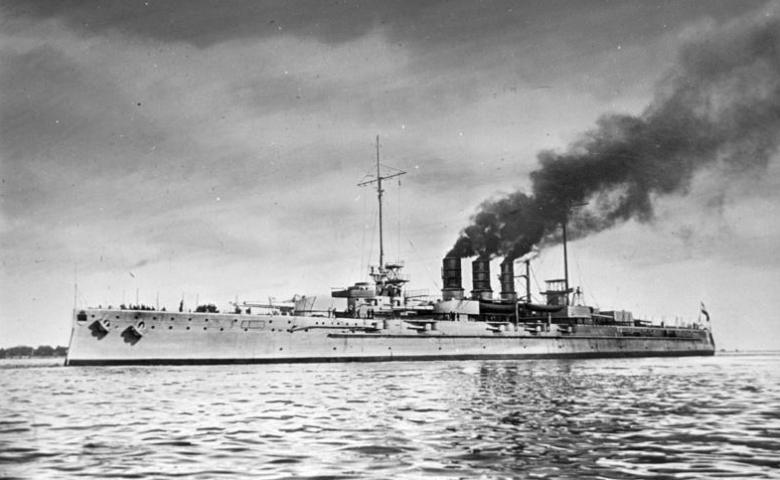
Construction of the Helgoland was completed and she entered service in 1909. She served throughout WWI, taking part in the famous battle of Jutland. After Germany's defeat England took custody of her, eventually selling her to be scrapped, in 1924. What a sad fate for such a monstrous beauty, and  what a waste of so much engineering work. But that's what happens to old ships, especially during/after wars.

SMS Helgoland (source: Wikipedia commons).*

I have to confess that the degree of detail provided here, which to me seems quite staggering, is a bit beyond what I require. Consequently I abandoned the complete reading of the text I initially embarked upon, about halfway through, with my head spinning, and instead skimmed through the remainder.

The largest of the reproductions is this four page spread profile.

What I spent more time on were the astonishingly detailed diagrams. Two of the pages fold out, giving two three-page spreads bookending one four-page spread. One could easily spend hours upon hours examining them. The many images run the entire gamut, detailing just about everything, and include plan, profile and sectional views. The combination of aesthetic  pleasure and awe at the engineering (not to mention admin, etc.) that I derive from studying these surprises me. What prodigious feats of construction/destruction we, the human animal, are capable of!

Whilst I'm morally confused about my fascination with war machines and war in general, I know that I'm totally blown away (wah-waah!) by the 'pure' engineering/tech aspects. Guns are great examples of this. Tanks are even better. But battleships? They have to be the ultimate, surely? Or maybe that'd be aircraft carriers... hmmm!?

There are detailed plan views of every deck, and way more besides.

Books like this often presume a certain degree of knowledge on the part of the reader. This one certainly does. Nevertheless, I feel such specialist publications really ought to include glossaries and the like, regardless. It'd be a great help to those readers of such works who, like me, might not yet know their binnacles from their bilge pumps.

However, that one gripe aside, the print quality and the number and detail of the schematic draughts used here are all very high. This level of detail is not, perhaps, for the mildly interested (or fainthearted). But I would imagine that for the nautical buff - and given how much a landlubber like me has enjoyed this - will love this.

26 spreads give 52 images detailing new station by station, from stem to stern.

Reading/perusing this has me determined to turn my hand to some form of naval modelling at some point soon. My only nautical kits are a 1/300 Dutch gunboat by Rod Langton, a U-Boat and the Bismarck (I forget yet make and scale if the latter; and poss you could also include my Arado AR-196 and Catalina flying boat models?), all currently in the attic I think. Anyway, back to the book: I'm no expert in this area, but I'd say this is an excellent book.

* As well as the lack of a glossary, there are no archival photos of Helgoland, which is a pity. Pictures of her under construction and in action would have made a terrific addition.

Saturday, 30 March 2019

Book Review: German Destroyers, Robert Brown


Despite being a long-term 'dyed in the wool' 1/72 military modelmaker I'm currently flirting with the idea of making model ships (I have kits for a U-boat and the battleship Bismarck). I was offered this book for review, by the publishers (Pen & Sword, on their nautical imprint Seaforth), and thought 'why not?' 

Lavishly illustrated throughout, the book starts with a chapter on design. It's interesting to learn, given the German reputation for design and building excellence, that this class of ship fared pretty poorly. Many ideas that were good on paper failed to translate into real benefits. Indeed, a number of clever ideas wound up working against seaworthiness. The exposition on design is followed by a detailed look at Z39, which is done via images derived from its period of postwar American ownership.

But it's pages 17-45 that really form the core of the book, comprising two chunky, informative and well illustrated chapters, the first on available model products (both full kits and partial aftermarket detailing sets), and the second showcasing some very impressive modelmakers' works. Chris Flodberg's 1/350 Z30 (also pictured on the cover) is particularly impressive, in no small part due to the amazing rendering of a heavy sea.

Three further chapters - colour schemes, appearance and plans - add to the wealth of useful visual reference this slim but info-packed book offers. And the whole is finished with a small bibliography. I always think specialist books such as this should, as a matter of course, have a glossary (inc. any abbreviations, etc.). That's the only real omission here that a landlubbin' armour modeller like me really notices.

Anyway, all told, a very attractive and useful publication. Further grist to my mill of nautical modelmaking fantasies. Perhaps I will actually build a small Operation Sea-Lion flotilla one day... hmm!?