Monday, 20 June 2016

Film Review: The Desert Rats, 1953

An older poster for the movie.

My DVD has this father more sober cover.


Released just two years after The Desert Fox, The Desert Rats, despite seeing James Mason reprising his role as Rommel, and despite also featuring stock newsreel footage of actual combat, is an entirely different kettle of fish. 

This movie actually stays in the sandy wastes of North Africa. Well, sort of. Tobruk and environs mainly, actually! And it's a lot more of your typical action-based war film as well, whereas Rommel was more a character study.

A sandstorm arrives, reducing visibility. Just before the Germans attack.

Burton's MacRoberts in dashing action-hero mode.

Richard Burton stars as a British Captain named MacRoberts, given charge of a bunch of 'green' Aussies, freshly arrived in the theatre of operations. Which means, essentially, Tobruk, and the defence thereof. MacRoberts is a tough nut, twice decorated; a no nonsense, down to business kind of fellow.

At his first meeting with his new charges he discovers among them an old schoolteacher of his, Tom Bartlett (Robert Newton), now a drunkard. Their troubled but nonetheless close relationship is one of the key ones in the film. Eager for action, he sees that the men are soon blooded, along the way commending actions he approves of, and punishing those he doesn't. 

Some of his troops like him, some don't. His decision to court-martial a soldier who attempts to save their own Captain isn't popular. His old schoolmaster remonstrates with him, revealing a hitherto secret instance of his own leniency towards MacRoberts, back at school. How will MacRoberts react?

Bartlett, most likely confessing his cowardliness to 'Tammy' MacRoberts.

The film has an excellent cast, and a good energetic action-filled pace. It's filmed in a suitably sandy and dusty location, and - apart from obsessive military history nuts like us, who notice and disapprove of Allied materiél being passed off as German [1] - it all feels just about right. Even the sock footage is better integrated (though still easily discernible) than it is in The Desert Fox, largely because a lot less is used.

After initial success in repelling Rommel's first major attack, the remainder of the action centres mostly around two particular events, as well as following a more general plot trajectory that includes other minor actions. The first of these more major actions is a Commando style raid behind enemy lines. The second is the defence of a strategically important forward outpost east of Tobruk. Both of these main scenarios, the first being the big central set-piece of the film, the second a kind of conclusion, are excellently handled, such that you really feel involved in the men's plight.

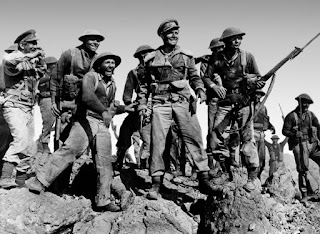
Disembarking for the commando action. The funky looking italian trucks are actually American!

I do like Burton's jacket, especially those great big woolly collars!

Mason's reprise as Rommel is quite a scanty affair, amounting really to a few cameos. But he has such presence and charisma when he is onscreen, just as, if we are to believe the popular tales, Rommel also possessed, that this doesn't matter. [2] And so too does Burton. Their paths inevitably cross, the scenario in which this happens being a rather excellent and intriguing one that I won't spoil for those who haven't seen it.

I haven't looked into whether this is in any way based in real events as yet. But, regardless of whether it is or it isn't, it's certainly a cracking good war film. In terms of sheer balls out fun, it's, er... the nuts!

----------
NOTES:

[1] Donning my anorak: if I'm not mistaken the Desert Rats were a British fighting force, whereas these guys are the Australian 9th Division.

[2] There are two, no, make that three, notable differences in Rommel's appearances in this film: first, he's hardly in it; second, in most his scenes (and German scenes generally) the characters, including Rommel, speak German (and my disc appears to have no subtitles); thirdly, in the main he's not portrayed so sympathetically as he is in Desert Fox.

Film Review: The Desert Fox, 1951

An older more dramatic poster for the film. As misleading in its visual content as the film's title!

A more contemporary DVD cover (same as mine). Less dramatic, but more in keeping with the content.


This is an odd film. For starters, the title is misleading. Only a very small portion of the movie is set in North Africa, where Rommel got his nickname of 'Desert Fox'. Most of the story unfolds in Europe, during the defence of France after D-Day.

James Mason is excellent in the title role, portraying Rommel as a suave, gentlemanly professional soldier. Also worthy of note is Leo G. Carroll, as von Rundstedt, who also portrays his character in a light many modern viewers might find surprisingly sympathetic.

The film is based on the literary and historical detective work of Desmond Young, who also portrays himself in a cameo role in the film, as a prisoner of war who gets a glimpse of Rommel at one point, and believes he owes his life to him. I won't go into the details, as I don't want to spoil it for those who haven't seen it.

Young's glimpse of Rommel.

Author Young appears in the film as himself.

One of the more striking cover designs for Young's biography.

Young became intrigued by the mystery surrounding Rommel's demise, and decided to investigate, which eventually lead to the publication of a book, and this film is built upon that book. The film itself starts with a brief depiction of Operation Flipper, a 1941 commando raid, the purpose of which was Rommel's assassination. [1]

One of several instances where footage shot for the movie is either superimposed over or intercut with stock newsreel footage from the war itself.

Most of the combat portions of the film, save only a flashback coda at the end, utilise real WWII footage, which, whilst adding authenticity, looks a bit weird to the modern eye. This was in fact quite a common practice at the time. But here it's handled a little heavy-handedly, in my view, with the result that it makes the transitions between such segments a bit clunky, and disruptive of the narrative flow of the dramatic element of the film.

Like so much to do with the war, and perhaps especially to do with Hitler and Nazism, much relating to the 'facts' are still hotly debated, and parts of the scenario this film is predicated on are contested, of particular relevance being the issue of whether Rommel was involved in the 20th July bomb-plot. This event, when Stauffenberg succeeded in placing a suitcase bomb in the 'Wolf's Lair', is depicted in a scene in the film.

Luther Adler as Hitler, giving Rommel a stern pep talk.

This scene is cut from the version I watched, but it's content is alluded to.

This is a good point at which to note that Luther Adler's portrayal of the Führer is pretty convincing, even in its very melodrama. [2] There's a very interesting scene - whether such a scene took place in real life I don't know - where Rommel meets Hitler, and attempts to make him see reason regarding the situation on the crumbling western front. Hitler continues to place his apparently unshakeable faith in himself, and the new V-weapons. It's a fascinating scene.

It was widely believed at the time that Rommel died of wounds received when his staff car was strafed. This film portrays a very different end to the general's career. I will, not wanting to spoil it, leave it here without giving too much away. What I will say is that this film's dramatic power crystallises around the ending, and is quite moving.

Von Rundstedt (Carroll) and Rommel (Mason).

Mason and his subject.

Interestingly it appears that Young's desire to clarify the story of Rommel has, in the longer term, failed. The 'Rommel myth', something this film is credited as being a key contributor towards, remains contested. It's also said of this film that it helped contribute to reconciliation between former enemies, by depicting some Germans as 'worthy foe', as opposed to caricature Krauts, Huns, Bosch, or whatever.

The Desert Fox doesn't explain why Rommel had such a good reputation as a general, that's taken as written, and pertains to a period prior to that covered in this biopic. What it does give is a portrait of the human side of a man struggling with his professional duties and his conscience, in a very tricky and unenviable position. And it's in respect of that theme that the film is most interesting and successful, whatever its relation to the truth of the events depicted.

Rommel with his wife and son.

Saying goodbye to his son in the movie.

----------
NOTES:

[1] Movie trivia fans might be interested to note that the commando raid is lead by Dan O'Herlihy, in an uncredited role. O'Herlihy is better known to me as General Ney, in Bondarchuk's Waterloo.

[2] Adler, an American actor, played Hitler twice; here and in a film called The Magic Face, also, coincidentally, filmed in '51. Adler's name sounds both strikingly Germanic, and yet totally Jewish. And he was indeed Jewish, performing in both Englsh and Yiddish, and best remembered in the US for his Broadway appearances in Fiddler On The Roof!

Painting Progress: Basing #1


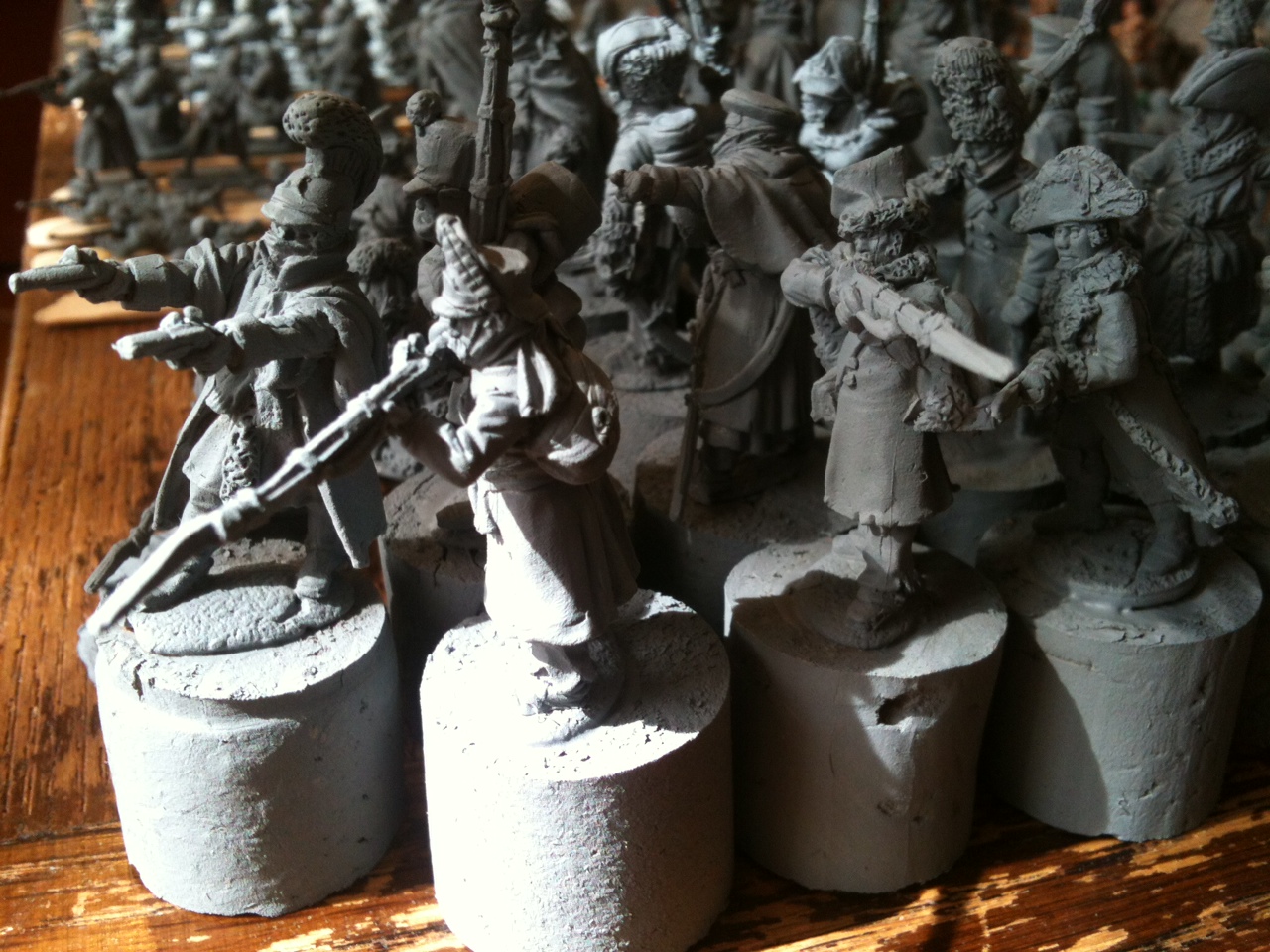
Pictured above is the scene of prolific semi-organised chaos on my 'workbench'*. 

I decided to unearth some 10mm Napoleonic 1812 battalions - only two: one French, one Russian - and think about basing some figures, at long last. In the process I recovered some other almost forgotten figures, including four 40mm AWI figures by Front Rank, which my wife bought me at some show several years ago, in a bid to get me working in a scale she could appreciate without an electron microscope.

AW 15mm Peninsular Brits (discontinued?) [1]; Magister Militum 10mm French, and Old Glory 10mm Russians. [2]

Unfortunately I have very little to hand suitable for basing, as I've yet to come up with definitive decisions on my methodology. I have, however, collected some odds and sods, in the form of a few packets of various sized pre-cut MDF bases. Mostly by (I think?) Minibits.

I soon discovered that, out of all the odds and ends I can currently find, only two, or perhaps three, at best, were suited to my current wants and needs: consequently I could only base one French 10mm battalion, an (under strength) 15mm British Peninsular battalion, my 20mm SS Cavalry, and the 40mm Front Rank AWI guys.

I opted to pair these guys off, excepting only the dismounted fellow...

... who stand guard over an assortment of temporarily discarded gear...

... whilst his buddies are out on patrol.

I used to base my old Minifigs 15mm and the like on card bases (!?), onto which I'd superglue the figures, before 'bedding them in' with Milliput. This last step was done to create a stronger base where the white metal bases of the figures would be flush with the tops of the scenic bases. I used to texture the Milliput with a pin (!?), before blocking in with grass green, and finally doing a dark green wash, followed by a light green dry-brush. Before the enamel paint had dried I'd scatter some green railway modeller's scenic flock over them. Presto, my basing was done!

Fast-forward 20+ years, and these modern MDF bases are so much better than my flimsy card bases ever were. But I thought I'd honour the old tradition, at least on some of the larger scale figures, and use Milliput on some of these bases. So rather than starting on the 10mm or 15mm units, I went with the SS Cavalry and AWI bases. The process can be seen in the two accompanying sets of pics on this post. This time around I used an old toothbrush and a cruddy paintbrush to texture the Milliput.

40mm giants ...

... trudging through Milliput snows ...

... with some Spring in their step.

I'm actually quite pleased with how these came out. I will be working further on them; adding sand, grit, grass, etc. But I have to confess I do like the rather toy-like simplicity of blocked green bases!

* The dining-table!

----------
NOTES:

[1] Looking at the AW Miniatures site today, it appears they no longer do their 15mm Napoleonic figures. A pity that, for me, as my two 'battalions' - one Frnch one British - are both woefully (but, historically speaking, more accurately, perhaps?) under-strength.

[2] These 10mm units were amongst the first units to be painted on my return to the hobby, and have sat, unfinished and gathering dust, for a number of years. Until now!

Friday, 17 June 2016

Painting Progress: 1/72 Caesar WWII German Infantry in Zeltbahn


Some while back I bought several packs of Caesar 1/72 WWII Germans, and these guys were amongst them. Obeying my whimsical nature, I followed up the Britannia Miniatures SS cavalry with these fellows. Described on the box as 'with camouflage cape', these soldiers are in fact sporting the famous zeltbahn.

On the box artwork these guys have foliage on their helmets. But open the box, and their headgear is in fact plain and unadorned. Most of the figures are relatively flash-free, which is good. Sadly one or two particular poses - the guy kneeling with panzerfaust is worst - do suffer from rather more flash.  Fortunately there are no ejector pin sink holes or nodules.

I really rather like these chaps. The zeltbahn get-up is pretty cool, and affords ample opportunity for camo painting fun. The level of detail, the slim proportions, and assortment of poses and weapons is pretty good to. The only real downer is that soft-plastic figures' weapons tend to be afflicted with a case of martial brewer's droop!

Choosing the right colours can be tricky.

Working on their gear: breadbags, gas mask container, entrenching-tool, etc.

Viewed from the front...


I experimented on the trio of figures shown above. The original pose, in respect of how he held his grenade, looked awkward and unnatural. The rightmost guy has had his hand and potato-masher grenade rotated 180°; the bloke in the middle now has his grenade in his left hand; the guy on the left now has no grenade. I reckon I'll give the leftmost guy an ammo box. I think I modified a couple of other figures from this set. But I seem to have misplaced them!

Nearing completion of the blocking-in phase.

This is how they looked when I left off for today.

The next stage will be a couple of sprays with gloss varnish, and then some washes. And then I'll perhaps go in for some touching up, and a little highlighting and detailing. But ultimately, what with the volume of figures I have to paint, I'll be keeping these guys relatively simple.

Tuesday, 14 June 2016

Painting Progress: loadsa figures...


Nothing too specific in this post, just keeping myself motivated on the painting front, really.

I bought a can of matt grey undercoat paint, from a car parts shop in Ely, on a friend's recommendation. You get more coverage for your buck! I bought the can Saturday, it's Tuesday today, and I've emptied it already. 

Proper 'toy soldiers' these!

These fellows in zeltbahn needed their right hands adjusting, to look more natural/realistic: left as bought; right, after plastic surgery.

But then I have sprayed base-coats on quite a bit of stuff: about 150 1/72 plastic figures (not the hard plastic type either, but the 'toy' soft plastic sort!), from several different brands, inc. Airfix, Revell, and Caesar; then there are about 40 or 50 28mm Retreat From Russia figs, almost all of which are Perry (there's one figure, of Ney, in the famous musket-toting, long fur-lined-jacket wearing pose derived from that famous painting of him fighting with the rearguard... but I forget who the manufacturer is!?); and fourteen 28 hard plastic hussar mounts (Perrys again!).

Ready for undercoating.

I love these figures!

Can you spot the lone non-Perry fig?

The can also saw service on Saturday and Sunday, as well as today, covering a further 10 or so mounted 28mm figs, and around the same number on foot, both groups being Napoleon and staff. 

There are also a few random extras, like some Salute figures from various years. And then there are all the ongoing 20mm WWII Germans, that I started during Half-Term. Oh, and the 10mm Russians, and the 28mm Front Rank drummers, and...

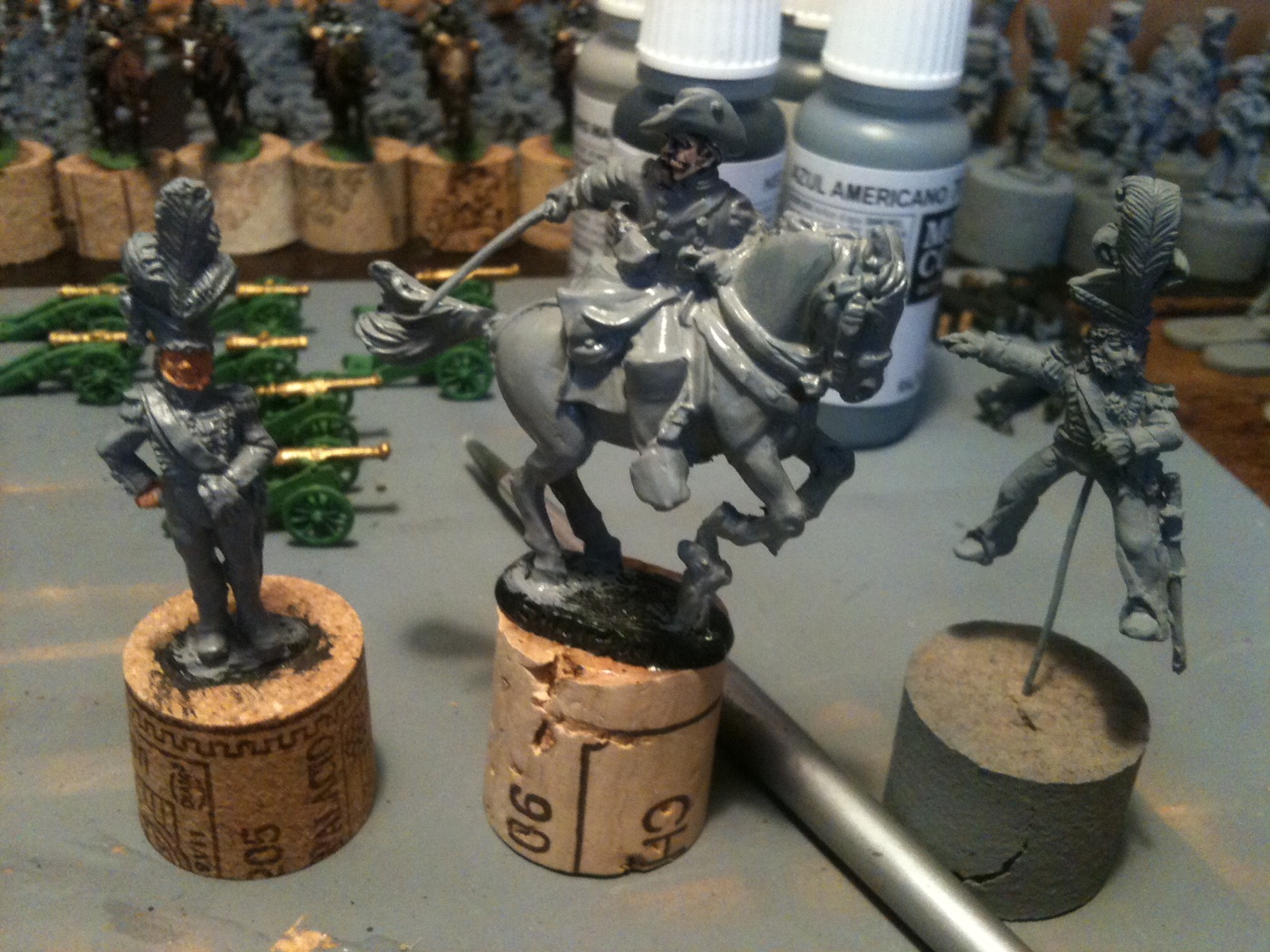
At left, Gringo 40's rather nice 28mm Murat, a pied; centre, a Salute ACW officer (shades of Custer?); right, Foundry's Murat, also in Polish garb.

One of my several 28mm Napoleon's, this a one-piece casting, from Foundry.

Another great Salute figure: Colin Maud, or rather Kenneth More, with blackthorn stick and faithful mutt, Winston.

Well, it's all proceeding in a rather haphazard manner. That kind of bothers me on one level. I feel I ought to fix on one project, and see it through. But, thus far at any rate, I seem incapable of doing that. So, never mind, I'll just follow my whims for now!

Sunday, 12 June 2016

Film Review - Love & Death, Woody Allen (1975)


For me this film is a dream come true: I love Napoleonic history, and I'm especially fascinated with the 1812 campaign in Russia. And of course Russian literature and music offers vast riches for Woody Allen to both mock and do homage to. Then there's Allen himself - my favourite film maker - indulging in a rather silly take on all this stuff.


Released in '75, Love & Death marks the end of his run of early 'funny' films, after which he enters upon the decade that I see as the apex of his career, between Annie Hall and Radio Days. Love and Death certainly isn't his greatest film. Indeed, it's fairly dumb in places, as Allen movies go. But,  nevertheless, it's wonderful: there's no one else makes films quite like Woody Allen.


The Russian soldier, brave and resolute, faces death without fear.

The many faces - and fab outfits - of Boris Grushenko, 'scholar and coward'.


Despite the weighting towards farcical broad comedy, which often approaches slapstick, there are poignant moments, such as the opening and closing titles, where the pure beauty of landscape and music, despite Allen prancing about with the figure of death at one point, are quite intoxicating. Allen uses Prokofiev throughout, which helps with the Russian flavour, and the 'Troika' section from the Lieutenant Kijé Suite, used in the titles, is utterly perfect. 

Allen and Diane Keaton are brilliant, deadpanning a very Noo Yoik type convoluted love-affair into a cod-Tolstoyesque (or sometimes even cod-Dostoyevskyan) setting. There are some fabulous exchanges between Keaton's philosophical Sonja and Allen's wise-cracking Boris. And the supporting cast do fine as well, Keaton's first (herring merchant) husband, her unctuous piano-teacher - the first of her many lovers - and James Tolkan as Napoleon, are all noteworthy. Numerous other actors give brief but entertaining performances, such as the guy who portrays one
 of Napoleon's forgotten staff, Sidney Applebaum.


James Tolkan very much looks the part (every inch, perhaps?), as Napoleon.


As ever with Allen there's plenty of reference to such themes as existential angst and sex, which are, of course, facets of the titles themes, love and death. His encounter with and seduction of the stunning cocquette Countess Alexandrovna is very amusing. Inevitably, it being Russia in the C19th, he then has to fight a duel with Countess Alexandrovna's cuckolded lover Anton. Needless to say, the resulting duel in the snow is rather different to that between Bezukhov and Dolokhov in the many film and TV adaptations of War and Peace.

Countess Alexandrovna: 'You're the greatest lover I've ever had' 

Boris: 'Well, I practice a lot when I'm alone.'

Eventually, having become embroiled in the wars - first when Napoleon goes to war with Austria, and later when he invades Russia - very much against his will (he's a self-professed 'scholar and coward'), he finally gets together with Sonja, much against hers, only to be dragged into a plot she hatches to kill Boney. But in case you haven't seen it, I'll leave it there. 


Boris struggles with the deep moral implications of murder, and his pistol.

But, ah me... as I said above, there's no-one else makes films like Allen! So, whilst not his best, it's still a four-and-a-half bicorne affair, especially compared with the vast and seemingly endless tidal-waves of brainless, humourless dross Hollywood pumps out these days. As silly as this undoubtedly often gets, it's still packed with not just wit, but intelligence, pathos, and even reflections, albeit largely tongue in cheek, on the kind of deeper themes that Tolstoy et al loved to ruminate on.

'You luuu-rve Russia, don't you!?'

Oops, Boris chooses the wrong place to hide!

Projectile Woody. Who'd Dare accuse Allen of being a dummy? [1]

I don't recall this scene, perhaps it was cut?

Russian soldier: 'God is testing us'.

Boris: 'Couldn't he have given us a written?'

In terms of military scenes and action, whilst there's a fair bit of it, and on quite a grand scale, it's all pretty silly, from the deliberate anachronism of the bawling black U.S. Marine style drill-master, to Woody's malfunctioning weapons, and his ill-advised choice of the barrel of a cannon as a place to hide. Nevertheless, and rather like Harry Flashman, despite his own best efforts to shirk, cower and hide, Boris becomes a hero.

The first and only major military campaign depicted on film here is, as in War and Peace, the 1805 campaign, which culminatesd in Austerlitz. In this film, Allen doesn't - as mainstream American directors would undoubtedly do - signpost such references (and the film is littered with cultural cross defences), they're there for the knowing to spot and enjoy.


The second military phase is of course the 1812 invasion, but again history, military and civil, just serves as a vehicle for Allen's comedic take an everything from sex and art, to angst and philosophy. This is the segment in which Boris is not a soldier, but a would-be assassin. So it's not so much battles, as intrigue, Boris and Sonja inveigling their way into the Imperial HQ.


In a film like Bondarchuk's Waterloo, one might lament any license with history. Here, however, we are clearly dealing with a film in which historical accuracy was not paramount. Nevertheless, the uniforms and settings are, for the most part, pretty good - and certainly sumptuous and quite spectaular - but mostly it's just great fun to see a favourite era used for comedic mileage.


It looks like making the film was fun, but...

... Woody explains to readers of Esquire why making films like Love And Death isn't fun.

A nice publicity still.

A great very retro image, used in some versions of the post series for the film.

On set in Hungary. An experience which put Allen off filming abroad for about 20 years!