Showing posts with label model making. Show all posts

Thursday, 1 October 2020

Misc: Moulding & Casting, cont.


My erdpfahl. Far from perfect, but passable... I hope?

I'm kind of getting ahead of myself here, starting with the above image of numerous erdpfahl, or stakes, and other bits and bobs. But they are the item I first had a yen to scratch-built and cast in resin, thereby launching this whole moulding and casting saga.

I did a lot of mould-making and quite a bit of casting after the episodes I've blogged already. And I'm not showing all of them. One thing I did was cut the big mould which contained ammo boxes and shells down into two smaller moulds. And in turn I then further cut these moulds in two, adding more pouring and venting channels. The improved results, pictured below, show that this was a better idea than simply chucking the mould out.

Much better results from modified moulds.

The largest group, at the top, are best.

In the image above, I've cleaned up the castings from the modified moulds, and 75% or thereabouts are great. There's one iffy one, and one outright dodgy/unusable one per item: spent shell, live round, and ammo box.

Next up I decided to revisit copying some wheels. But this time in sets of four, and with properly laid out pouring and venting channels. Would this extra effort produce better results? Indeed, would it yield usable items?

Sets of better prepared wheels, ready to be moulded.

Wheel moulds in progress, plus another single erdpfahl mould.

Once all the new moulds were made I get the whole lot ready for a potential complete casting session (not, alas, of the Hollywood starlet variety). And here they all are. A good little set, quantity wise, even if not quality wise. One issue however, is that the resin I'm using cures so quickly I can't really cast a whole set as big as this lot. If I try to, the resin is already going off before I've done all the pouring.

Lots of luvverly blue moulds...

Before I move on to the final chapter in this saga, for the time being at least. Here are a couple of pics of some of the multiple little gubbins that I made for the 88s, this time cast in several sub-sets, as opposed to the over-filled single mould attempt I made earlier on. As can be seen in the upper of the two images below, I usually try and do a few other little moulds as well, to use up all the resin I've mixed.

Casting the 'multiple gubbins' moulds.

The results of splitting stuff up speak for themselves, I think

As the lower pic above shows, pretty clearly, breaking the over-filled mould grouping into smaller sub-sets paid off. Air flows far more freely through the admittedly still tiny passages, and the items are, as a result, far more likely to cast properly. The wheel on its own and a tiny erdpfahl, nigh on invisible below the wheel, were the only successes out of the several other smaller moulds in the upper of the two pics above.

After the steps shown just above, I moved on to a more mass production casting stage, and the results are shown immediately below. Including one set each of the new tyre casts. The latter aren't perfect. But I think they are usable. I'll be doing this with a few wheel sets. Primarily on account of Chester, our new cat/kitten, waging a pretty successful war on my mini-Wehrmacht forces. I have artillery, cars, trucks and even tanks needing various bits - mostly wheels - replacing. I had to move my whole modelling workspace upstairs out of the lounge on his account. The little devil! 

Once I got a stockpile going, I started to feel reasonably pleased.

Bagged up, sorted into groups for specific jobs.

And so it finally came time to add some of this stuff to a few of the models for which they've been produced. The moment of truth, I suppose! I started with the Hasegawa 88s, both of which needed erdpfahl, linkages, and handles. I've done one as if just deployed, before being staked, and the other with the stakes going through the arms/legs, whatever they are, ready to fire.

A Hasegawa 88with added stakes (stowed), linkages and handles.

Stakes deployed, and ammo and boxes added to the scene.

This is the Airfix 88, with stakes deployed, linkages, and (not visible) handles.

Another view of an Hasegawa 88, with stowed stakes, plus ammo stuff.

I've gone to great effort, considerable expense, and produced some not too great parts, that most folk probably won't even notice. Yay! That's the life for me. And, I think, quite typical model-making behavious, from what I see elsewhere. But I've had a lot of fun, and learned a fair bit. I think for my next attempts at mechanical reproduction, I'll try another and much cheaper technique. But before I get to that point, I think I need to paint these 88mm guns. And perhaps even base them?


Saturday, 19 October 2019

Kit Build/Review: Matchbox 1/76 Churchill AVRE Bridge-Layer, Pt. III

Making tubular bits of sprue for my scratch-built hinges.

This 1/76 Churchill AVRE is bound to take a bit longer than a normal build, on account of the bridge. Particularly so as I'm trying to make it deployable. To do this I decided to build two little hinges on the underside of the bridge. This has been both challenging and fun. I probably should've tried to rig some sort of reliably accurate vertically aligned drill-press. But I felt that'd be too time-consuming, so I just pressed on - boom, boom! - with freehand attempts. 

Parts prepped, ready for assembly. Note angled notches in bridge-ends

After a lot of fiddly freehand drilling, and many failed off-centre bits of sprue, I finally got six pieces I felt were good enough to use. Gluing these to the bridge required shaving off some bits of the structure where the hinges would sit. Then I had to glue them in place accurately positioned enough that the 0.6mm central hole would align through all the segments. This wasn't easy! Especially as the holes weren't perfectly central on any of the parts to start with.

Hinge elements being glued in place.

Another view.

I then made two pins, approx' 0.5mm in diameter, and roughly 6mm long. These go through the little tubular sprue sections, forming the hinges. Getting these in was tricky, as the central holes weren't perfectly aligned. But with a little gentle persuasion I managed it. This first attempt resulted in one fully functional hinge, and one which failed. 

Sliding the pins into the hinges.

The hinge that failed is on the right in the above picture (and is the upper hinge in the photo below). What happened was the central tubular piece got glued to the outer two pieces, resulting in one big block, which then sheared off from the bridge when I attempted to test the moving parts.

I decided to try and keep the successful hinge, and remove the central part of the failed one, and work on it - reducing the width a fraction and widening the central hole by 0.1mm - before re-assembling it. I also reinforced the central tubular parts on both sides of the bridge, as these are the weakest, and most likely to fail.

The hinges, glued, ready for testing.

Below is the dis-assembled hinging mechanism. The two hinges have been very slightly worked on, in particular the upper of the two, i.e. the one that failed. I'll give that a good few hours to cement. And then I'll re-insert the metal pins, and hope that the hinges won't break! I'm thinking I may add end-caps to either one or most likely both sides of the hinges as well, to prevent the pins from working their way out.

Dis-assembled, working on fixing the failed upper hinge.

Patience is paramount! I must give the repaired hinge time to really set. It's not easy to leave it alone! If I'm successful, the next thing is either mounting the whole bridge to the tank, or painting both tank and bridge before attempting to do so. Hmm!? I reckon the latter is probably the more sensible option... but... 
Friday, 18 October 2019

Kit Build/Review: Matchbox 1/76 Churchill AVRE Bridge-Layer, Pt. II

Prepping bridge parts.

The instructions for this venerable aulde Matchbox model start with assembling the bridge. I saved this part for after I'd made the tank. It's a rather lovely thing! You need to pay attention at this stage, as the components are quite siecifjc in how they go together. 

Oops! I forgot to add a weight to the inner rear of the tank.

Having assembled the bridge, whilst casting my eye over the instructions I spotted an important step in the construction of the tank that I'd omitted; adding a counterweight, so the attached bridge won't topple the model forwards! 

I used a hacksaw to remove the head of a latte heavy hex-headed bolt. I then had to bar God the resulting nut bybreming about 1mm from opposite sides, so it'd fit in the very narrow Churchill tank body. As ur forgotten to do thus at the construction stage, it meant I had to perform fairly drastic surgery to the rear underside of the rank body to get the weight in.

The instructions called for 20g of weight. Miraculously that's exactly what the nut weighed initially. It lost a gram in the process of dancing the two sides, winding up weighing 19 grams. I superglued it into the base of the tank, and 'stitched' the patient back up with surgical glue!

The nut part of a large bolt, sawn off by hand.

It also required a small amount of narrowing to fit...

... on two opposite facets.

Bridge and winch assembled.

By end of play last night I had all the kit assembled, bar actually attaching the bridge. Oh, and the mudguards (are these what Americans call the fenders?). The winch assembly is a fun thing to assemble. Fiddly but satisfying! 

I may be mad. And/or it may prove impossible. But I have a yen to build the bridge in such a way that it actually folds, so it can be shown both stowed and deployed. Hence saving this part of this build to the end. I'll need to fabricate some mini-moving joints!

Winch assembly in place.

So, that's it for part two of this very enjoyable build. Today is friday, the tubal teaching day of this half-term. Once the work's out of the way, I can return to the conundrum of building the bridge. I also need to source some crew figures, to populate my now open-hatched vehicle. What fun!

Wednesday, 16 October 2019

Kit Build/Review: Matchbox 1/76 Churchill AVRE Bridge-Layer, Pt. I


I recently built a 1/72 Churchill, which I wound up modifying with a scratch-built spigot mortar. I then read about and got interested in Churchill AVRE types of all sorts, including these bridge-layers. I posted about wanting this kit on a few sites, and a fellow member of Wisbech IPMS kindly got me one at a show. Thanks Darren!

Inside the box...

In the box, which was still wrapped in its original cellophane, was a kit potentially as old as me. The sprues are in three different colours, green, beige and brown. The decals, which I assumed would be fossilised, look like they might be ok. Which, in a kit of this vintage, is pretty amazing. There's even a tube of ancient glue!

The rubber-band tracks are of a more plastic than rubber material.

Beige and brown sprues... nice!

The instructions start with the bridge. I decided to skip that, and start with the turret. I'll probably do the bridge last. In part because I want to make the bridge workable. The petard mortar is not as nice, in mine 'umble opinion, as my scratch-built one. I've built it as is. But I might want to redo the gun at some stage.

Will the ancient glue still work?

Assembling the running gear, pt. I.

I like the running gear assembly on this kit. Having all the road wheels in a single piece makes it easier to assemble. And the rubber-band tracks in this kit seem to be more plastic than rubber, meaning they actually glue together! 

Running-gear, pt. II.

Tracks on, turret with modified hatches.

Tonight I'm stopping at this point, having assembled the bulk of the Churchill body. I already left the two stowed blankets, or tarpaulins , off the turret. I'm not sure whether or not to put the mudguards on over the tracks either. Quite a few AVRE I've seen don't have the upper track guards

Mostly assembled. Do I add the upper track-guards?

Friday, 10 May 2019

Book Reviews: Panther Tanks, Normandy '44, & Defence of the West '45, Dennis Oliver


Taken together these two titles, numbers 3 and 18 in the Tank Craft series, give a very decent account of the Panther tank, as deployed on the Western Front circa '44-45. One might immediately think 'what then of the Panther's history and development before this, and it's service on the Southern and Eastern Fronts?' I'll return to these thoughts in due course.

As ever with Dennis Oliver, he deploys his own particular approach, utilising maps, timelines, organisational schematics, unit histories, and so on. Where he follows the standard Tank Craft template is in the central three segments: Camouflage and Markings, Model Showcase, and Modelling Products.

A Panther pauses on a French road, Normandy, '44. [1]

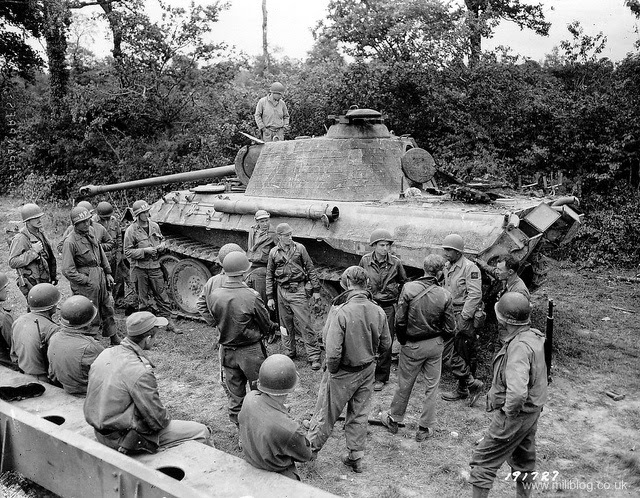
U.S. troops gathered around a disabled Panther.

The Normandy title features five models, all in1/35, and all very impressive. The Defence of the West  book, on the other hand, has just two 1/35 models and a single 1/48 example, the latter getting more pages than are normally given over to any one model in the Showcase section. Between the two books that's eight models, all bar one in 1/35. I'd have liked to have seen at least one bigger kit, in 1/16, perhaps, and one or two smaller models, in 1/72 or 1/76.

The colour profiles in the Camouflage and Markings chapter are nicely done, and are both fascinating and exciting. The range of styles and approaches the Germans employed, despite a palette of just three basic colours (which admittedly varied in themselves) was very diverse and, I find, endlessly intriguing. My only gripe on this front is that either the work of the illustrator, or perhaps the printing process, has rendered the core trio of colours less than 100% satisfactorily.

Panther in 'ambush' camo' scheme with infra-red sight.

Fabulous Panther Ausf G, by Lim Kian Guan, aka ChefLim. [2]

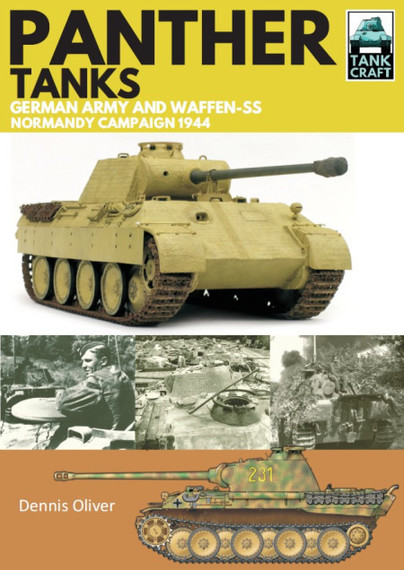
This is particularly noticeable with the green. The Dunkelgelb and Rotbrün, whilst only approximate, are near enough. But the green is way too light and bright. This is exaggerated even more in the bottom of the two cover images, shown at the top of this post (the Defence of the West one, sourced from Pen & Sword's own website listing for the book), where the green is almost fluorescent marker-pen bright! The actual books are closer colour-wise to the very top Normandy Campaign cover image.

Panzer graveyard with Panthers in the foreground.

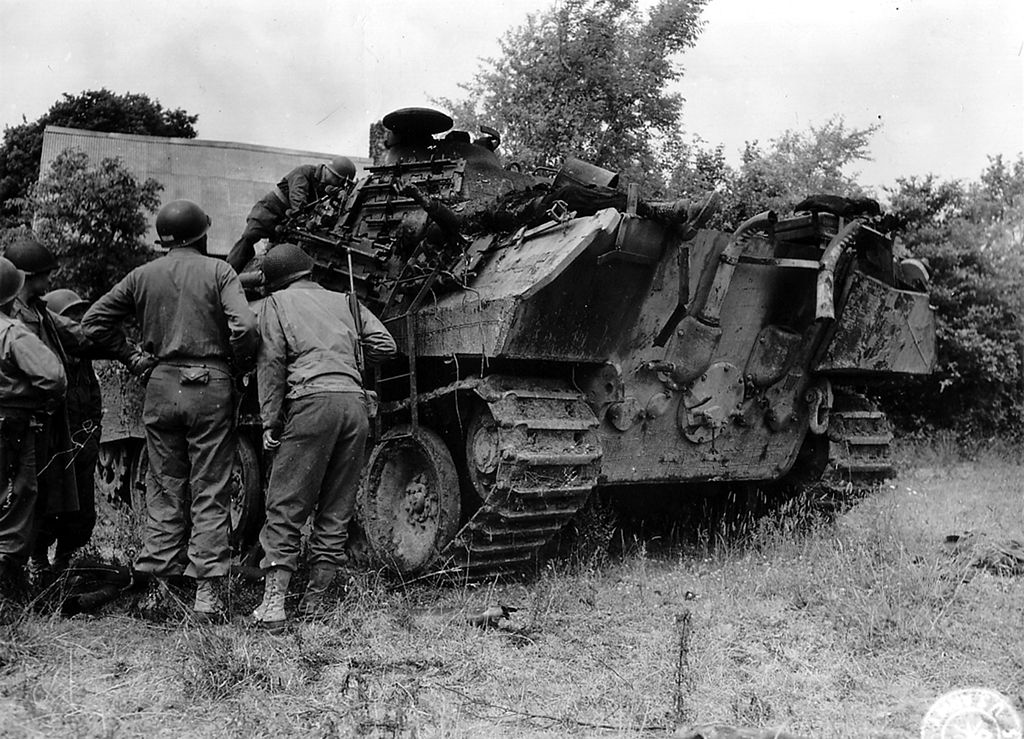
A grimmer graveyard scene. Is this 'Ursula' again? [3]

It's this colour issue that leads me to dock half a balkenkreuz. Whether Oliver's obsessively detailed coverage is a blessing or a curse - what of Panthers in Italy and Russia, and prior to '44? - depends on how much hardcore info you can take, and whether you can stretch to buying so many titles on the one vehicle.

At an RRP of £15 a time (£14.99 to be exact), they aren't exactly cheap! NB: at the time of posting this review both titles are available at reduced prices, at Pen & Sword's website. I'm lucky in that the publishers have been generous enough to send me copies gratis, for review. Otherwise I'd be lusting after these whilst lamenting the lack of brass in my pockets! Anyway, as regards useful info and inspiration, etc, these books are fab. And I'd highly recommend them.

----------
NOTES:

Note on photos/pictures: in this post I've tried to use images that do appear in the books under review.  The two exceptions are the final black and white image above, and the colour picture of ChefLim's model, which is from his website.

[1] This picture appears in a smaller/cropped format.

[2] This superb model appears in the Showcase section of the Defence of the West title.

[3] The more eagle-eyed might notice that a charred corpse lies atop the rear deck of this knocked out tank. In fact more than one German soldier died on the back of this particular Panther - which may be 'Ursula', a Panther featured in Oliver's book on several different occasions - as other pictures I found online show clearly. A grisly reminder of the true nature and costs of war.

Thursday, 9 May 2019

Book Review: JagdPanther Tank Destroyer, Dennis Oliver


Another highly detailed and very specific Tank Craft title from the prolific Dennis Oliver, utilising his signature approach, with maps, timelines, unit histories, organisational schematics and so on. This particular publication covers one of my favourite German tanks, the Jagdpanther tank destroyer.

I remember buying some of these in 1/300, from Heroics & Ros, as a kid, and painting the tiny little blighters in the tri-colour ambush camouflage scheme. The 6mm scale is not one I've ever seen featured in these Tank Craft titles. There are three 1/35, one 1/48 and one 1/72 example in the Model Showcase section here. 

A fabulous 1/72 winter whitewashed Dragon Jagdpanther, by Jaroslaw Witkowksi, aka Gulumik.

This tank is featured in the Model Showcase chapter.

Another of Gulumik's 1/72 meisterwerks, above, appears in the Modelling Products chapter.

This is the old Esci kit, plus scratch-built detailing.

In keeping with both the stated aims of this series and the standards set so far, this book is a treasure trove of info and imagery. I have one relatively minor gripe on the latter front, however (and this is why I dock half a balkenkreuz); regarding the archival pictures, the vast majority show captured or destroyed Jagdpanthers. They're all very interesting photos. But it would have been great to see more either being built - there are a couple of great pictures of the MNH factory production line - or in active German service.

As usual with Oliver's contributions to this ever-expanding and very useful series, he's very time/theatre specific. On this occasion addressing the late-war Western Front, of 1944-45. Perhaps another volume will appear on the Eestern and Southern fronts? And perhaps that'll have more 'in action' photos and less wrecks?

Unfinished Jagdpanthers at the MNH factory, Hanover,  1945.*

I love this pic of Panthers in the rain. Note the brollys deployed by the crew!*

This abondoned Jagdpanther, Reichswald, March '45, appears a couple of times

The colour profiles, or Camouflage And Markings illustrations are, as usual, excellent. My only gripe regarding this last feature being that the green used in the three-colour schemes appears rather too bright. Anyway, all told, another great instalment in this excellent series.

* Neither of these specific photos are in this book.